
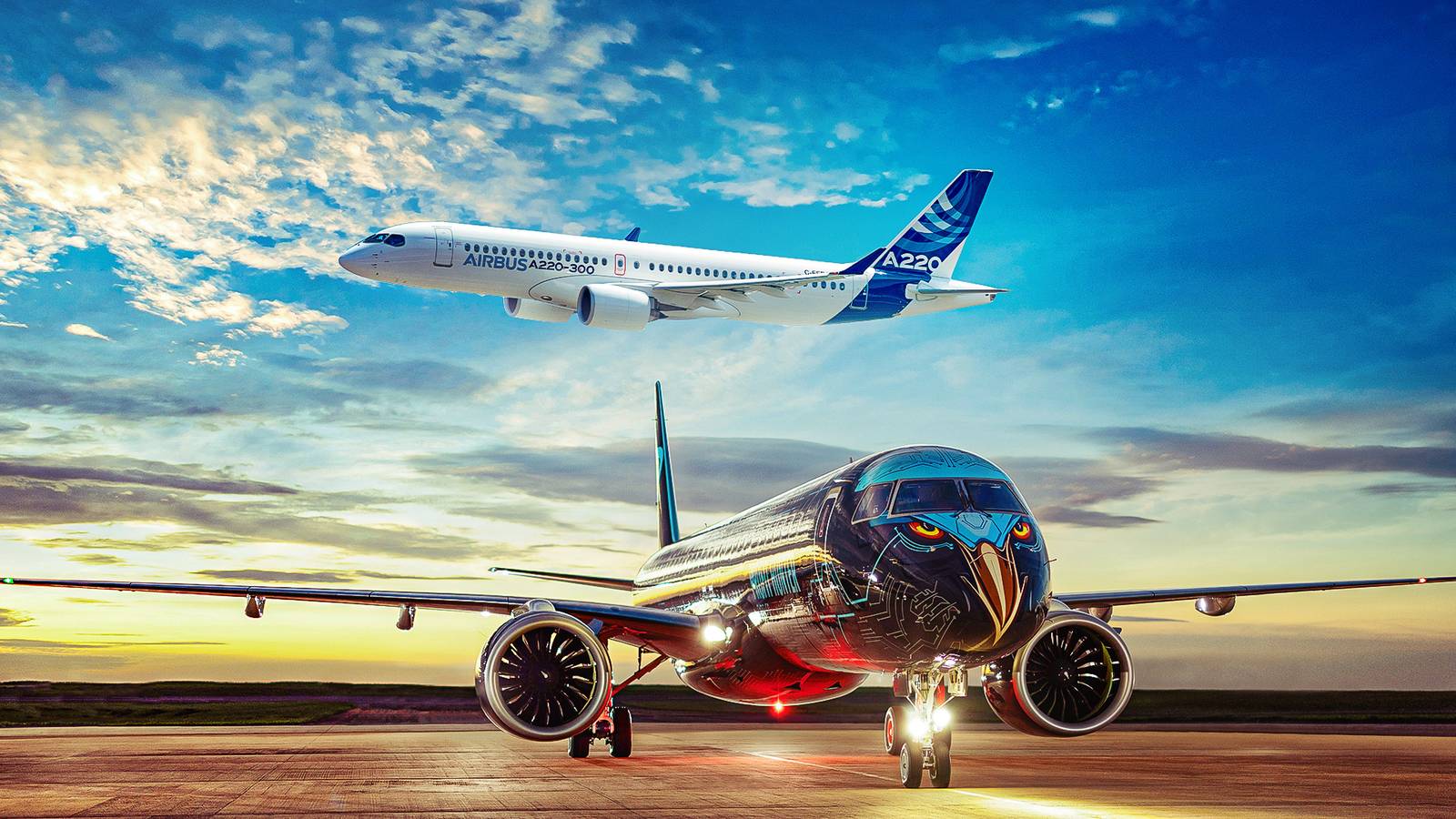
Published Sep 4, 2026, 4:00 PM EDT Airline and Airport Management Graduate, Student Commercial Pilot and Commercial Aviation Writer. Based in London & Nagoya Transitioning between two aircraft designed for the exact same 100- to 150-seat crossover market usually feels like an incremental step. When pilots step out of the Airbus A220 and into the flight deck of the Embraer E195-E2, they encounter two completely opposing visions of modern aviation philosophy. Moving between these two next-generation single-aisle platforms is actually much more challenging than it may seem on the surface. With carriers replacing their older regional jets and operators such as Porter Airlines and Breeze Airways building their growth plans around these competing platforms, aircrews face a very new perspective in the flight deck. This article explores how shifting from Airbus’s sidestick to Embraer’s central control yoke and closed-loop fly-by-wire system changes pilot workload, hand-flying mechanics, and overall situational awareness in real-world operations. Sidestick Or Yoke Credit: Markus Mainka | Shutterstock Like with any pilot moving away from an Airbus aircraft, the biggest difference at first glance is the control column. The A220 uses a passive outboard sidestick that leaves the center workspace entirely open, whereas the E195-E2 retains Embraer’s signature M-shaped control yoke mounted on a traditional central column. That fundamental hardware choice immediately changes how a pilot interacts with the airframe during manual flight, but the yoke itself is only the surface of a much deeper spatial transformation. Embraer intentionally preserved the central yoke on the E2 family to give existing E-Jet operators a streamlined 2.5-day differences training path without requiring full-flight simulator qualification. In contrast, the A220's sidestick design, inherited from its Bombardier CSeries roots, frees up enough flight deck space to fit a retractable tray table directly ahead of each pilot seat. For pilots making the switch, losing that flat desk surface changes how they manage flight logs, review arrival charts, and even consume inflight meals across long sector lengths. Adapting to a central control column after flying with a side-mounted stick does often need a rapid recalibration of upper-body posture and crosswind landing inputs. However, control positioning is only the outer layer of the flight deck interface. The deeper operational shift occurs when pilots look beyond the yoke to process flight data, and it is where each manufacturer’s underlying avionics architecture handles complex flight management commands in noticeably different ways. The Latest In Avionics Credit: Robin Guess | Shutterstock The visual center of the flight deck is where another distinct divergence in avionics design can be found. The A220 features five large-format 15.1-inch (38.4 centimeter) landscape liquid crystal display screens driven by the Collins Pro Line Fusion avionics suite, creating a continuous glass panel across the forward glare shield. In contrast, the Embraer E195-E2 utilizes the Honeywell Primus Epic 2 suite, built around four 13 by 10-inch (33 by 25.4 centimeter) displays. Both cockpits remove analog gauges, but the A220 provides significantly more screen space, allowing pilots to display primary flight data, navigation maps, engine instruments, and system synoptics side by side without cluttering their primary field of view. The A220 cockpit carries the operational lineage of Bombardier business jet systems, featuring fully integrated electronic checklists that automatically detect system failures and present the corresponding emergency procedures on screen. Flight crews interact with the displays using two trackball cursor control units mounted on the pedestal console. On the E195-E2, Honeywell Primus Epic 2 integrates SmartView synthetic vision technology and uses trackballs alongside traditional keypad interfaces. While Embraer automated many routine system checks to reduce crew workload during high-density flight phases, the A220 offers a more deeply paperless environment where system synoptics update dynamically based on flight phase. Experiencing these distinct display architectures shapes how pilots monitor automation, input route changes, and perform instrument approaches in low-visibility conditions. The visual interface is rarely the same across manufacturers, as is, of course, the case for how flight computer systems interact with aircraft controls. Equally Intuitive To Fly Credit: kamilpetran | Shutterstock Underneath the flight deck displays, the software setup shows exactly how each aircraft interprets pilot control inputs. The A220 uses a C*U flight-path command law, where deflection of the sidestick commands a pitch rate at low speeds and load factor (g-demand) at higher velocities. When a pilot releases the sidestick to neutral, the flight control computers automatically trim the aircraft and maintain the existing flight path and bank angle. Moving to the Embraer E195-E2 requires re-engaging active pitch trim habits. Embraer designed its fourth-generation closed-loop fly-by-wire system to replicate the traditional handling feel of a conventional jet, requiring crews to use thumb switches on the yoke to trim pitch forces manually as airspeed and configuration change. Both airframes incorporate advanced flight envelope protections to guard against loss of control, though their operational execution varies. The A220 has hard limits on angle of attack, pitch attitude, and bank angle, allowing up to 80 degrees of roll during emergency maneuvers,per AIN. The E195-E2 employs smart envelope protection that delivers active force feedback through the yoke as it approaches pitch and bank thresholds, warning the crew before hard limits are applied. Notably, both manufacturers equipped their cockpits with servo-driven moving thrust levers, meaning autothrust power adjustments provide visual and physical feedback to the crew, a welcome feature for pilots accustomed to traditional throttle quadrants. These flight control nuances directly affect handling techniques during crosswind landings, high-altitude encounters with clear-air turbulence, and manual touch-and-go maneuvers. Adapting to auto-trim logic versus active yoke trimming needs specific adjustments during simulator training, shifting the focus from cockpit hardware to the formal type rating process required by aviation regulators. Simple Switch For Pilots? Credit: CSWFoto | Shutterstock The financial and operational aspects of pilot training are major considerations for airline flight operations. For operators already flying first-generation E-Jets, transitioning flight crews to the E195-E2 is a seamless path that preserves commonality under a single ERJ-190 type rating. Conversely, transitioning to the A220 requires a clean-sheet type rating under the BD-500 designation. The rating typically needs two to three weeks of intensive instruction, combining computer-based ground school, flight training devices, and multiple full-flight simulator sessions to master Collins Pro Line Fusion logic and flight characteristics. Unlearning entrenched habits in itself has distinct challenges inside the simulator. Pilots moving from an Embraer yoke to the A220 sidestick must alter their instrument scan pattern and retrain their off-hand coordination, as control inputs shift from the center column to the outboard console. During crosswind landings, A220 crews perform a de-crab maneuver using the rudder while maintaining roll with the sidestick, allowing C*U flight laws to handle pitch trim automatically. Conversely, pilots converting to the E195-E2 must master manual thumb-switch trimming alongside Embraer's active force feedback, ensuring they do not fight the artificial yoke resistance during high-workload maneuvers. These contrasting training requirements directly influence how airlines structure their pilot rosters, fleet assignments, and long-term capital investments. Beyond individual pilot adaptation in the simulator, network planners have to weigh crew conversion costs against route flexibility when determining which modern narrowbody best serves their international and regional networks. Plenty Of Customers At Both Ends Credit: volkova natalia | Shutterstock Airlines are always evaluating crew cross-qualification, maintenance infrastructure, and capital expenditure when deciding between these crossover narrowbodies. Operators like JetBlue Airways are an excellent example of a clear switch from one to the other, undertaking a complete transition by phasing out Embraer E190s in favor of the A220-300, absorbing the upfront training cost of a new type rating to gain superior range and seating capacity. Conversely, Porter Airlines selected the E195-E2 for its rapid expansion across North America, banking on lower trip costs and streamlined crew integration. Meanwhile, European regional networks demonstrate two distinct approaches, with airBalticoperating an all-A220-300 fleet to optimize single-type maintenance, while KLM cityhopper standardized on the E195-E2 to maintain flight crew commonality with its existing E-Jet fleet. From a network planning perspective, range capabilities are a key metric for flight schedulers when choosing an airframe for mainline and regional sectors. The A220-300 offers a maximum range of 3,400 nautical miles (6,296 km), enabling transatlantic hops and deep transcontinental routes that traditional regional jets cannot perform. The E195-E2 features a maximum range of 3,000 nautical miles (5,556 km), focusing its operational efficiency on high-density regional trunks and coast-to-coast sectors where lower operating costs per seat-mile maximize route profitability. Both airframes rely on Pratt & Whitney Geared Turbofan engines, the PW1500G for the A220 and the PW1900G for the E2, but their underlying operational profiles create clear niches for network carriers. As carriers continue to retire older narrowbodies, the long-term choice between an open, paperless sidestick flight deck and an evolved yoke-based fly-by-wire environment will shape pilot staffing pipelines and fleet structures for decades to come. These aircraft are very similar and occupy the same space in the broader market, but it is clear that airlines do not have a clear preference. Ultimately, the choice depends on an airline's specific values and operational needs. So, Which Is Better To Fly? Credit: Michael Derrer Fuchs | Shutterstock The ongoing debate between sidesticks and central yokes in the 100- to 150-seat crossover market is indicative of the world we live in; aircraft design is incredibly advanced but still not perfected. As flight control computers assume greater responsibility for flight envelope protection, the layout of the flight deck becomes less about mechanical control leverage and more about human-machine interface efficiency. Regional and mainline carriers are facing pilot hiring demands and tightening training budgets, so the ability to transition pilots quickly or seamlessly integrate new airframes into existing fleet structures will weigh heavily on future fleet acquisition plans. Operators committing to single-type strategies, such as airBaltic with its all-A220 fleet or Porter Airlines with its E195-E2 expansion, demonstrate that long-term operational efficiency relies as much on cockpit standardization as it does on engine fuel burn. For pilots stepping onto the flight deck, transitioning between the Airbus A220 and Embraer E195-E2 is far more than choosing between a sidestick or a center yoke. It is an evolving relationship between human control inputs and flight control software, with each pilot witnessing it in real time. Regardless of which one is perceived as objectively better, the practical feedback from crews flying these aircraft daily will directly shape how aircraft manufacturers design the next generation of commercial flight decks.
Here's What Pilots Notice When Switching From The Airbus A220 To The Embraer E195-E2
Full Article
Original Source
Read the full article at Simpleflying →KhanList aggregates and links to publicly available news content. We do not host full articles from third-party sources. Always verify important information with original sources.