
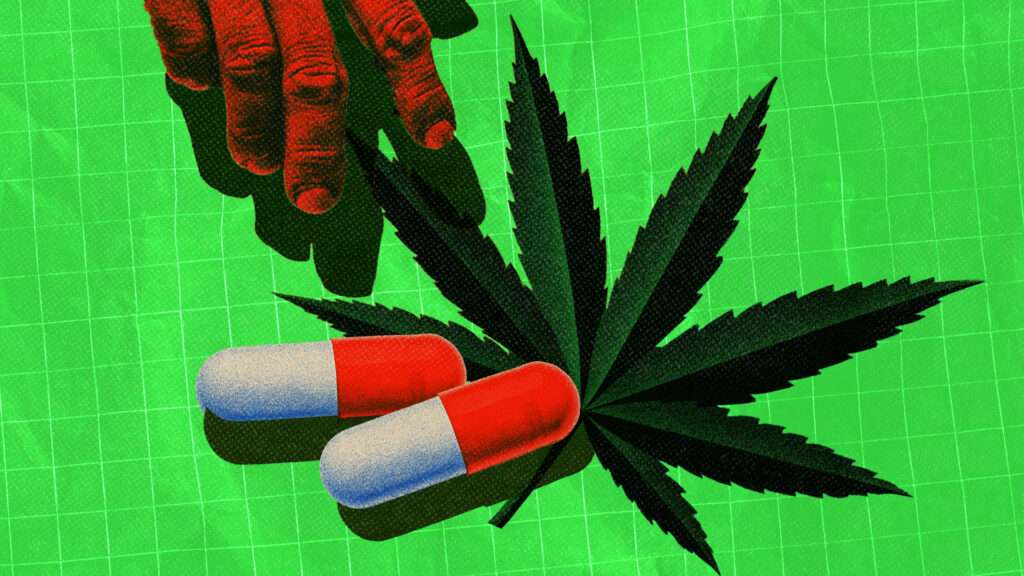
Half a century ago, Congress approved the Controlled Substances Act (CSA), which established a system for classifying drugs based on their "medical use" and "potential for abuse." But as a recent report from the Government Accountability Office (GAO) notes, the statute does not clearly define either criterion, opening the door to debatable and changeable regulatory judgments with far-reaching criminal justice implications. Schedule I of the CSA is supposedly reserved for drugs that have "a high potential for abuse," "no currently accepted medical use," and "no accepted safety for use under medical supervision." Those drugs, which include heroin, LSD, psilocybin, and MDMA, are prohibited except for government-approved research purposes. Schedule II drugs, which include cocaine, methamphetamine, fentanyl, morphine, hydrocodone, and oxycodone, also are deemed to have "a high potential for abuse." But their medical use is "accepted," and they are legally available by prescription. So are drugs in Schedules III, IV, and V, which are supposed to have progressively lower abuse potential, justifying less severe criminal penalties for unauthorized possession and distribution. Right away we see a problem: A drug with "potential for abuse" short of "high" but no "accepted" medical use does not fit into any of these schedules. The historical treatment of cannabis illustrates that puzzle. When Congress enacted the CSA in 1970, it placed marijuana in Schedule I, and the Drug Enforcement Administration (DEA), which had the authority to reclassify drugs in consultation with the Department of Health and Human Services (HHS), kept it there, rejecting a series of petitions arguing that it did not meet the statutory criteria. Beginning in 1992, the GAO notes, the DEA defined "accepted medical use" based on five criteria, including "adequate safety studies" and "adequate and well-controlled studies proving efficacy." Since those requirements are similar to the evidence that the Food and Drug Administration (FDA) demands to approve a drug for prescription use, the DEA's definition essentially equated "accepted medical use" with FDA approval. During the Biden administration, the HHS embraced an alternative test for "accepted medical use" that considers "widespread" clinical experience with a drug (in the 41 states that have legalized medical marijuana, for example) and requires "some credible scientific support" for at least one application. Based on an FDA analysis, HHS said cannabis passed that test and, after reconsidering its "potential for abuse," recommended placing it in Schedule III, which includes prescription drugs such as ketamine, anabolic steroids, and Tylenol with codeine. Last April, Acting Attorney General Todd Blanche issued a final rule that followed the HHS recommendation, but with a twist. For the time being, he said, only marijuana products currently sold by state-licensed medical dispensaries or approved in the future by the FDA would qualify for Schedule III. The scientific and legal logic of that decision was hard to follow, since the included and excluded products are pharmacologically identical, distinguished only by their intended use. By contrast, cocaine, fentanyl, and methamphetamine are all Schedule II drugs, regardless of whether they are dispensed by pharmacies based on medical prescriptions or purchased on the black market without legal authorization. In any event, the government's reversal on cannabis showed how malleable the CSA's scheduling criteria are. The drug's reclassification hinged on a change in attitude rather than a change in the underlying science. In addition to a redefinition of "accepted medical use," that shift entailed a new assessment of marijuana's abuse potential. The CSA "does not include a statutory definition of 'potential for abuse,'" the GAO notes, and "FDA officials told us that the lack of a written definition…presented challenges for determining the relative abuse potential and appropriate schedule recommendation for some substances." The GAO thinks the FDA should specify "the criteria and process for determining a substance's 'potential for abuse.'" The lack of clarity highlighted by the report is astonishing, given how long Americans have been living with the CSA, which criminalizes a wide range of peaceful conduct and prescribes penalties based on arbitrary bureaucratic distinctions. © Copyright 2026 by Creators Syndicate Inc.
Hazy Drug Classification Criteria Invite Dubious Bureaucratic Judgments
Full Article
Original Source
Read the full article at Reason →KhanList aggregates and links to publicly available news content. We do not host full articles from third-party sources. Always verify important information with original sources.