
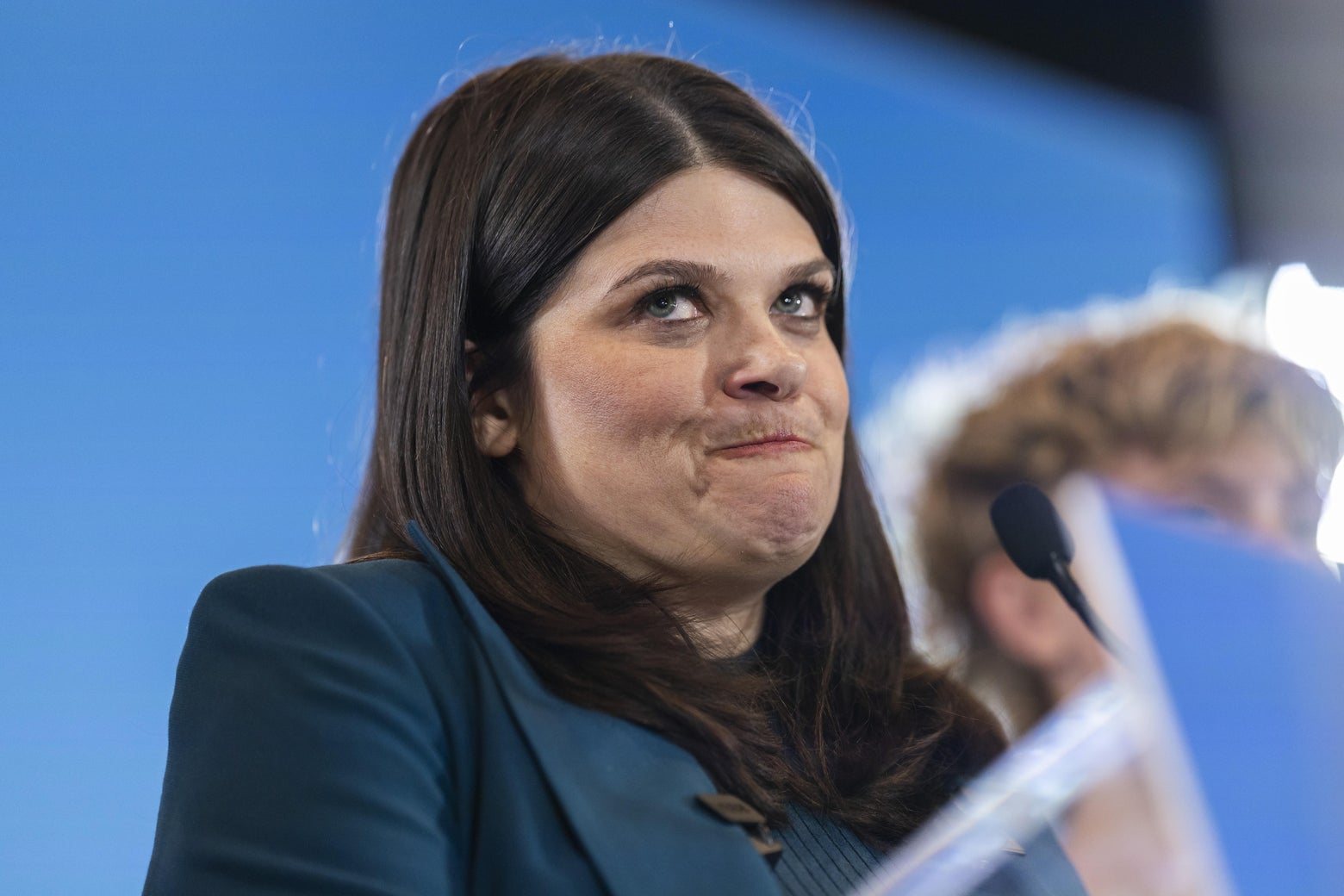
Politics Who’s to Blame for Democrats’ Michigan Disaster? When Haley Stevens turned on Abdul El-Sayed and her fellow Democrats, it was a betrayal for the ages. But she’s not alone in the blame. Finn Gomez/Getty Images Sign up for the Slatest to get the most insightful analysis, criticism, and advice out there, delivered to your inbox daily. The first thing to know about the Democrat-on-Democrat catastrophe engulfing the Michigan Senate election is that it didn’t have to happen. The second thing to know is that there’s a lot of blame to go around. On Sunday, Rep. Haley Stevens pulled a heel-turn for the ages. Stevens, a pro-Israel centrist who narrowly lost the Democratic primary to progressive Abdul El-Sayed, was slated to appear at a “unity rally” on the last weekend before Election Day. Instead, she pulled out—and went to church with El-Sayed’s Republican opponent, former Rep. Mike Rogers. A formal Rogers endorsement followed, completing the betrayal. Now, in a tight race that’s crucial to Democrats’ hopes of retaking the Senate and grinding Donald Trump’s agenda to a halt, a candidate who got almost half of the primary vote is supporting the Republican. There are a few ways in which this disaster could’ve been avoided. If Democratic Sen. Gary Peters—who in congressional terms is but a 67-year-old whippersnapper—had sought reelection, the messy primary that set up Stevens’ about-face never would’ve happened. The same thing is probably true had either Michigan Gov. Gretchen Whitmer or former Transportation Secretary Pete Buttigieg, who lives in Traverse City, decided to run for Peters’ seat. Once they passed, the state’s Democratic primary voters could have picked a compromise candidate in Mallory McMorrow, a (now-proven) team player who is more centrist than El-Sayed and more progressive than Stevens. After McMorrow dropped out, Stevens and El-Sayed could have pulled their punches instead of sparring nastily over the Israeli government’s actions in Gaza and Stevens’ support from AIPAC, the pro-Israel lobbying group. And once the primary ended, the pair could have buried the hatchet permanently rather than letting the tensions simmer into the general election. In short, everything in the race has broken toward conflict rather than comity. Michigan wasn’t the only bare-knuckled race in a primary season that served as an extended proxy fight between the Democratic Party’s center-left establishment and its progressive insurgency. The Senate contest in Florida, several House races in New York, and the gubernatorial primary in Wisconsin all got heated. A few other primaries even yielded sore losers; in Texas, Rep. Jasmine Crockett has refused to campaign with fellow Democrat James Talarico after he beat her. Yet even Crockett says she “WOULDN’T, EVER” endorse Talarico’s Republican opponent, so something has clearly gone uniquely sideways in Michigan. What went wrong? Who’s to blame? And is anyone entirely innocent? Stevens is obviously the headline villain, the architect of a hard-to-find-precedent-for defection that is indefensible on both substance and timing. But the difficult reality is that the blame doesn’t rest with her alone. At the heart of this disaster is a spectacularly poor match of political egos, an issue that promotes intransigence over compromise, and, in El-Sayed, a nominee who failed a critical test. Stevens Let’s start with the person who’s most at fault for Sunday’s explosion: the one who actually pulled the pin out of the grenade. Despite continuing to describe herself as “a very proud Democrat,” Stevens has arguably done more damage to her party’s nominee than Republicans have. It’s certainly possible that El-Sayed will win, and that Democrats could retake the Senate even if he doesn’t. But winning Michigan in what’s shaping up to be a blue-wave election shouldn’t be this hard, and retaking the Senate without it would require Democrats to vastly over-perform in much more Republican-friendly states. But Stevens has betrayed more than just her party: She’d previously argued that a Rogers win would imperil a suite of issues she professed to care about. After losing the primary, she full-throatedly endorsed El-Sayed and argued that Rogers would “keep rubber-stamping Donald Trump’s harmful agenda of higher prices, manufacturing jobs lost nationwide, corruption and abuses of power” while helping “ban abortion, gut health care, and roll back workers’ rights and voting rights.” The only thing that’s changed since then is the candidate Stevens supports. Then there’s the matter of her rationale. Stevens’ defection followed a war of words over a pro-El-Sayed ad, which argued that groceries have become unaffordable because the U.S. sends weapons to Israel. Stevens criticized the ad as antisemitic and demanded El-Sayed condemn it. (More on that in a moment.) But if bigotry were really her concern, she wouldn’t be throwing in with Rogers, a candidate who built his campaign around Islamophobia. Rogers has accused El-Sayed of adhering to a “radical Islamic agenda” and of backing the Muslim Brotherhood, an extremist group the Democrat has repeatedly denounced. Stevens is also, by her own prior admission, helping a president who mocks El-Sayed’s name (“To me, he’s Mohammed, and he’s a radical jihadist,” Trump said last month) and fearmongers that his victory would “invite hordes of jihadis to our shores, creating a nightmare of violence and terror until you cannot even have a Christmas.” On Sunday, Stevens characterized her flip-flop as “a personal and private decision” in the middle of a press conference talking about it, which made the whole thing look more petty than principled. Abdul El-Sayed Salwan Georges/Getty Images El-Sayed His culpability is more complicated, but it really does take two to tango. Stevens chose to pull her switcheroo, yet El-Sayed has done a bunch of tactically questionable things that seem to have made that outcome more likely—and could make it more politically damaging, too. One of those questionable choices has been to associate himself with controversial figures. During the primary, El-Sayed campaigned with Hasan Piker, a left-wing streamer who has said that the U.S. “deserved 9/11”. El-Sayed spent months refusing to distance himself from Piker, deriding questions about their joint appearances as “gotcha politics.” And although El-Sayed ultimately did condemn those remarks and others (including Piker’s claim that Jewish Americans, or Jewish American institutions, being too pro-Israel could lead people to “take action” against them), some Democrats already had concerns about El-Sayed’s approach to antisemitism. In March, El-Sayed responded to an attack against a Detroit-area synagogue by saying that “hurt people hurt people,” which sounded to some like a justification for the violence. (El-Sayed later apologized.) “I’m just sick of the people he stands with,” Stevens told Anderson Cooper on CNN last night. Self-defeating prickliness also seems to have shaped El-Sayed’s response to the ad Stevens criticized before endorsing Rogers. It’s true that the ad didn’t come from El-Sayed’s campaign; a left-wing commentator named Cenk Uygur, who happens to be Piker’s uncle, posted it online. But even as he distanced himself, El-Sayed also released a statement accusing Stevens of “relitigating” their primary that pointedly noted her millions in AIPAC support and disinvited Stevens from Sunday’s unity appearance, which national Democrats helped broker in a bid to squash their beef. El-Sayed’s defensiveness, as he runs to be the nation’s first Muslim Senator, is understandable. His opponent has put El-Sayed’s religion and ethnicity at the center of his attacks, yet El-Sayed is the one who’s continually asked to disavow bigotry. It must be exhausting. And it’s a challenge for a candidate whose rise was fueled by a combative approach to entrenched power, an approach many of his supporters appreciate. But politics is often unfair and rarely easy, and the job of the candidate is to win. That’s particularly true in an election where Democrats have repeatedly (and accurately) told supporters that their would-be Senate takeover is an essential bulwark against Trump’s authoritarian impulses. In that context, it’s not unfair for Democrats to ask El-Sayed to make sacrifices in the name of winning—and it’s not always clear that he has been willing to. Before the August primary, El-Sayed predicted a double-digit victory against Stevens, only to end up winning by less than a point. A nominee laser-focused on the general election might have been chastened, hastening to court the 47.6 percent of Democrats who’d backed his opponent. Yet even now, polls suggest El-Sayed is leaving votes on the table. He currently leads Rogers by an average of five points, while the Democratic nominee for Michigan governor leads her Republican opponent by almost nine. As my colleague Aymann Ismail has reported, El-Sayed has struggled to convince some core Democratic constituencies, including Black Michiganders, that he will improve their lives. Of course, it’s possible that nothing could have kept Stevens inside the tent. Some of her criticisms—like going on CNN to accuse El-Sayed of getting “angrier and angrier”—aren’t things politicians say if they’re open to appeasement. Stevens has also refused to explain her apparently spur-of-the-moment decision to switch sides; as of Saturday, she was still telling fellow Democrats that she supported El-Sayed. Maybe getting engaged to a Democratic donor who also recently pledged to vote for Rogers caused a (literal) change of heart. Maybe Stevens snapped after spending another week butting heads with the rival who foiled her Senate dreams. Or maybe she’s been promised a job after she leaves Congress in January in exchange for changing jerseys. (On Sunday, Trump praised Stevens’ “bravery” and House Speaker Mike Johnson said he’d encouraged her to “keep speaking the truth.”) The losers of competitive primaries—and their supporters—always face pressure to back their party’s nominee, and lately that pressure has fallen hardest on the left. During the last three presidential elections, more moderate Democrats urged progressives to shelve their objections and get on board with Hillary Clinton, Joe Biden, and Kamala Harris in the interest of beating Trump. Stevens’ desertion isn’t a great sign that the party’s more centrist losers are willing to return the favor. Still, many moderate Democrats—including erstwhile Stevens supporters, congressional staffers, and House colleagues—have condemned the Rogers endorsement, meaning Stevens’ exit may not bring many voters along. So far, El-Sayed has chosen to downplay it. “This race was never about me. It was never even about Mike Rogers. It’s certainly not about Haley Stevens,” he said on MSNBC last night. “This race is about the people in the state of Michigan, the people that I’ve gotten to get to know in their churches and synagogues, in their basements, in their living rooms, talking about what they need and deserve.” Yet if there’s any race in which the “vote blue no matter who” calculus could flop, it’s this one. The tension at the heart of the primary—and the feud between El-Sayed and Stevens—is less a policy disagreement than a moral one. Debates over health care have a moral valence, but there’s room to compromise between, say, expanding Obamacare and passing Medicare for All. By contrast, there isn’t much of a middle ground between thinking Israel is committing genocide in Gaza (as El-Sayed does) and believing that it isn’t (per Stevens). It’s certainly Steven’s right to decide that her support for Israel outweighs her desire to see a Democrat win her state’s Senate race, just as it’s El-Sayed’s right to say good riddance to a Democrat who feels that way. But part of the job of being a party’s nominee is uniting as many of that party’s supporters behind you as possible. The reasons for El-Sayed’s failure to do that may be a matter of debate, but he will bear the consequences all the same. On Tuesday, it could cost his entire party.
Haley Stevens Just Did Something Unforgivable. But She’s Not the Only One Responsible for Democrats’ Michigan Mess.
Full Article
Original Source
Read the full article at Slate →KhanList aggregates and links to publicly available news content. We do not host full articles from third-party sources. Always verify important information with original sources.