
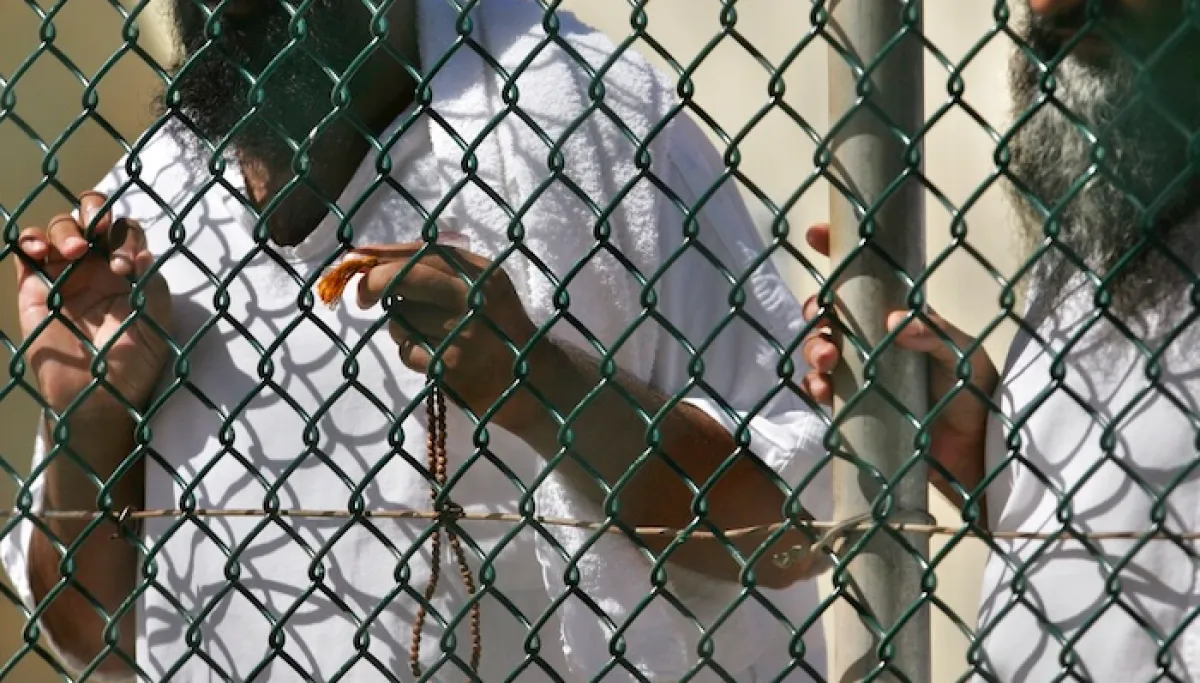
The most infamous detention facility on the globe is still open, now 25 years after the event that precipitated its necessity, with no end in sight until the remaining prisoners die, or by an act of a future Congress and president.Approximately 780 men have been or are detained at Guantanamo Bay during the nearly 25 years it has been open, and only 15 remain, almost a quarter century after its creation. All 15 of them have been detained at Guantanamo Bay since at least 2008, three of whom arrived in 2002, the year it opened.“I thought we were looking at 10 years,” retired Marine Maj. Gen. Michael Lehnert told the Washington Examiner. “I didn’t think we were looking at 25 years, and by the way, you and I both know there’s no push right now to close it either. We’re running a geriatric prison at this point. A very expensive one, by the way.” Lehnert, the first commander of the U.S. detention facility at Guantanamo Bay, has long advocated the closure of the prison, arguing that it “does not make us safer.”“American citizens were killed, and our political leaders at the time were angry,” he added. “American people were afraid, and we made decisions at that time that had not served us well.”His deputy, now-retired Navy Capt. Bob Buehn, who was also the commander of U.S. Naval Base Guantanamo Bay from 2000 to 2003, told the Washington Examiner, “I will say, I never thought that — I didn’t envision at the time we were setting it up that any part of it would still be around on 25 years later.”The first detainee arrived at Guantanamo Bay on Jan. 11, 2002, just a couple of weeks after Buehn said he was informed of the decision on Christmas Eve 2001. The CIA would detain fighters captured during the war and often torture them for information about possible future plots, the whereabouts of leaders, and more. The actions in those black sites have complicated and contributed to the lengthy delays in the legal process.Guantanamo Bay continued receiving new prisoners until the last known arrival in March 2008.By the time President George W. Bush left office in 2009, his administration had transferred about 540 detainees out of the facility to the custody of their home countries.His successor, President Barack Obama, sought to shut down the facility. Obama submitted a plan to Congress in 2016 on how to close the prison facility and what to do with those who were still being held. He did not accomplish his overarching goal during his two terms as president, but under his tenure, another roughly 200 detainees were repatriated.In this photo reviewed by U.S. military officials, flags fly in front of the tents of Camp Justice in Guantanamo Bay Naval Base, Cuba, on April 18, 2019. (Alex Brandon/AP Photo, File) One man was transferred during the first Trump administration, though it was upholding an agreement made in court in the Obama years. Then-President Joe Biden followed in Obama’s legacy of trying to figure out a way to end the expensive prison. Twenty-five detainees were transferred during his term, leaving the 15 who remain there now.The Trump administration and War Secretary Pete Hegseth’s Pentagon have not publicly discussed a willingness to transfer those who are eligible, and Trump transferred only one prisoner during his first term in office. The White House declined to comment when asked whether the president wants to see eligible detainees transferred or the prison shut down altogether.The Pentagon also did not return multiple requests for comment regarding Hegseth’s current stance on the facility, where he himself was deployed from 2004 to 2005. Under this administration, the Pentagon has set up another facility at Guantanamo Bay to hold noncitizens undergoing deportation temporarily.Three of the current detainees — Gouled Hassan Dourad, Ismail Ali Faraj Ali Bakush, and Muieen A Deen Jamal-A Deen Abd al Fusal Abd al Sattar — are eligible for transfer from the detention center and return to their native country.Among the three of them, Abd al Sattar has been eligible for transfer the longest. He was approved back in 2010, but he would not cooperate with the traditional transfer procedure of meeting representatives from a possible host country or the International Committee of the Red Cross. He is also a stateless Rohingya, making his potential relocation more difficult to resolve.In this Feb. 2, 2002, file photo, detainees from Afghanistan sit in their cells at Camp X-Ray at the U.S. Naval Base in Guantanamo Bay, Cuba. At the time the image was taken, there were 158 al Qaeda and Taliban prisoners being held at the camp. The 20th anniversary of the first prisoners’ arrival at the Guantanamo Bay detention center is on Tuesday, Jan. 11, 2022. (Lynne Sladky/AP Photo, File) “Americans, our fellow citizens, may have forgotten that Guantanamo exists, but I will assure you that our enemies have not forgotten,” Lehnert added. “When we try to establish ourselves or say that we’re the shining city on the hill, and a nation of laws, it makes it almost impossible to make that claim. We have 15 individuals down there. Some of them, candidly, are very bad people. Others have been determined by our own laws, three of them at least, that they should be released, and yet they’ve been there for over two decades. That’s not the America that I know.”In late August, a military judge scheduled a June 2028 trial date for alleged 9/11 mastermind Khalid Sheikh Mohammed. The judge also ruled that his 2007 confession to FBI agents was not voluntary and excluded it from evidence in his long-delayed case.KSM, Walid Bin Attash, Ramzi Bin al Shibh, Ali Abdul Aziz Ali, and Mustafa al Hawsawi were all charged with conspiring to commit the Sept. 11, 2001, terrorist attacks. A judge determined years ago that al Shibh was not mentally competent to face trial and removed him from the case.Ali Hamza Ahmad Suliman al Bahlul and Abd al Hadi al Iraqi are the only two who have been convicted. Al Bahlul, who is serving a life sentence, is the longest-held prisoner, having been there since the day the first group of detainees arrived.SIX-MONTH IRAN WAR PUTS PRESSURE ON THE PENTAGON’S PROCUREMENT TRANSFORMATION TO MEET THE ‘1939 MOMENT’One of the many difficulties that have come in Obama and Biden’s efforts to shut down the prison was the laws Congress enacted that barred the government from moving Guantanamo Bay detainees to supermax prisons stateside. A factor in that decision was that bringing the detainees onto U.S. soil would give them legal ground for more rights than they would otherwise have outside the country.If Trump, Hegseth, and Congress do not pursue the repatriation of the remaining 15, it will be up to a future president, secretary, and Congress to make it happen or let the prisoners remain there indefinitely.
Guantanamo Bay 25 years after 9/11: ‘We’re running a geriatric prison at this point’
Full Article
Original Source
Read the full article at Washingtonexaminer →KhanList aggregates and links to publicly available news content. We do not host full articles from third-party sources. Always verify important information with original sources.