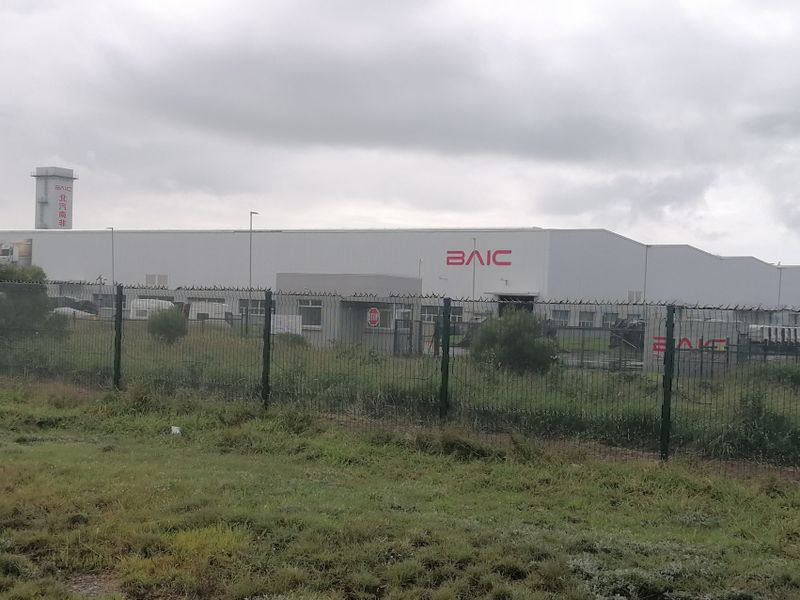
The strike at the Beijing Automotive Industry Corporation (BAIC) vehicle assembly plant near Gqeberha will set an important precedent for industrial policy, says Mziyanda Twani, Eastern Cape regional secretary of the National Union of Metalworkers (Numsa). The strike centres on whether or not BAIC should pay the same wages as other auto companies.The strike at the plant in the Coega Special Economic Zone involves about 350 workers. It began on 15 June and production is at a standstill.Unlike other manufacturers, BAIC is not part of the National Bargaining Forum. According to Numsa the company is paying much lower wages.But the Department of Labour says an inspection has shown that the wages paid are above the national minimum wage. The department will be conducting another inspection to investigate the workers’ other complaints, says spokesperson Teboho Thejane, but only when the strike has ended.According to Numsa, the lowest-paid workers at BAIC earn R48 per hour, compared with the National Bargaining Forum entry-level rate of R121. Spraypainters earn R84 per hour instead of the industry rate of R163.24, and welders earn R48 per hour compared with R180.53.The national minimum wage is R30.22 per hour.Numsa says that when production at the plant began in 2018, workers were paid Bargaining Forum rates. But in June 2025, workers say, the company told them they would be laid off for a month while the plant was made ready to assemble new models. When they returned in August last year, they had to sign new contracts at the reduced wages.A Numsa member who works in the paint shop at the plant, and who spoke to GroundUp on condition of anonymity, said: “When workers came back, they had to sign new contracts for this wage structure of R40 and R48. The employer didn’t give any reasons for cutting the rates.”She said many of the employees had previously worked at other vehicle manufacturers. “Many of the workers were retrenched from General Motors and Goodyear in the recent past and others come from automakers like Mercedes-Benz and VW, so they know the industry well,” she said.She said about 160 workers are permanently employed and about 200 are on short-term contracts which are extended for one or two months at a time.According to Numsa, workers hired since July 2025 are paid even less – R40 per hour.GroundUp sent questions to BAIC but had received no response by the time of publication.Precedent for industrial policyThe union says the immediate campaign is for wage rates, but the bigger issue is BAIC’s refusal to join the National Bargaining Forum.The forum brings together South Africa’s major vehicle manufacturers. Companies participate by joining the Automobile Manufacturers Employers’ Organisation, which negotiates wages and employment conditions on behalf of its member companies.Unlike a statutory bargaining council, participation in the forum is voluntary. By contrast, collective agreements concluded in a statutory bargaining council can be extended by the minister of employment and labour to cover all employers and employees in the sector, including those that are not members of the employer organisations or trade unions that negotiated the agreement.Twani told GroundUp: “What you get at BAIC in terms of human capital is the same as what you get at Volkswagen, Isuzu and the others.“These are people trained in the industry’s skills and experience. BAIC cannot enjoy the benefit of those workers while paying them very low wages.“Employers didn’t join the bargaining forum for the fun of it. They joined to standardise conditions across the industry and prevent unfair competition.”The BAIC plant was established as a flagship investment within the Coega Special Economic Zone, where the government sought to attract foreign investment. The R11-billion assembly plant is jointly owned by BAIC with a 65% stake, and the Industrial Development Corporation (IDC) with a 35% stake.Twani said the dispute would set an important precedent for industrial policy.“Government must strengthen its policy when it comes to foreign direct investment,” he said. “There is no value in giving companies public money and concessions in special economic zones if decent jobs and labour standards are not protected.”The union is also demanding that workers employed on fixed-term contracts for longer than three months be made permanent, that employees working without written contracts be formally appointed, and that workers employed through the Youth Employment Service learnership programme be absorbed into permanent employment once they complete their 12-month placements.Thejane said complaints about unilateral changes to contracts, as well as complaints about changes to working conditions, should be taken to the bargaining council and the Commission for Conciliation, Mediation and Arbitration (CCMA).The IDC declined to comment on the substance of Numsa’s allegations, saying discussions to resolve the dispute were ongoing.“The IDC is aware of the protracted strike at BAIC,” head of corporate affairs Tshepo Ramodibe told GroundUp. We are in continuous discussions with both BAIC and Numsa to find solutions to end the strike action.”Ramodibe said the IDC did not want to comment on the specifics of the dispute while negotiations were under way.“We are confident that the two parties will break the deadlock that has characterised the discussions.”Numsa says it has repeatedly written to BAIC and referred the dispute to the CCMA but that the company has yet to make a substantive offer.The Department of Trade, Industry and Competition confirmed that it remained involved in efforts to resolve the dispute.“We continue our engagements with BAIC led by the IDC,” said department spokesperson Kaamil Alli. “We remain committed to ensure there is a speedy resolution to this matter.” DMFirst published by GroundUp.
GROUNDUP: Strike at Chinese carmaker BAIC’s Coega plant will set a precedent, says union
Full Article
Original Source
Read the full article at Dailymaverick →KhanList aggregates and links to publicly available news content. We do not host full articles from third-party sources. Always verify important information with original sources.