
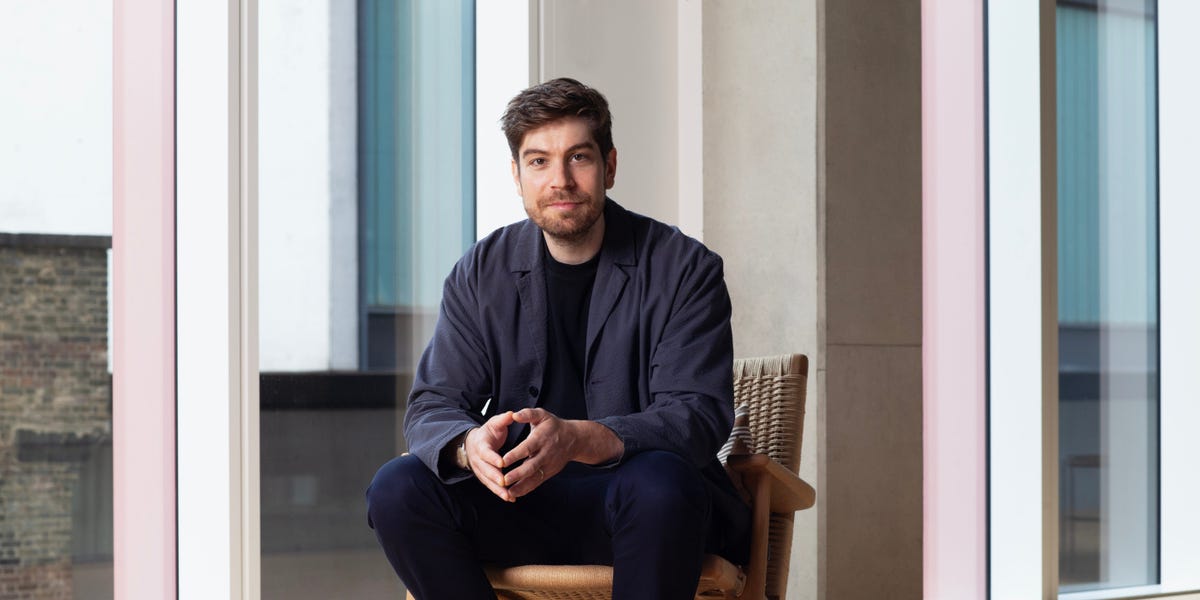
In a cavernous office in London's AI hub, a group of researchers is preparing to do battle with humanity's oldest enemy.Isomorphic Labs, a spinoff of Google DeepMind and the brainchild of AI pioneer Demis Hassabis, has an ambitious mission even by the standards of other AI labs: using AI to create drugs that could cure cancer and make disease a thing of the past.Max Jaderberg, Isomorphic's president and the person running day-to-day operations at the company under Hassabis' aegis as CEO, knows it's a lofty goal. Even so, he is unfazed."It's a ridiculous statement, but we really say it with a straight face," said Jaderberg, 36, who spoke to Business Insider in an exclusive interview in September. He added that the rate at which Isomorphic employees were coming to him with internal breakthroughs had accelerated from monthly to weekly in the past three years."There's no world in five years' time, where all drugs aren't designed by AI," he said.Right now, that goal seems a long way away. AI-designed drugs have been in development for over a decade, but none have yet received FDA approval or completed the clinical trials process, a yearslong regulatory slog that around 90% of drug candidates fail.Isomorphic has enjoyed an early-mover advantage thanks to AlphaFold, the AI model developed by DeepMind that won Hassabis a Nobel Prize and revolutionized protein mapping, opening the door to AI-designed medicines.Jaderberg said Isomorphic planned to use its AI models to overcome many of the hurdles that typically trip up promising drug candidates. The company is working on a method of using its models — and its plentiful supply of compute — to predict how the drug molecule will interact with every other molecule in the body, a process that would be far too expensive to test by hand.In February, Isomorphic unveiled a "drug design engine" that the company said improves on AlphaFold.Isomorphic plans to use it to precisely engineer molecules so that patients can receive the minimum amount of drug needed, Jaderberg said. The hope is that this will avoid complications caused by high concentrations of the drug building up in their bloodstream.The company's ultimate goal, Jaderberg said, is to be able to predict the interaction between molecules so well that its scientists will not even have to step inside a lab while designing a drug.Jaderberg said the company's internal drug design efforts are focused on developing breakthrough drugs for cancer, conditions related to the immune system, and inflammatory diseases."There's a lot of companies that just say, 'Here's a medicine in the clinic, can we just make a small change and make an incremental improvement that will allow us to capture some of that market?'" he said."I think we see a bigger opportunity, which is to go after medicines that haven't been made before," Jaderberg added.From prototypes to patientsJaderberg, who was part of Isomorphic's founding team, was recruited by Hassabis to DeepMind straight out of university. He initially approached Hassabis to be an angel investor in the computer vision startup he founded as a student, but Hassabis instead offered to buy the company outright to bring Jaderberg to DeepMind. University of Oxford graduate Max Jaderberg became president of Isomorphic Labs in January. Jillian Edelstein for BI A former engineering student from a family of cancer researchers and doctors (his grandfather ran drug trials as a cardiologist in Sweden), Jaderberg was elevated to Isomorphic's president in January, having previously served as chief AI officer.Now, he faces the challenge of actually shepherding Isomorphic's AI-designed drugs from prototypes to patients.So far, Isomorphic has struck research partnerships with pharma giants Novartis, Johnson & Johnson, and Eli Lilly. Jaderberg said the AI startup's new drug design engine has also provided a foundation for the company to begin testing AI-designed drugs in preclinical trials, with human trials not far away."If we want to solve all disease, you need a drug design engine that doesn't just work for one disease area, one therapeutic area, one indication, one type of protein, even one modality. We need something that works for everything," said Jaderberg.Isomorphic's president declined to provide a timeline for clinical trials, which the company has previously pushed back. However, Jaderberg said the company had not experienced any new delays and had been building up a clinical development team in Boston over the past year in preparation for the milestone.Even with cutting-edge AI models and a healthy supply of compute, the barrier Isomorphic faces is daunting. Navigating the clinical trials gauntlet and taking drugs from concepts on a computer screen to real-life medicines is one of the most grueling challenges in biochemistry.Researchers build molecules designed to target a specific protein, then subject them to an exhaustive trial-and-error process. Teams often end up going back to the drawing board when the drug fails to work on living cells as predicted or causes unexpected side effects.Eventually, a few designs reach the stage where they can be tested on animals. After years of testing, a tiny selection might advance to human trials.The entire process can take over a decade. Successful drug researchers can see just one or two of their drugs make it to patients across their entire career. Many more will have none.Running the drug trial gauntletJaderberg said there were a few reasons for the 90% failure rate drug candidates face.Traditional biotechs are often funding-constrained, he said, so they have to take a chance on molecules they know are not perfect. The drug molecule might hit "off-target" proteins that can cause unintended side effects and toxicity.In Jaderberg's view, however, the underlying reasons for failure run deeper. Unsuccessful drug candidates usually fail because they are based on an incorrect understanding of biology, he said.Building a truly revolutionary drug design engine requires a comprehensive model of biology that can understand how proteins interact, and the step-by-step chemical reactions that dictate how cells grow and die, he said."I think that points to a deeper and longer-term research goal that we're already underway on. Just how can you understand biology mechanistically better?" said Jaderberg.Despite Isomorphic's ambition, the road to the first AI-designed cancer drugs is still uncertain.AI-first drug design startups like Recursion and Schrödinger have reported setbacks for their AI-designed medications, and some high-profile drug candidates have failed to move beyond Phase 1 trials.Experts have urged caution. In a March essay, Emilia Javorsky, a director at the Future of Life Institute, warned that while AI excels at solving problems that are rules-based or data-rich, biology is neither. Javorsky criticized "flippant promises by tech CEOs" that their technologies will quickly usher in treatments for diseases that have tormented humanity for millennia.Lennard Lee, an associate professor at the University of Oxford and project lead for the UK's cancer vaccine AI & supercomputing project, told Business Insider that AI has transformed scientists' ability to predict molecular properties and design new medicines. However, he warned that these medicines still face their "ultimate test.""Drug development remains extraordinarily difficult, and promising predictions frequently fail when confronted with biological reality," Lee said.Charlotte Deane, a professor of structural bioinformatics at the University of Oxford, said that many proteins within the body have a fluid structure that is hard for even the most advanced AI tools to model."We all aim for the stars and that's exactly what we should be doing. But it is still a long process to show that a drug works," Deane said.'A SpaceX for drug discovery'The success of AlphaFold may have given Isomorphic an early lead in the race to discover cancer-beating drugs, but both Anthropic and OpenAI have unveiled their own drug-discovery efforts in recent months.In April, OpenAI announced GPT‑Rosalind, a dedicated frontier AI model built to shorten the time from drug discovery to approval, and announced partnerships with pharma giants Novo Nordisk and Moderna. In October, the ChatGPT maker said it had acquired AI-powered drug development platform Orchestra Bio for an undisclosed sum.Anthropic, which recently revealed plans for a blockbuster IPO, said this month it had partnered with six life sciences organizations to deploy AI throughout drug development and accelerate the clinical trial process. The AI lab has also set up its own internal drug discovery efforts that are targeting treatments for diseases, including rare childhood forms of muscular dystrophy, with Anthropic aiming to begin human trials as early as late 2028.Anthropic CEO Dario Amodei made his belief that AI could cure most major diseases in the next five to 10 years the opening salvo of his call to pace the frontier last month, revealing that he had survived an "early-stage cancer" himself.In an X post in August, Amodei went further. He suggested that delivering real progress in the fight against diseases like cancer would be necessary to help the AI labs turn around the increasingly skeptical public view of the AI boom and justify the enormous cost in money and land."At this point, saying that AI will cure cancer is more a cliche than it is inspiring, and most people think it is deceptive. The thing that will work is actually curing cancer," Amodei wrote. Jaderberg argued that top AI scientists are thinking more about "impact" when deciding where to work. Jillian Edelstein for BI Jaderberg said that frontier labs like Anthropic and OpenAI, both of which are eyeing massive public listings, are more interested in "building up hype" and communicating results than Isomorphic was."We don't want to over hype what we're doing. We're not trying to sell software. We're not trying to license our models. We want to make medicines for patients," he added.He said he ultimately envisioned Isomorphic as a vertically integrated drugmaker that designs, builds, and ships its medicines directly to patients; a "SpaceX for drug discovery."'We have a ton of Demis time'Isomorphic boasts one huge advantage over its rivals: Hassabis, who remains the company's CEO after stepping away from his role as head of DeepMind in August to take on a broader research role at Alphabet.In his post announcing his new role, Hassabis said he would be "leaning into" his work at Isomorphic "to help cure disease." Jaderberg said there had been no change in Isomorphic's organizational structure, but added that the company was already benefiting from Hassabis' new focus."He believes this is one of the most important missions we should be pushing. We have a ton of Demis time already to help push us on that vision, and having even more of his headspace is going to be positive for us," Jaderberg said.Jaderberg added that he expects Isomorphic's singular goal to give it another advantage over Anthropic and OpenAI in the most hotly-contested part of the AI business: hiring.Both Anthropic and OpenAI have been rocked by high-profile departures in recent months. Researchers from both companies have quit with dramatic warnings of catastrophic safety risks and AI-driven apocalypses.Speaking before those departures, Jaderberg said that Isomorphic offered researchers a route to apply AI in a way that would have a positive real-world impact."I think there are a lot of AI scientists and engineers who actually want to see that final impact and want it to be something really tangible and different to what I think is being offered as impact from the current frontier labs," Jaderberg said."As a species, we have to be driving this technology toward the good applications as well," he added. Google AI Health More Most popular Business Insider tells the stories you want to know about the world of business, technology, and finance Business Insider tells the stories you want to know about the world of business, technology, and finance Business Insider tells the stories you want to know about the world of business, technology, and finance Business Insider tells the stories you want to know about the world of business, technology, and finance Business Insider tells the stories you want to know about the world of business, technology, and finance Business Insider tells the stories you want to know about the world of business, technology, and finance
Google spinoff Isomorphic Labs is in a race to shake up the long, painful road to cancer-beating drugs
Full Article
Original Source
Read the full article at Businessinsider →KhanList aggregates and links to publicly available news content. We do not host full articles from third-party sources. Always verify important information with original sources.