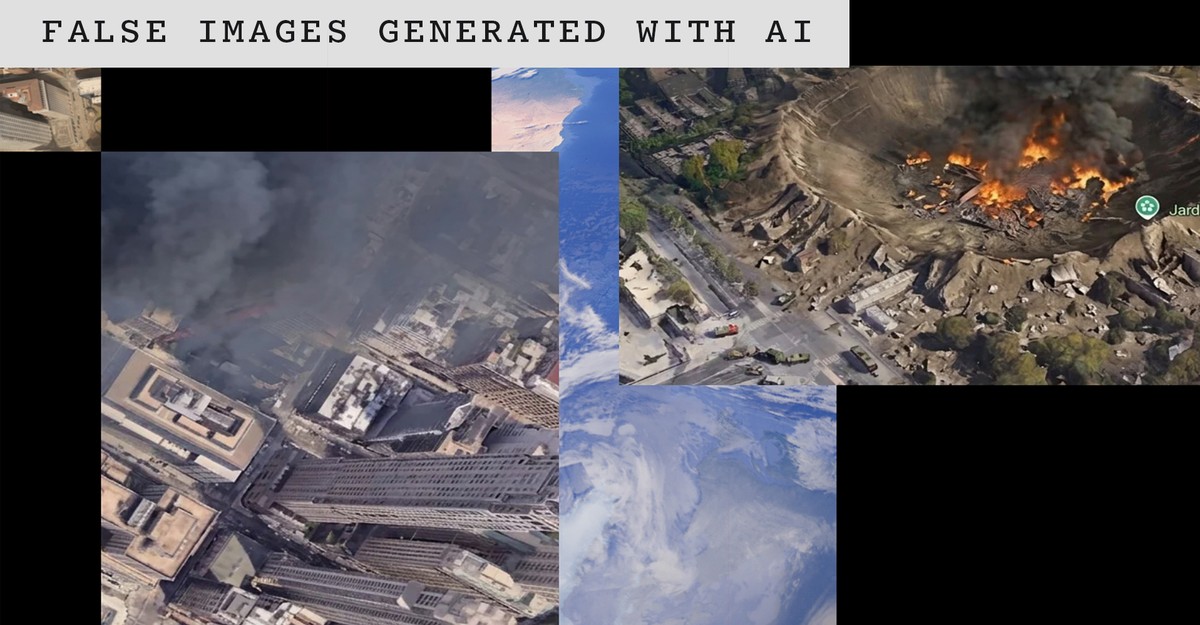
Google Earth was a boon for researchers—and then came the deepfakes.AI-generated images produced using Google Earth show multiple fabricated violent events. (Illustration by The Atlantic. Source: Google Earth.)July 31, 2026, 5:36 PM ET Earlier today, I used Google Earth to conjure images of terrible things: office buildings on fire, mass destruction in San Francisco, a smoldering crater in place of the Eiffel Tower. I was able to because Google had just decided to integrate its AI image generator, Nano Banana, into the service, which has historically been used by people seeking satellite or aerial imagery of real-world locations.Just open the site, “pick a spot on the map, and start bringing your ideas to life,” Google wrote in a press release announcing the update some 24 hours ago. So I did.I was easily able to generate those violent images simply by searching for a location on Google Earth, clicking the “Create image” icon, and typing in a few words. The feature also readily doctored stills of less spectacular, and likely less immediately falsifiable, events: a homeless encampment on the White House lawn, protesters outside the Mar-a-Lago resort, immigrants streaming over the U.S.-Mexico border.Google initially responded by directing people to check any suspicious images themselves. As fake images generated with this new Google Earth feature began circulating the web, the company stated that it takes “misinformation seriously” and that “every image created with Nano Banana in Google Earth includes the SynthID digital watermark, so if someone is unsure about an image, they can ask the Gemini app or use Lens in Search to see if the image was AI-generated.” At first, Google did not remove or restrict access to the tool. But today, shortly after I reached out with a request for comment, the company reversed course and announced that it is “rolling back this feature in Google Earth while we work on implementing stronger guardrails.”Before it allowed people to create fake imagery, Google Earth was a unique resource for researchers, journalists, and intelligence officials, particularly those studying armed conflict and natural disasters. Satellite and aerial imagery can be used to monitor crop failure or deforestation, the creation of mass graves, and the results of bombing campaigns. Especially in conflict zones and other areas that are hard for people to reach, satellite imagery is a go-to method for establishing some sort of ground truth. After Google Earth rolled out the AI feature, though, one investigative reporter wrote on LinkedIn that the tool could be used to easily and rapidly create images of drone strikes that look “very close to what we’ve seen in Ukraine, Russia, the Middle East, and other war-torn conflict zones.” And instead of requiring malicious actors to find a screenshot and then get around some AI model’s safeguards, Google rolled everything needed for a misinformation farm into one smooth user interface. It took me all of four seconds to generate a rendering of a Trump Hotel on the Gaza Strip.Read: The AI industry keeps breaking the internetThe problem should have been obvious to Google, whose other products already forbid such edits. I was able to create an aerial image on Google Earth of a plane flying into the new World Trade Center building, but when I tried to do this directly through Nano Banana, the tool refused to edit an image of the building to depict a terrorist attack. Indeed, 9/11 and other high-profile events are well-known, even classic, subjects for AI-image trolling.This is not Google’s first time launching an AI feature, and in particular an AI image-editing feature, without serious safeguards. Last year, the company released an AI shopping tool that allows you to visualize what clothes might look like on your body by uploading personal photos. As my colleague Lila Shroff and I reported at the time, “With little friction, anyone can use the feature to create what are essentially erotic images of celebrities and strangers. Alarmingly, we also discovered that it can do this for minors.” In 2024, Google Gemini was ridiculed for generating images of a racially diverse group of Nazis but not of any white Wehrmacht soldiers. And Google’s most prominent AI feature, the chatbot-powered answers in its flagship search engine, were an utter disaster upon their rollout—the AI overviews told people to eat rocks and gave other potentially dangerous health advice. Only after tremendous public pressure did the company make a substantial change, and two years later, the AI responses in Google Search continue to be inconsistent and unreliable.Google is, of course, not alone in releasing AI features that have had embarrassing, dangerous, and avoidable consequences. See, for instance, Elon Musk’s Grok generating more than 1 million sexualized images, including of children, over just a few days, or any number of embarrassing errors made by ChatGPT releases throughout the years. Again and again, the AI industry undercuts its rhetoric about safety by launching products with little or no due diligence. If, as every major AI executive has pronounced, this technology really could upend human civilization, their companies should perhaps start taking that responsibility seriously.
Google Just Torched the Credibility of Its Satellite Images
Full Article
Original Source
Read the full article at Theatlantic →KhanList aggregates and links to publicly available news content. We do not host full articles from third-party sources. Always verify important information with original sources.