
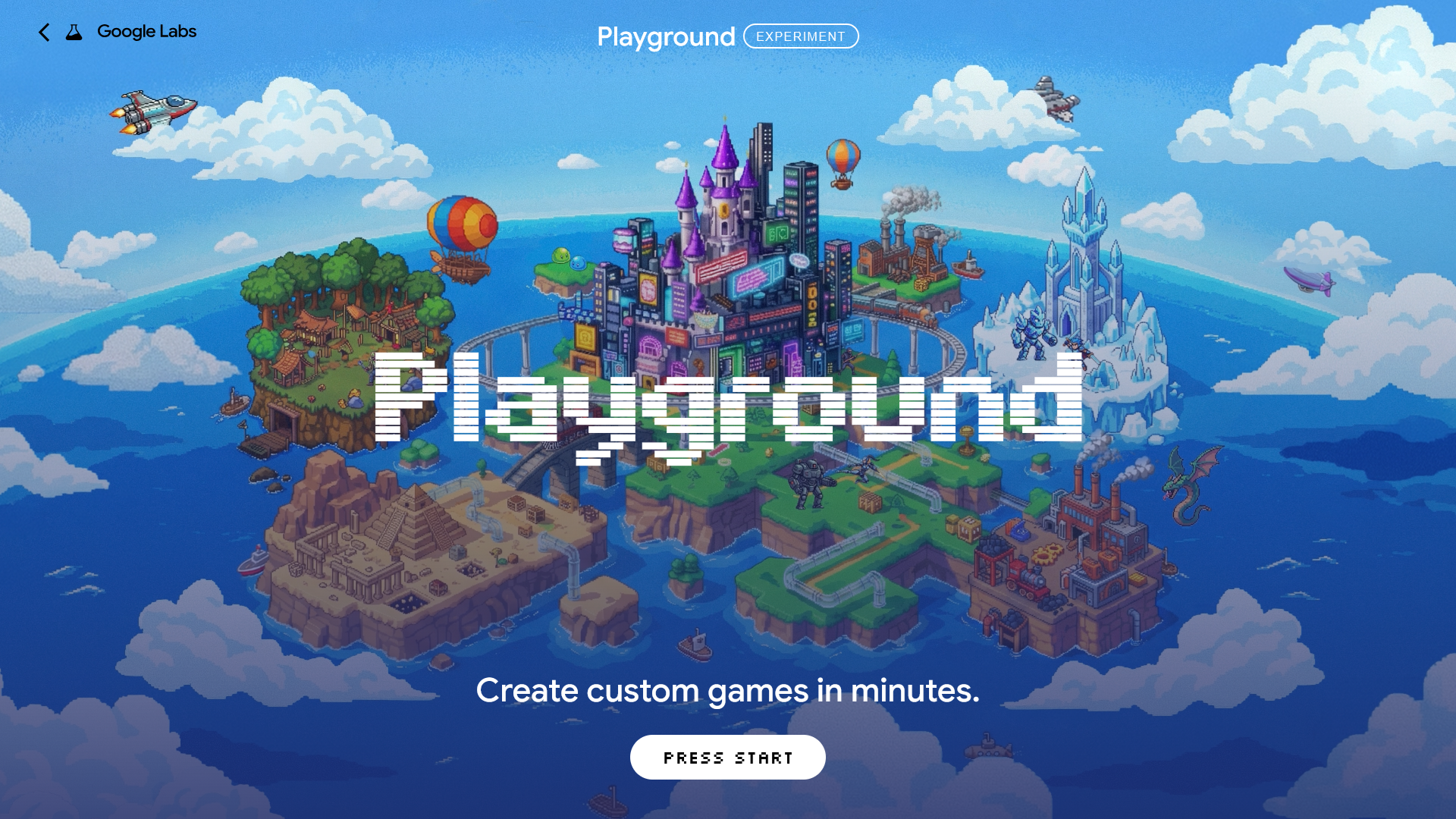
(Image credit: Google Playground) I have had plenty of video game ideas over the years, but I've always faced a somewhat enormous obstacle to turning any of them into reality. I can invent the characters and backstories, even devise some mechanics, but I cannot actually program a video game. Google’s new Playground experiment offers people like me a rather extraordinary shortcut.Google Playground lets you describe the game you want in ordinary language and have generative AI turn those instructions into something playable. Instead of learning a game engine, writing code, creating artwork and composing music, you can explain your idea and let the AI handle much of the construction. You can then keep prompting it to change the result, making game development feel closer to a conversation.You can start creating a game from scratch, modify an existing example, or use guided prompts to develop an idea. You can choose between 2D and 3D games, specify whether you want single-player or multiplayer gameplay, and describe everything from the setting and characters to the controls and objectives.The platform then generates a browser-based game, which can be tested and modified through additional instructions. If something doesn't work the way you imagined, you can ask it to try again.That is an impressive technical achievement, and my two experiments made the appeal clear, but neither left me convinced that generative AI will start making the games I actually want to spend dozens of hours playing.Code-free dragon flight (Image credit: Google Playground)I deliberately started with a straightforward concept: a platformer starring a dragon that could breathe fire. A couple of sentences were all it took to produce Mystic Dragon Glide. A few minutes later, I was in control of a small dragon traveling between floating islands, collecting sacred dragon eggs and using fire breath to deal with enemies and environmental hazards.The result was prettier than I expected. My little red dragon stood on a grassy island floating above a pastel landscape of mountains and clouds, with ancient ruins suspended mysteriously in the distance. A golden egg hovered above another platform, while an island covered in blue ice crystals suggested that some elemental obstacles awaited me farther along.Sign up for breaking news, reviews, opinion, top tech deals, and more.More importantly, Playground understood what those ideas meant in gameplay terms. I could move the dragon, jump between platforms, hold the jump control to glide and breathe fire. The title screen explained that I should scorch knights, melt glacial hazards, and collect eggs to unlock ancient portals, giving me objectives rather than simply dropping me into a generated fantasy scene.Even the soundtrack completed the effect. Playground supplied pleasant, generic fantasy video game music, with a gently adventurous melody that sounded entirely appropriate for flying around enchanted islands. There was nothing objectionable about it, but there was also nothing that made me want to immediately find the soundtrack afterward. The AI appeared very good at understanding the average of what a fantasy platformer should look and behave like.That ability has genuine value. Someone who could never make a platformer before can now describe one and start playing something resembling their idea remarkably quickly. As a creative toy or prototyping system, that is almost magical.As a game, though, Mystic Dragon Glide reminded me how much of game design lives in details that are difficult to capture in a description. Great platformers are built around movement that has been adjusted obsessively and surprises carefully placed by clever designers. My AI-built dragon could fly, but it would take a lot more work to make the game take flight.Fantasy bureaucracy (Image credit: Google Playground)Red Tape Hero was born out of a more complex prompt. I decided to write up a page or so of detail and submitted it to Playground as a request to create a satirical fantasy puzzle RPG where the player had been accidentally declared the Chosen One because of an administrative error and now had to navigate a kingdom where adventuring was bureaucratized and paperwork was better than any magic sword. I also wrote up a brief outline of the kind of conversational adventuring I had in mind.Playground didn't take long to produce a colorful low-poly 3D world filled with simple geometric trees and tiny humanoid characters walking along the paths. The whole thing had the appearance of a cheerfully strange RPG from the early days of 3D gaming. But considering the time and effort on my end, still pretty impressive.This time the music was a kind of mellow lo-fi beat and tune rather than an orchestral fantasy soundtrack. It was an odd choice for a heroic adventure, but it actually suited the game's relaxed absurdity rather well.The conversations were where Playground really impressed me. Guildmaster Rickert of Adventurers' Guild Operations welcomed me to my "quarterly performance check-in" and informed me that the quest dispatch algorithm had designated me the Chosen One under Section 9, Subsection C. His immediate concern was whether I had completed Form GT-902 for the goat rescue.My possible responses reflected the RPG system I had described in the prompt. With sufficient Bureaucracy, I could invoke Kingdom Bylaw 12 and argue that completing more than 10 goat rescues entitled me to hazard pay. A Confidence option allowed me to claim that I had already audited the goat and it had passed with flying colors.Another character, Sir Galahad, carried a talking sword called Ex Cali-Bot that offered unwanted motivational advice. It proudly announced that "100% of the dragons you don't slay are opportunities missed" and declared that "Synergy is the true holy grail." Galahad apologized because the sword wouldn't stop giving TED Talks, while one of my available responses involved claiming to be a senior agility consultant there to optimize his chivalric pipeline.This was much closer to seeing my particular idea reflected back at me. Playground had understood that the corporate jargon was supposed to collide with fantasy conventions, and it had connected the joke to RPG skills such as Heroics, Confidence, and Bureaucracy. I was more impressed by Red Tape Hero than Mystic Dragon Glide, despite its considerably less polished look.It also exposed what I think is the much larger problem with the idea of completely AI-generated games. A few funny lines can establish a comic premise, but a genuinely funny RPG needs dozens of characters with distinct voices, jokes that develop over time, careful pacing, and writers who understand when to stop making jokes altogether. A great RPG also needs quests that intersect in unexpected ways and decisions whose consequences have been deliberately considered. Maybe I could do all of that on my end, but melding it successfully with actual game software seemed more difficult with AI than by collaborating with talented humans. Spark takes the tedium out of a library card application. (Image credit: Google Playground)Why developers don't need to worry just yetThe best games are full of decisions that somebody made for a reason. A strange empty room might be there to build tension before a boss fight. A frustrating section might deliberately make the next ability feel liberating. A musical theme heard near the beginning can return 30 hours later because a composer knows exactly what that memory will mean to the player.Those choices come from designers thinking about an experience that unfolds over time. Generative AI can produce variations based on patterns it has learned, but generating more content is different from having something particular to say with it. Playground dramatically lowered the technical barrier between my imagination and something playable, which is genuinely exciting. It gave me a way to experiment with game ideas I otherwise could have done little more than write down.I can easily imagine using tools like this to prototype a mechanic or otherwise become part of a real game development flow. I can't believe most people will choose a wholly AI-generated game over the next carefully crafted game from developers and designers working hard to build the next hit video game. The more sophisticated these systems become, the more convincing their imitations will probably get, but technical sophistication does not automatically produce good taste or creative surprises.My games were impressive precisely because I knew how little effort was required to create them. And they were so riddled with issues, from mechanical confusion to plot holes, that it would take quite a lot of prompting work to make them truly playable for more than a few minutes anyway. It was telling that those I let try out the games, who didn't see my initial prompts, all said the most interesting elements of the RPG to them were the bits I had written into the prompt to begin with. That's why I'll keep going to professionally made games when I want something that can genuinely entertain me. Follow TechRadar on Google News and add us as a preferred source to get our expert news, reviews, and opinion in your feeds. Eric Hal Schwartz is a freelance writer for TechRadar with more than 15 years of experience covering the intersection of the world and technology. For the last five years, he served as head writer for Voicebot.ai and was on the leading edge of reporting on generative AI and large language models. He's since become an expert on the products of generative AI models, such as OpenAI’s ChatGPT, Anthropic’s Claude, Google Gemini, and every other synthetic media tool. His experience runs the gamut of media, including print, digital, broadcast, and live events. Now, he's continuing to tell the stories people want and need to hear about the rapidly evolving AI space and its impact on their lives. Eric is based in New York City.
Google AI turned my ideas into two playable games
Full Article
Original Source
Read the full article at Techradar →KhanList aggregates and links to publicly available news content. We do not host full articles from third-party sources. Always verify important information with original sources.