
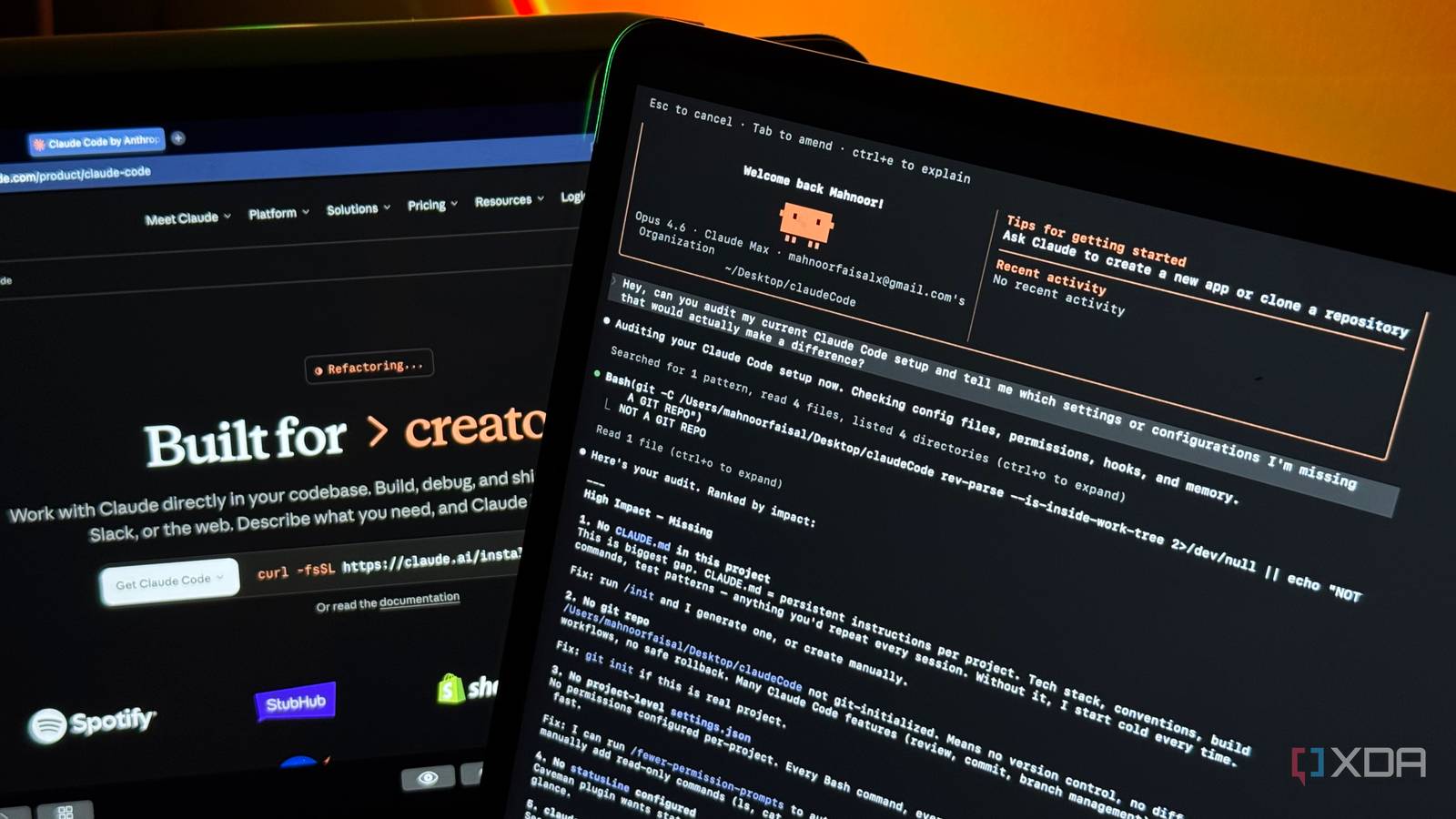
Published Oct 9, 2026, 12:30 PM EDT Mahnoor Faisal is a tech journalist covering AI and productivity tools with bylines at XDA, SlashGear, MakeUseOf, Laptop Mag, and Android Police. She's been writing professionally since she was sixteen, and has since penned hundreds of articles. This includes in-depth coverage of AI tools like NotebookLM to breaking news across the AI space. Her passion for technology started when she received her first iPod Touch (4th generation) on her 8th birthday, and she's been deep in the tech world ever since. Currently pursuing a degree in computer science, Mahnoor brings both a journalist's eye and a technical foundation to her coverage of how AI is reshaping the way we work and learn. I like to think of myself as fairly good at prompting AI tools. A huge chunk of my daily work involves interacting with these models directly, I regularly attend briefings where the people actually building them share advice on how to get the most out of them, and I spend a good chunk of time seeing how other people are using them. Well, to put it quite simply: it turns out I overestimated myself. A hidden Claude Code command that I didn't even know existed was all it took to expose that the instructions I've been giving it are just... terrible. There’s a built-in command for auditing your Claude Code setup Buried in plain sight Before I talk about what the prompt-audit bit does specifically, though, it's worth explaining /doctor itself. The command has is essentially Claude Code's built-in diagnostics tool, and Anthropic describes it as a way to diagnose and verify your Claude Code installation and settings. prompt-audit takes that same diagnostic idea in a much more interesting direction. Instead of checking whether Claude Code itself is set up correctly, it turns its attention to the instructions you've built around it. While I initially thought that you'd use prompt-audit to analyze the prompts you'd sent Claude during a specific session, that's not really what it's designed for. Instead, it looks at the more permanent layer of instructions surrounding your Claude Code setup — things like your CLAUDE.md files, skills, custom commands, rules, subagents, and other configuration that can influence how Claude behaves across a project. Once I ran the command, Claude first worked out exactly what it needed to inspect. In my case, that meant eight skills I'd created myself, 17 synced Anthropic skills, and seven installed plugins. Rather than going through all of that one file at a time, it split the job up between multiple subagents while continuing to inspect the smaller files itself. Claude gave each subagent an extremely specific brief of what to do and what not to do. For example, one agent was assigned my Docker and presentation-related skills. Claude told it that the files were strictly read-only, warned it not to execute any commands it encountered inside them, explicitly treated the files as data rather than instructions, specified Claude Opus 5.5 as the model the prompts should be evaluated against, and even pointed it toward the exact sections of Anthropic's prompt-audit methodology it should follow. The output format was fairly structured too. Claude asked the agent to return exact file locations, short quotes showing the offending instruction, the type of problem, why it was obsolete, a confidence rating, and what should be done about it. For anything that warranted a change, the agent also had to produce a proper diff containing the proposed replacement. In total, Claude found 75 issues, split evenly across three different buckets. Twenty-five of them were in skills I had created myself, another 25 were in synced Anthropic skills, and the remaining 25 came from third-party plugins I had installed. My Claude Code instructions had accumulated a lot of baggage Prompt debt is apparently very real Anthropic's reasoning behind the need for the /doctor prompt-audit command is that prompts tend to accumulate baggage as time passes. Think about it — with how frequently AI providers roll out new models, do you realistically pay heed to the instructions you've already written every single time you switch to a newer one? Do you analyze how you currently write prompts, keeping in mind the strengths and flaws of the model you're now using, and then go back to rewrite old instructions accordingly? While I've subconsciously begun to do that because of the nature of my work, I do admittedly leave plenty of instructions untouched once I've written them. If something seems to be working, I don't usually stop and ask whether the model still needs the same level of hand-holding it did a few months ago. That's exactly the kind of baggage prompt-audit is designed to catch. An instruction can start out as a perfectly reasonable workaround for one model, then become redundant, overly restrictive, or even counterproductive as newer models get better at following directions on their own. Every new model that launches gets a little better at things previous generations struggled with, which means some of the hand-holding you've built into your instructions can outlive the problem it was originally meant to solve! Sure enough, that was one of the biggest themes Claude found when it audited my setup. One of the clearest examples actually came from an Anthropic-synced skill. It contained instructions telling Claude that its "thinking time is not the blocker," to "take your time and really mull things over," and even used language about "billions a year" to pressure it into reasoning more deeply. The audit flagged all of that as unnecessary baggage for Opus 5.5, since reasoning depth is now controlled through the model's effort setting rather than by trying to coax more thinking out of it with increasingly dramatic prose. My own skills had plenty of the same sort of accumulated baggage. One of my presentation skills was littered with phrases like CRITICAL, MUST, "non-negotiable," and "mandatory for ALL," sometimes repeating the same rule multiple times. Rather than making the rule clearer, the audit suggested replacing all that shouting with the actual reason Claude needed to follow it. That one made me laugh a little, because it's exactly the kind of thing I've done when a model wouldn't consistently follow an instruction: emphasize it harder, capitalize it, and eventually throw a MUST in there for good measure. The problem is that the instruction sticks around long after the model that needed all that emphasis is gone! Some of my instructions were making newer models worse I was solving problems Claude no longer had What I found even more interesting when analyzing the results of this audit was that some of my older instructions were actively making the newer model behave worse. For instance, two skills I had installed told Claude to "narrate at most one short line" while it worked. While that has previously been recommended as a solid way to stop an AI assistant from rambling (and a big reason why skills like Caveman exist), the audit pointed out that Opus 5.5 already tends to under-narrate when given instructions like that. The result can end up having the exact opposite effect of what the instruction was originally meant to achieve, and ultimately make Claude feel unusually quiet while it's working and leaving you wonder whether it's actually doing anything at all. That wasn't the only instruction whose usefulness had expired. One of Anthropic's own synced skills told Claude that its "thinking time is not the blocker," instructed it to "take your time and really mull things over," and even used language about "billions a year" to encourage deeper reasoning. The audit flagged that entire approach as outdated for Opus 5.5. Rather than trying to coax the model into thinking harder through increasingly forceful prose, reasoning depth is now something you control through its effort setting. Some installed skills had the opposite problem: instead of trying to make Claude think more, they were pushing it to do too much. One rule said that if there was even a 1% chance a particular skill applied, Claude "ABSOLUTELY MUST" invoke it. According to the audit, wording that aggressive causes skills to fire far more often than they should. Another required verification before "ANY positive statement," while a debugging skill enforced a rigid multi-phase process even for smaller bugs. None of those rules sound completely unreasonable when looked at separately, but a model that's increasingly good at following instructions literally can end up taking them much further than you intended. Claude found instructions that directly contradicted each other It was basically being told “yes” and “no” both This was an observation Claude Code's audit pointed out specifically with skills I had created myself. One skill I have is built to generate alt text for images and rename the files to match those descriptions. At some point, I'd clearly changed my mind about exactly how I wanted that workflow to behave. One instruction told Claude to show me the filename-to-alt-text mapping so I could review everything before any files were renamed. Another instruction, just a couple of lines away, said there was no need to ask first. The contradictions didn't stop there. In one place, renaming the files was described as optional. Elsewhere, Claude was told to always rename them unless I explicitly said otherwise. So, I essentially had a skill that was telling Claude to both wait for my approval and proceed without it at the same time. This made me recall the last few times I've used the skill, and I could immediately connect the above to what I'd actually experienced. Sometimes Claude would go ahead and rename everything without waiting for me, while other times it would stop and ask for confirmation first. If there's one habit I'm taking away from all of this, it's that I'm no longer going to treat the instructions I've written for Claude Code as something I can set once and forget about. I've now made a mental note to run /doctor prompt-audit every single time a new Claude model launches!
I ran this hidden Claude Code command on my setup, and apparently I've been giving it terrible instructions
Full Article
Original Source
Read the full article at Xda-developers →KhanList aggregates and links to publicly available news content. We do not host full articles from third-party sources. Always verify important information with original sources.