
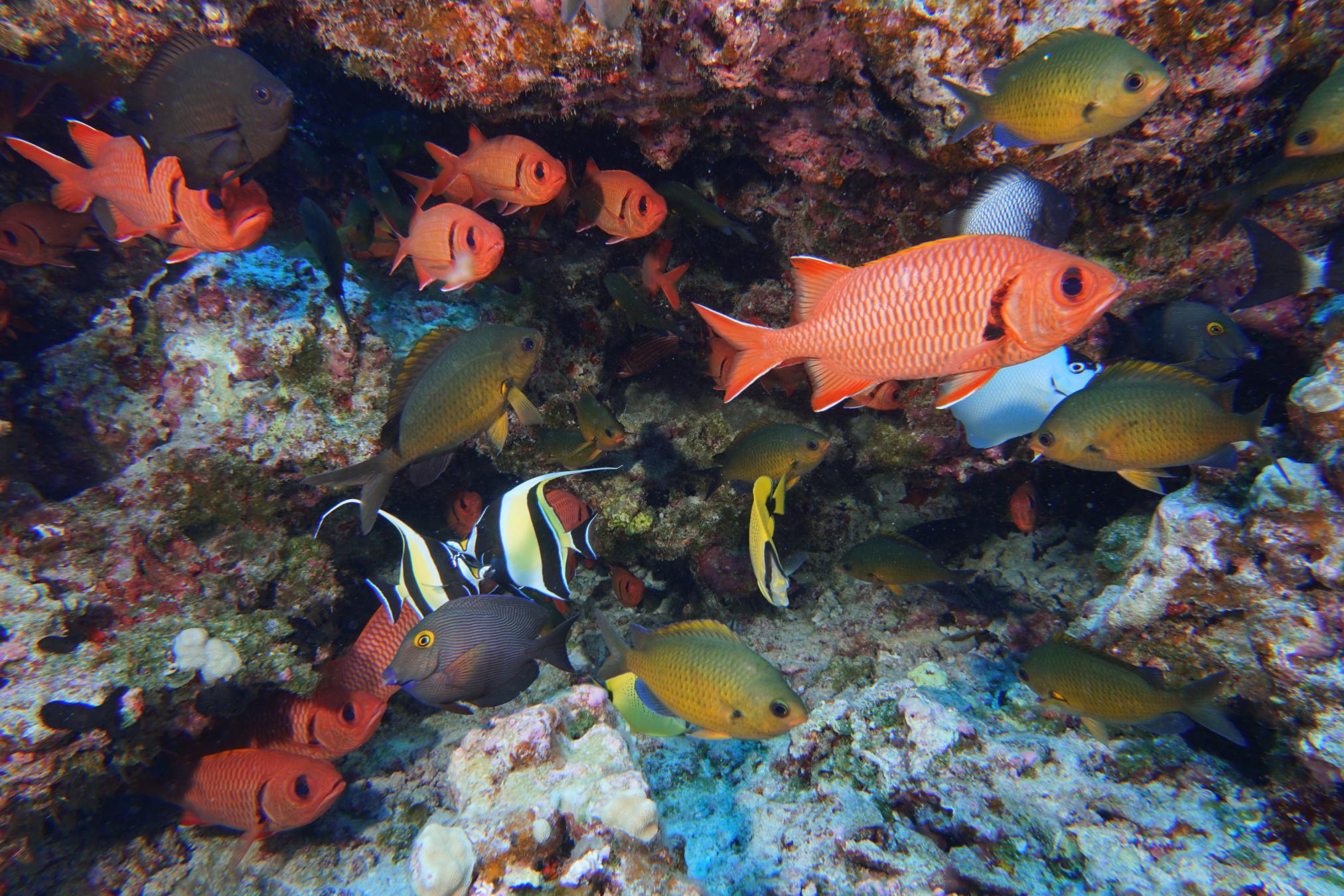
The largest global coral reef assessment finds that average hard coral cover has declined 9.5% relative to a three-decade reference period spanning 1980-2009.A fourth global bleaching event in 2023-2025 drove a record 8.9% one-year loss, though its full effects are not captured in this analysis, which ends in 2024.Reefs can recover after bleaching events, but increasingly frequent marine heat waves are shortening their recovery window.Scientists say local management can strengthen reef resilience, but rapid greenhouse gas emission cuts remain essential to prevent further widespread losses. The world’s coral reefs are losing both hard coral cover and, just as critically, the time they need to recover between increasingly frequent marine heat waves, according to the most comprehensive global reef assessment yet. Released Aug. 31 by the Global Coral Reef Monitoring Network (GCRMN), the “Status of Coral Reefs of the World: 2025” draws on 21.1 million observations from 87,299 surveys at 36,886 sites across 123 reef-bearing countries, territories and economies, collected between 1980 and 2024. The report estimates that global hard coral cover, defined as the proportion of reef surface covered by living hard corals, fell from an average of 30.2% during a 1980-2009 reference period to an average of 27.3% between 2020 and 2024. That represents a decline of 2.9 percentage points, or 9.5% relative to the reference period. The assessment characterizes this estimate as conservative: Monitoring began after many reefs had already been degraded, and uneven data coverage can limit comparisons across regions. Hard coral cover dropped further to 25.8% in 2024. The report focuses on hard coral cover because hard corals are ecosystem engineers, and their cover is readily measured, easily understood and consistently monitored worldwide, allowing comparisons across regions and over time. A variety of fish species swim above a patch reef 24 meters (80 feet) deep at French Frigate Shoals, a large coral atoll in the Hawaiian Islands. Image by Andrew Gray/NOAA via Flickr (Free to use). From April 2023 to mid-2025, coral reefs experienced a fourth global bleaching event, declared by the U.S. National Oceanic and Atmospheric Administration (NOAA) after a year of accumulated heat stress across the tropical Atlantic, Indian and Pacific oceans. Manuel González-Rivero, the report’s lead author, GCRMN global coordinator and a research team leader at the Australian Institute of Marine Science, said the estimate does not capture the fourth global bleaching event’s full toll because heat stress continued into 2025. “Given current ocean temperatures and the strengthening of El Niño, we may anticipate conditions favouring another global bleaching event,” González-Rivero told Mongabay by email. Extending the analysis through 2025 and 2026 will likely produce a steeper long-term decline, he said. On Sept. 10, NOAA said that El Niño had a greater than 90% chance of becoming “very strong” during the Northern Hemisphere fall and winter of 2026-27. El Niño is a naturally occurring climate phenomenon characterized by the extensive warming of surface waters in the central and eastern equatorial Pacific, which elevates global ocean temperatures and amplifies marine heat waves that can trigger mass coral bleaching. Acheron Island off Queensland, northeast Australia, surrounded by patches of bleached coral. Image by J. Jones/Commonwealth of Australia (Reef Authority) (CC BY 4.0). A shrinking recovery window Global coral bleaching occurs when marine heat waves cause corals to expel the photosynthetic algae they rely on for food, leaving them vulnerable to starvation and death across the tropics. Modern records show four global bleaching events: the first in 1998-1999, the second in 2010-2011, the third in 2014-2017 and the fourth in 2023-2025. The fourth global bleaching event drove an 8.9% relative drop in hard coral between 2023 and 2024 alone, the largest single-year decline on record, according to the report. Reefs can rebound when disturbances ease. After the third global bleaching event, global cover rose about 6% between 2017 and 2019, according to the report. But bleaching events now occur roughly every four to six years — down from an average of once per decade — leaving reefs with far less time to recover before another heat wave arrives. Average sea surface temperature over coral reefs rose by 0.81° Celsius (1.46° Fahrenheit) between 1985 and 2025, it says. Coral cover alone can also overstate ecological recovery. González-Rivero said independent research indicates cover may return before the former mix of coral species does. Some reefs instead develop new assemblages that may support less biodiversity and fish habitat, provide fewer ecosystem services and remain more vulnerable to disturbance. Underwater reef with damaged corals during a bleaching survey conducted in the Cairns/Cooktown Management Area of the Great Barrier Reef Marine Park in 2017. Image by J. Stella/Commonwealth of Australia (Reef Authority) (CC BY 4.0). Julia Baum, a coral reef ecologist and professor at the University of Victoria in Canada who was not involved in the report, said she had not reviewed it in detail but described the broader outlook as dire. “The coral recovery documented following the third global coral bleaching event is minimal and provides little cause for optimism,” Baum told Mongabay by email. “I would not call 6% a rebound.” She said the frequently cited interval of roughly six years between global bleaching events is a global estimate, not a fixed cycle experienced uniformly by reefs. Another global bleaching event is likely developing in 2026 under the current El Niño, she said. “With current global ocean temperatures at an all-time high, the unfolding El Niño will almost certainly be a death sentence for many of the world’s coral reefs,” Baum said. She said steep, immediate cuts in greenhouse gas emissions are essential to avoid losing most reefs this century. Without them, Baum said, interventions to protect corals such as restoration and local stress reduction cannot counter the underlying rise in ocean heat, amounting to “rearranging the deck chairs on the Titanic.” Coral reef east of Iran’s Kish Island in the Persian Gulf. Image by Hamed Saber via Flickr (CC BY 2.0). Uneven losses The global trend masks sharp regional differences. Hard coral cover declined 48.7% in the region encompassing the northern Arabian Sea, Persian Gulf and Gulf of Oman, and 43.4% in the Caribbean Sea. The Pacific Ocean’s corals declined 18.3%, while Australia’s fell 10.9%. The report found no clear long-term change in Brazil, the East Asian Seas, the Eastern Tropical Pacific, or the Red Sea and Gulf of Aden. South Asia and the Western Indian Ocean registered increases of 16.2% and 43%, respectively, but the report cautions that degraded starting conditions and sparse early observations complicate those suggested trends. The assessment also examined changes in macroalgal cover on coral reefs. Macroalgae are seaweeds with important ecological roles, but excessive cover can crowd out corals and hinder growth of new corals, impeding reef recovery after disturbances. Scientists track them because increases in macroalgae can indicate declining reef resilience. While global macroalgal cover grew by 44.1% relative to the 1980-2009 reference period, macroalgae covered just 6.8% of coral reefs globally in 2024. The authors found no evidence of a worldwide shift from coral-dominated to algae-dominated reefs, though such transitions have occurred in particular locales. Bright yellow polyps of a turret coral at night. Image by K. Anthony/Commonwealth of Australia (Reef Authority) (CC BY 4.0). Supporting reef recovery Around 104 million people now live within 5 kilometers (3.1 miles) of a coral reef, according to the study. This is 46% more than two decades ago, increasing both human pressure and dependence on reefs. Although reefs cover less than 0.2% of the ocean floor, they support at least 25% of marine species and sustain the livelihoods, food security and cultural traditions of nearly a billion people. González-Rivero said fishing sustainably, improving water quality and controlling coastal development can preserve local reefs’ capacity to recover. Suralaya coal power plant in Cilegon City, Banten Province, Indonesia. Experts say the best chance for coral reefs is to rapidly cut greenhouse gas emissions while protecting areas that may provide refuge from ocean warming. Image © Kasan Kurdi/Greenpeace. Restoring damaged reefs and assisted evolution — breeding corals that can better withstand heat — may help in some places, González-Rivero said. But local projects can only do so much as marine heat waves intensify. The best chance for reefs, he said, is to rapidly cut emissions while protecting areas that may remain relatively sheltered from warming. “Shrinking recovery windows will have a more profound impact on reef composition and function than we yet fully understand, with the potential for long-lasting consequences for coral reef ecosystems,” González-Rivero said. Banner image: Various fish including bigscale soldierfish (Myripristis berndti), Moorish idols (Zanclus cornutus), and a masked angelfish (Genicanthus personatus) swim in a small outcropping of coral on a reef in Papahānaumokuākea Marine National Monument, Hawai’i, in 2017. Image by Andrew Gray/NOAA (CC BY-NC 2.0). Coral bleaching: How warming seas are transforming the world’s reefs Global ocean breaks records with 100 days of heat as El Niño adds new threat Citations: González-Rivero, M., Dallison,T., Wicquart, J., Brigdale, A., Logan, M., Fobert, E. K., Staub, F., and Planes, S. (eds.), 2026. Status of Coral Reefs of the World: 2025. Global Coral Reef Monitoring Network (GCRMN), International Coral Reef Initiative (ICRI). doi:10.59387/LFPR6347 Hughes, T. P., Anderson, K. D., Connolly, S. R., Heron, S. F., Kerry, J. T., Lough, J. M., … Wilson, S. K. (2018). Spatial and temporal patterns of mass bleaching of corals in the Anthropocene. Science, 359(6371), 80-83. doi:10.1126/science.aan8048 Fabricius, K. E., Crossman, K., Jonker, M., Mongin, M., & Thompson, A. (2023). Macroalgal cover on coral reefs: Spatial and environmental predictors, and decadal trends in the Great Barrier Reef. PLOS ONE, 18(1), e0279699. doi:10.1371/journal.pone.0279699 Feedback: Use this form to send a message to the editor of this post. If you want to post a public comment, you can do that at the bottom of the page. Credits Topics
Global coral reefs get less time to recover as oceans heat up, report finds
Full Article
Original Source
Read the full article at News →KhanList aggregates and links to publicly available news content. We do not host full articles from third-party sources. Always verify important information with original sources.