
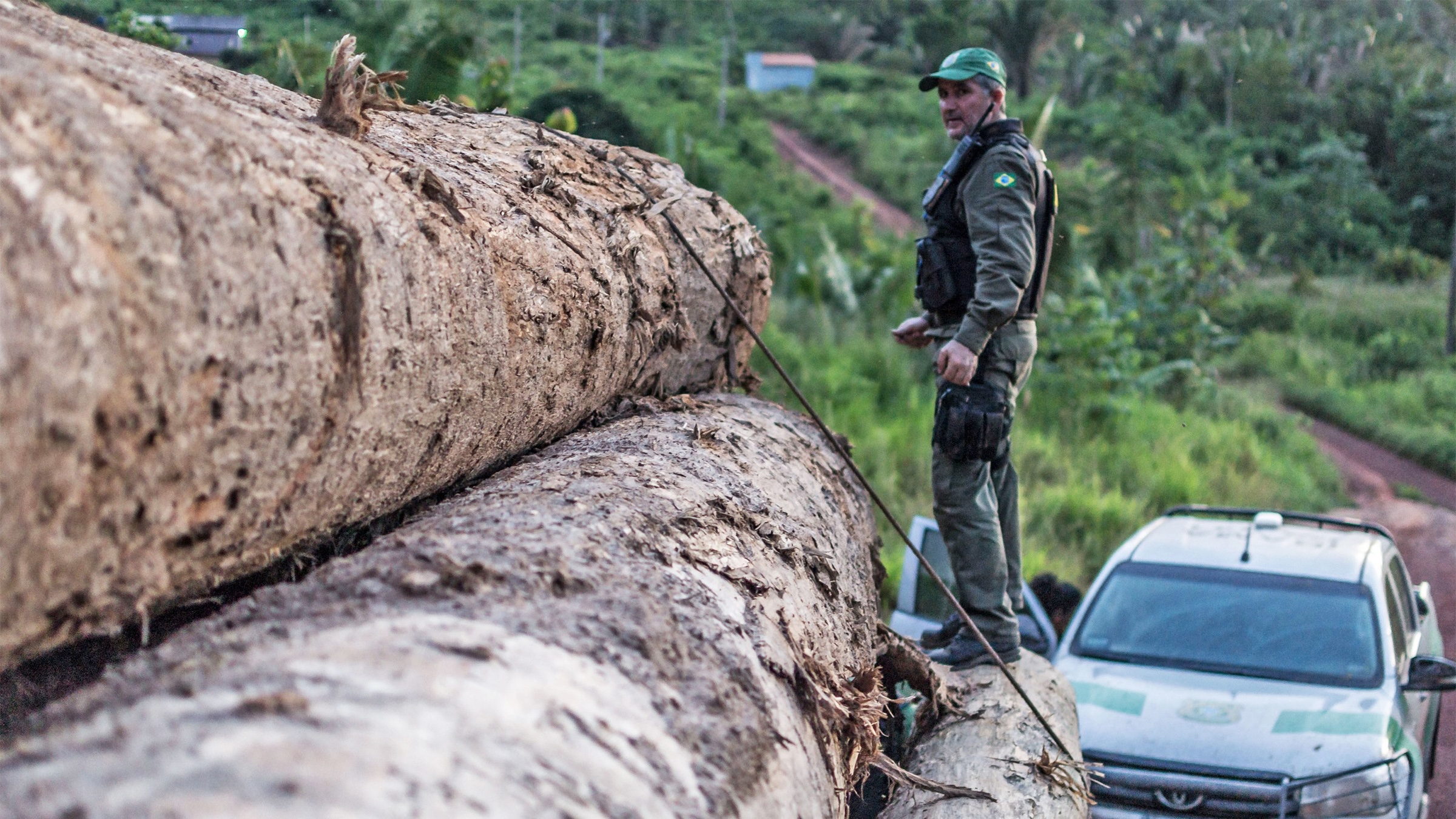
The world has spent a decade trying to put a price on nature, yet the criminal economy has been putting a price on it for much longer.Land grabbing, illegal logging, illicit gold mining and wildlife trafficking are extremely lucrative and have become a serious drag on both sustainable development and climate action, a new op-ed argues, and its drivers must be addressed from where extraction begins all the way to corporate offices.“The world is still working out how much a standing forest is worth. Criminal markets settled on a price for a felled one long ago,” the authors write.This article is a commentary. The views expressed are those of the authors, not necessarily of Mongabay. The world has spent a decade trying to put a price on nature. Forests have become carbon sinks, while wetlands are increasingly described as natural infrastructure. Biodiversity is also being drawn into financial markets. Governments and investors have poured billions into carbon markets and conservation finance, including green bonds. Around them, a financial system is emerging on the assumption that intact ecosystems can generate enough economic value to protect them. A more destructive economy has been putting a price on nature for much longer. It makes money by extracting and selling it. Land grabbing, illegal logging, illicit gold mining and wildlife trafficking are usually treated as environmental offenses, so responsibility falls to park rangers, customs officials and specialized police. That view badly underestimates what is happening. In a new paper for the Brookings Institution, we argue that environmental crimes are a serious drag on both sustainable development and climate action. They damage ecosystems and weaken the institutions charged with governing them. They also drain revenue from legitimate companies and public coffers. Enforcement alone will not solve a problem that runs through trade, finance and local political economies. An IBAMA agent participates in a raid on an illegal logging and mining operation within an Indigenous reserve. Image courtesy of IBAMA. Global criminal economy No one knows exactly how large this economy has become. A widely cited estimate puts annual proceeds at between $110 billion and $281 billion, but the true figure is probably far higher, perhaps in the trillions. What makes the business so difficult to see is that much of the money disappears into transactions that look perfectly ordinary. Consider a tree felled illegally in the Brazilian Amazon. It reaches a sawmill, acquires paperwork and is mixed with legal timber. Gold extracted with mercury can change hands several times before reaching a refinery. Illegally caught fish can pass through a processing plant before entering ordinary retail markets. In each case, the commodity becomes harder to connect to the damage that produced it. By the time the goods reach an exporter or a consumer, their provenance has been rewritten. For instance, investigators have traced timber illegally harvested in Pará through laundering schemes to buyers in Europe and America: One recent case followed more than 25,000 cubic meters (almost 883,000 cubic feet) of wood to importers in France, Germany, Portugal and the United States. Legal and criminal commerce often pass through the same commercial infrastructure. Informal gold mines consuming tropical forest in Peru. Photo by Rhett A. Butler for Mongabay. Where the money is made The logger with a chainsaw remains the familiar face of environmental crime, and is also among the cheapest labor in the chain. Much larger profits are made farther downstream by those financing the equipment, arranging transport or manipulating permits, as well as by businesses that help move the proceeds into the legal economy. Police operations in the Legal Amazon keep uncovering the same overlap between environmental and organized crime, so the forest absorbs the damage while the value is captured elsewhere. Criminal organizations built on drug trafficking have diversified into gold, timber and land across the Amazon Basin. Brazilian investigations have exposed networks running gold over borders before laundering it into legal markets. ‘Grilagem,’ or the forging of documents like land titles, converts the fraudulent occupation of public land into a saleable asset, while informal or illegal mining (‘garimpo’) depends upon accessing machinery, mercury and intermediaries linking mining areas to buyers and refiners. Some of the transport networks used for this gold are the same ones used for cocaine. Gold is especially difficult to police because refining can erase its history. Research on mercury trafficking shows chemicals used in its extraction moving through opaque cross-border networks, while gold flows in the opposite direction into formal trade. In Peru, illegal production has at times approached the scale of legal gold, but by the time police arrive at a mining camp, many of the people making the real money are already sitting in trading houses, refineries or offices hundreds of kilometers away. After burning off the mercury used in refining gold, a relatively pure piece remains that ‘garimpeiros’ can mix with gold mined legally elsewhere to make its origin hard to trace. Image by Thomas Graham for Mongabay. People at the bottom Many people doing the extraction are poor and part of a survival economy. A smallholder may clear protected forest after a failed harvest, an artisanal miner may use mercury because cleaner technology is beyond reach, or a fisher might enter restricted waters after nearby fish stocks collapse. The environmental damage from these actions can be severe, though the economic position of these workers is very different from that of the financiers and brokers higher up the chain. Informality and the absence of credit keep many artisanal miners locked into destructive methods. Criminal groups exploit these gaps by providing cash, purchasing outputs and offering transport when legitimate banks and buyers are absent. In some areas they become employers and lenders, and may also provide protection. Families may know perfectly well that the economy around them is destructive while having few realistic ways to leave it, and weak state presence entrenches these interests. This is one reason enforcement so often has limited effects, as closing a mine may simply move extraction somewhere else. Blocking a timber route can redirect traffic, while arrests among workers achieve little if their organizers remain untouched. Farther up the chain, paperwork is altered, officials are bribed and companies continue trading. Local authorities also learn the lesson that enforcing laws can be dangerous, so more durable disruption requires regional cooperation and financial investigations that target the people organizing these markets. The economic damages also accumulate well beyond the forest, like when legitimate producers compete against others that ignore taxes and environmental rules. Governments lose royalties while paying for policing, health impacts and environmental restoration, and investors inherit risks that conventional due diligence and project assessments might miss entirely. A siamang gibbon seized in Chennai, India in August 2024, along with turtles and pythons. It was being carried in the baggage of a passenger travelling from Bangkok. Image courtesy of PIB India/Press release. These conditions also make investment harder in regions already short of capital. A carbon project built on insecure land tenure remains precarious, however attractive its financial model may look. Conservation finance struggles when illegal miners can put cash in someone’s hand that very afternoon, and environmental crime also limits how far climate and development finance can go. Companies face the same problem from the other end of the supply chain, because a suspect shipment may be seized, and problems with a supplier can interrupt their production, while those that fail to identify illicit proceeds may also face financial-crime enforcement. Meanwhile, environmental degradation also makes some raw materials scarcer and more expensive, and these risks are beginning to reach corporate balance sheets and boardrooms. Follow the commodity The response has to follow the commodity and the money through the whole system. Governments still concentrate much of their enforcement near the site of destruction, even though the people controlling the business are often elsewhere. Important points of leverage lie farther downstream, particularly in processing, trade and finance, while laundering in Amazonian supply chains often depends on false documents and front companies, followed by financial transactions that make illegally extracted goods appear legitimate. Investigators have much better tools than they did a decade ago, like satellite imagery that can identify forest loss or mining activity within days, while trade and financial data can be accessed to reveal patterns worth investigating. The institutional machinery has been slower to catch up, though, with relevant information being scattered across agencies and jurisdictions, while rules governing its use can make sharing cumbersome. Building a case from those fragments remains difficult. But in August, authorities from Bolivia, Brazil, Colombia, Ecuador and Peru reported the results of Operation Green Shield 2026. It involved more than 3,600 officers who carried out 1,045 field actions against illegal mining, logging, wildlife trafficking, and fuel smuggling. It yielded 839 arrests and seizures worth over $280 million, versus just 94 arrests and $64 million the year before. The cross-border coordination it required may prove as important as those numbers, though, as investigators began sharing information and using geospatial technology to organize operations across a large area. Consumer markets are exerting pressures of their own, like Europe’s new deforestation regulation which requires firms selling covered commodities to show that their goods are legal and deforestation-free, with the rules applying to large and medium-sized operators from the end of 2026. Brussels has delayed implementation of this twice and thinned some obligations along the way, but the requirement still changes incentives in markets where provenance has often been difficult to establish. Companies selling into Europe are therefore being made more responsible for understanding what enters their supply chains. Greenpeace activists paint barges of illegally felled trees en route to a ship destined for Europe. Photo by Jeremy Sutton-Hibbert for Greenpeace. Gold remains especially troublesome, due to its portability and fungibility, which make material from different sources easy to mix. Illegal gold can therefore enter formal markets far from where it was extracted. Once it crosses a border, national controls lose much of their force. Shared standards and stronger financial monitoring across the Amazon would close some of the gaps that domestic regulation leaves open. The problem also has to be addressed where extraction begins, since illicit economies survive partly because they provide livelihoods where formal alternatives are weak or absent. Land rights have to be enforceable and artisanal miners need practical routes into legal markets, while farmers need access to credit without depending on criminal intermediaries. Public institutions must also operate in places where illicit actors have spent years building local influence. Formalizing small-scale mining can help when cleaner technology and reliable legal buyers are available. Raids on illegal mines remain necessary, but they reach only one part of the system. Environmental crime has become embedded in ordinary commercial activity far beyond the places where the damage occurs. Timber moves through wholesalers and exporters while gold enters refineries and financial markets, with proceeds deposited and reinvested through the formal economy. Putting a price on nature will achieve little while those markets continue absorbing commodities and money generated by its destruction. The task is to make those transactions visible and costly enough to change behavior. The world is still working out how much a standing forest is worth. Criminal markets settled on a price for a felled one long ago. Robert Muggah is co-founder and research director for the Igarapé Institute. Ilona Szabó de Carvalho is a Brazilian political scientist and co-founder and president of the Igarapé Institute. Banner image: Environmental agents use satellite imagery analyses and on-site inspections to identify illegal timber. Image by IBAMA via Wikimedia Commons (CC BY-SA 2.0). See related coverage: Fake documents, real deforestation drive global trade in illegal Amazon timber Court convictions are the exception in Amazon land-grabbing cases, study shows Environmental crimes are often hidden by ‘flying money’ laundering schemes (commentary) The global gold rush consuming the Amazon (commentary) Citations: Agyei, E. K., Appiah-Kubi, G., Sunkari, E. D., … Mensah, C. (2026). Microfinance, informality, and the transformation of illegal artisanal mining supply chains: A bibliometric assessment from Ghana and sub-Saharan Africa. Sustainable Futures, 11, 101844. doi:10.1016/j.sftr.2026.101844 Rodrigues, L. B., … Franchi, T. (2026). Criminal convergence in the Amazon: An analysis of drug trafficking and illegal mining. Trends in Organized Crime. doi:10.1007/s12117-026-09615-6 Credits Topics
To tackle environmental crime, track profits through the whole supply chain (commentary)
Full Article
Original Source
Read the full article at News →KhanList aggregates and links to publicly available news content. We do not host full articles from third-party sources. Always verify important information with original sources.