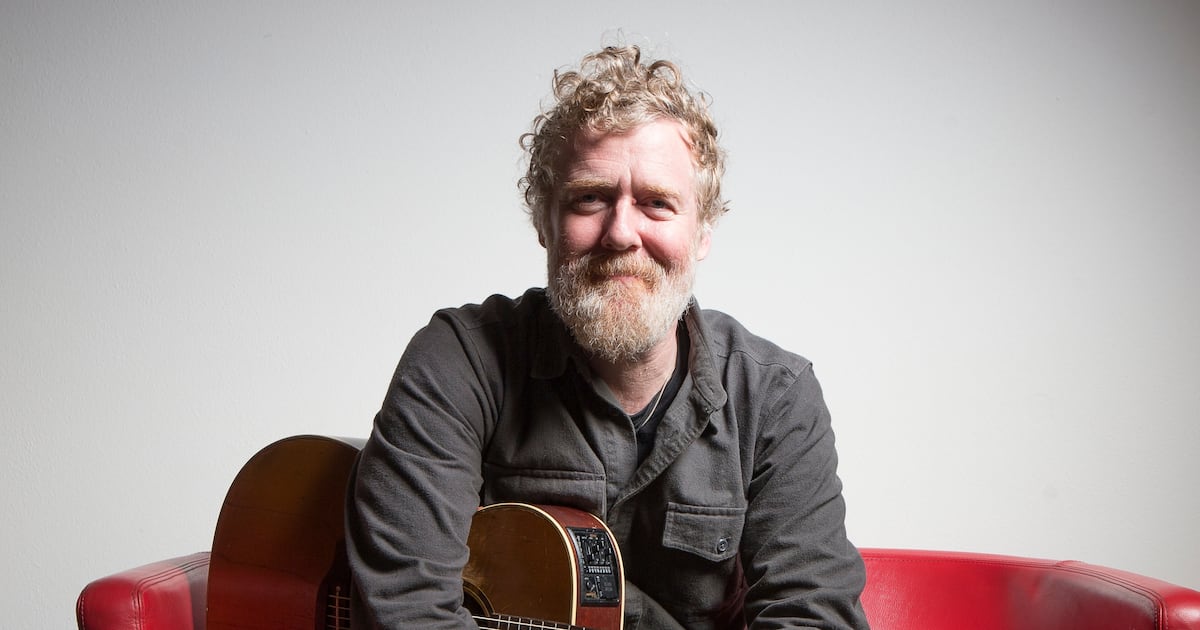
He was a leader, a force indomitable and a natural disrupter. With his scruffy hair, mischievous grin and will o’ the wisp charisma, Glen Hansard brought excitement into the room and energy on to the stage.He didn’t have fans in the ordinary sense, he had a flock. He made music that for many was a form of religion. “I want my life to make more sense,” he sang as frontman of The Frames in the early days, in the 1990s, on small stages around the country, from Connolly’s of Leap to Whelan’s in Dublin.The party faithful wore the mantra on their T-shirts and held it in their hearts. READ MOREGlen Hansard (56) died early on Wednesday in a motorcycle crash in Dublin. The shock of his loss – so abruptly – has been deeply felt throughout the Irish music and arts community, as well as by his large audience abroad.Many of those international fans first came to Hansard through his film work – he played the busker in the wistful low-budget film Once, winning an Oscar alongside his costar, Czech musician Markéta Irglová, for the song Falling Slowly in 2008.[ Glen Hansard the film star was at the centre of two key moments in Irish cinemaOpens in new window ]That the role had been initially been intended to go to Cillian Murphy was a detail soon forgotten once Hansard showed his worth.“By the second day of filming, it became clear to me that we were making something original and special,” director John Carney told me before the film’s release in 2007. In a career that spanned four decades, Hansard proved time and again that he could change hearts and minds. Raised in Ballymun, one of a large family, his journey in music began as a busker on the streets of Dublin.He cofounded The Frames in the early 1990s, quickly showing a verve, musicianship and ingenuity that set the band apart. Their early single Revelate was emblematic of the band’s musical intentions. Released in 1995 as the lead single from Fitzcarraldo, the song embraced the grungy spirit of the early 1990s – this was just a year after Kurt Cobain’s death – but also signalled their folksier origins, with violin from The Frames co-founder Colm Mac Con Iomaire forming an intrinsic part of the song’s architecture.Lacking a budget, the band made the video by using post office security camera footage. They performed the single on The Late Late Show as Gay Byrne looked on, discomfited and impressed.“Put your hands over your ears, to welcome from Dublin, the north side wouldn’t you know, The Frames,” Byrne said drily. The Frames initially had major label support. Touring England, they were even on a bill with Radiohead in the early days, but they were dropped by Island Records when The Cranberries became the label’s Irish success story. It was a short-sighted decision that left The Frames scrabbling for funds and saw a number of band members exit for steadier, safer careers elsewhere. Hansard never wavered. On their 1999 album Dance the Devil, he sang, “The stars are underground/And the proof is flying overhead/So kick me when I’m down/And I’ll be the one you’re laughing about now.”[ Tributes paid to Glen Hansard: ‘A troubadour whose gift for storytelling brought so much joy’Opens in new window ]In the dressingroom in Vicar Street before a gig for their 2004 Burn the Maps tour, Hansard made himself tea in a pint glass, which he stirred carefully with a fountain pen before fishing in his bag for a Breakaway bar, as he sought to explain his attitude.“Even though we’ve filled Marlay Park, friends say, ‘You’re only big in Ireland. Would you not go and get a real job?’,” he reflected.He had no intention of it or of adapting their indie sound to draw a bigger audience. “There’s a saying – seek people’s approval and become their slave. Being that kind of band has never been interesting for us.”When Burn the Maps was released in Ireland, it shot to No 1, outselling its nearest rival Green Day by 4,883 copies. The fans were there, and the sense was always that The Frames were on the cusp – about to make it big. Glen Hansard performing in Dublin's Vicar Street with The Swell Season. Photograph: Alan Betson That Hansard should find himself catapulted to global fame courtesy of Once was a surprise that was hard to square with, after so many years of struggle. Music was Hansard’s core identity, not film – a fact he often sought to communicate. But if he was uncomfortable with the way renown had arrived, he understood the opportunity it afforded, pragmatically and creatively.He became active with the Apollo House movement, drawing attention to Ireland’s homelessness crisis, and spearheaded the yearly busk for charity at Christmas on Grafton Street in Dublin with figures including Bono and Imelda May.Christy Dignam (left) and Glen Hansard perform out Apollo House on Poolbeg Street, Dublin, before the building's demolition. Photograph: Gareth Chaney/Collins He released several beautiful albums as part of The Swell Season with Irglová, with members of The Frames forming part of the band. He also spent more time abroad, recording in New York and elsewhere, and gradually releasing solo albums to acclaim, the first, Rhythm and Repose, arriving in 2012.Experiments with other musicians also gave him creative nourishment; earlier this year he talked of a project he was working on with Charlie Hall from the band The War on Drugs. “We’re noodling, we’re digging,” he told me.Change also came for him personally. He married the Finnish poet Maire Saaritsa and they had a son Christy, named for Christy Dignam, Christy Moore and – most especially – his great friend, the late singer-songwriter Mic Christopher. Fatherhood deeply affected him. As he moved between living in Finland and Ireland, financial security was on his mind for him and his family.“Funny as it sounds with all the success, the money is something that you have to go out and earn constantly.“It’s not something that you just have all put away and it’s all sorted,” he said. On The Swell Season’s 2025 album Forward, Hansard wrote a song for three-year-old Christy called Factory Street Bells. Its lyrics run:That’s another day over Go to sleep now, my son It’s a full-blown solid gold Miracle you’ve come And your mother’s a beauty Your dad’s a fortunate man And he’ll be back to hold you Just as soon as he canNí bheidh a leithéid arís ann.
Glen Hansard proved time and again that he could change hearts and minds
Full Article
Original Source
Read the full article at Irishtimes →KhanList aggregates and links to publicly available news content. We do not host full articles from third-party sources. Always verify important information with original sources.