
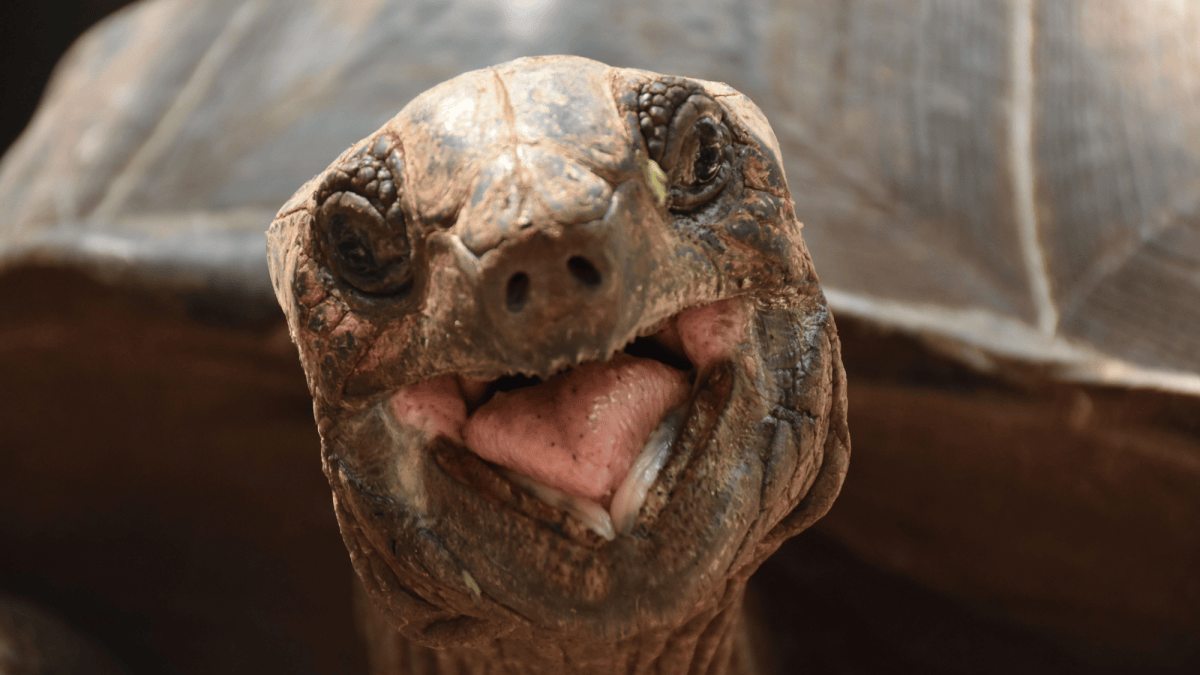
A giant tortoise at Changuu Island in Zanzibar, Tanzania on August 10, 2019. The island hosts a population of Aldabra giant tortoises, one of the largest tortoises in the world. Image: Recep Bilek/Anadolu Agency via Getty Images As Joanthan the Aldabra giant tortoise (Aldabrachelys gigantea) approaches his 195th birthday this December, there is some good news for his fellow tortoises. The previously endangered species is thriving and stable in the Seychelles, according to a study published this week in the journal Ecology and Evolution. Aldabra giant tortoises are one of the world’s largest land tortoises. They weigh up to 550 pounds and live 150 years. These gentle giants are native to Aldabra Island, one of the Seychelles northeast of Madagascar in the Indian Ocean. They are also found in the Galápagos, but the population on Aldabra here is much smaller. As the largest animal on Aldabra, they play an ecological role that is similar to elephants. Tortoises are the main consumers of vegetation and will change the habitat while searching for food. They will knock over small trees and shrubs all to get those nutritious leaves. Any seeds not digested will pass through the tortoise’s digestive tract and become food for many other animals. To check on the population at Aldabra, a team from the University of Exeter in England and the Seychelles Islands Foundation Aldabra analyzed giant tortoise counts collected between 2018 and 2022 on Aldabra Atoll. They found that the population currently stands at approximately 180,000 individuals. The survey is the first rigorous, atoll-wide estimate of the population and the first update since the late 1990s. At the time, it was believed that about 100,000 tortoises were living on the island. “More than 180,000 giant tortoises roaming freely on our atoll is proof of what long-term commitment to conservation can achieve,” Frauke Fleischer-Dogley, a study co-author and the CEO of the Seychelles Island Foundation, said in a statement. “This is wonderful news for Seychelles, for the world, and for everyone who has worked to protect Aldabra.” The team found that the population was relatively stable during the survey period, with a best estimate of almost 183,000 adult and sub-adult tortoises. This number is a far cry from the 19th century. Heavy exploitation and overhunting reduced Aldabra’s tortoises to fewer than 1,000 individuals. Aldabra became a strict nature reserve in 1981 and a UNESCO site in 1982, and these and other conservation measures have helped them rebound. Giant tortoises grazing in large numbers on Aldabra Atoll. Image: Dennis Hanse. “Aldabra’s giant tortoise monitoring programme is one of the longest running in the region, but the atoll’s dense vegetation makes counting tortoises genuinely difficult in places,” added study co-author and University of Exeter biologist Nancy Bunbury. “By modelling what we didn’t see, as well as what we did, we’ve produced the most reliable baseline yet for this iconic Seychelles species, establishing a benchmark we can use to track the population for decades to come.” However, the team cautions that this new figure does not mean that the population has nearly doubled since 1999. The earlier surveys did not account for tortoises present on the atoll, but not seen by surveyors, and were possibly hidden in dense scrub or shade. This new survey took advantage of a more sophisticated statistical technique called Bayesian hierarchical distance sampling. It corrects for both missed animals and for differences in visibility across habitats. Since these earlier methods likely missed tortoises, the team suggests that previous figures were probably underestimated. At the same time, the population has genuinely grown and now appears healthy and stable. The study also found that tortoises are at the highest densities in Aldabra’s grasslands, aka “tortoise turf.” They also are often found on open exposed surfaces and in open mixed scrub. The reptiles were harder to detect in dense scrub, mangrove, and habitats covered in a shrubby plant called Pemphis. The new modelling helped correct for reduced visibility from the scrub, Pemphis, and mangrove. Even with this welcome good news, the team says that vigilance remains essential. Aldabra’s climate is changing, and seeing longer and more frequent droughts. Scientists suspect that these serious dry spells will reduce the shade and food available to tortoises, and rising sea levels threaten low-lying parts of the atoll. The tortoises are also threatened by invasive mammals. Though feral goats were eradicated in 2012, cats and black rats will still eat tortoise eggs and hatchlings. While there are plans to eradicate the rest of these invasive species, reduced eggs could hinder further population growth. “These results are great news for the tortoises and testament to the fantastic work done in the field,” added study co-author and University of Exeter, Cornwall statistical ecologist Dave Hudson. “But it’s important to remember that the numbers provide a baseline – not an endpoint. Hopefully we have provided the conservation managers the evidence they need to track future change and act early as the tortoises face increasing pressures from climate change, drought and invasive species.” 2026 Popular Science Home of the Future Awards 39 products that will improve your everyday life.
Giant tortoises now outnumber people in the Seychelles
Full Article
Original Source
Read the full article at Popsci →KhanList aggregates and links to publicly available news content. We do not host full articles from third-party sources. Always verify important information with original sources.