
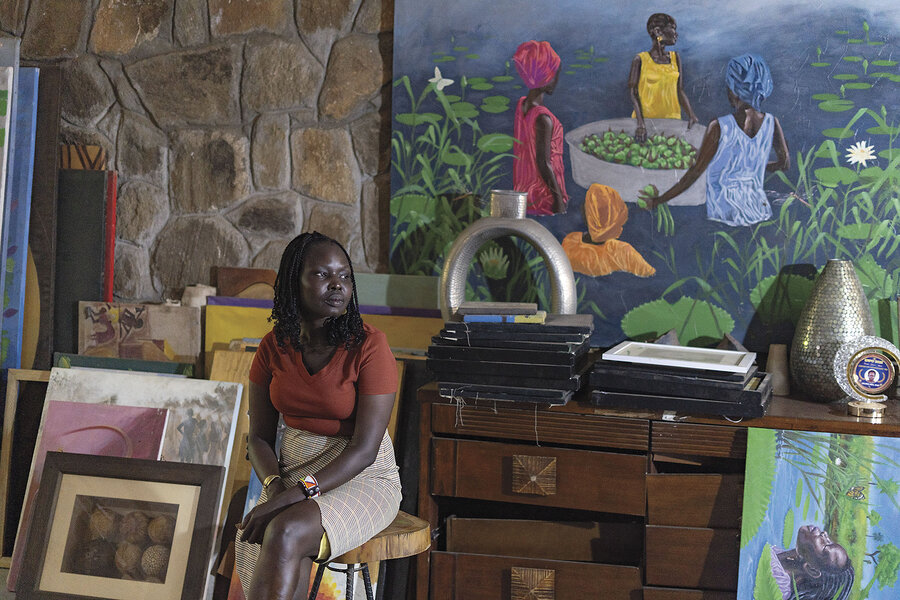
Juba, South Sudan | Oct. 09, 2026, 1:21 p.m. ET | 5 min read At The Baobab House one recent afternoon, entrepreneurs, aid workers, and artists of all kinds are mingling in Arabic and English. Two friends are playing chess, while a laptop is open on another table. The whole time, music plays softly from speakers, and red hibiscus juice flows from pitchers into tall glasses.Abul Oyay Deng Ajak moves gracefully among the crowd, stopping for a chat or rearranging pink bougainvilleas in a vase. For her, The Baobab House is home. But it is also an art gallery and a gathering place during lingering political instability in the world’s youngest country.“I have no privacy,” Ms. Oyay says, laughing. “It’s my home that I share with people.” She adds that The Baobab House is about “people getting together, talking about their daily life and what they go through.” When Ms. Oyay moved into The Baobab House in 2019, there was no grand plan for the small redbrick home with a large, leafy tree standing in the courtyard. Ms. Oyay, herself an artist, had found the house for rent while searching for a studio with Andreea Campeanu, a Romanian photographer friend who was covering the aftermath of South Sudan’s civil war. They organized concerts, art workshops, and exhibitions – and the visitors began coming.Ms. Oyay “has an incredible talent for gathering people around her and making them feel welcome,” says Ms. Campeanu, who is now back in Bucharest. “It was amazing to live there and see [The Baobab House] grow around us.” Paloma Laudet/Special to The Christian Science MonitorThe Baobab House is a small redbrick home named after a large, leafy tree standing in the courtyard. “Art really helped me”Ms. Oyay was born in Ethiopia’s Gambella region and grew up between Sudan and Uganda. Her mother is Ethiopian, and her father is from Malakal, which was still part of Sudan when she was born. He is from the Shilluk ethnic group, while Ms. Oyay’s stepmother, who helped to raise her, is Dinka.“I identify as a South Sudanese myself,” Ms. Oyay says. War entered the intimate spaces of her life. As a child, she was separated from her mother amid the conflict. “My father had to flee,” she notes. He was part of the Sudan People’s Liberation Army, which fought against the government in Khartoum for greater autonomy and, eventually, independence for southern Sudan.Her paternal grandmother, who made traditional crafts, became one of the most important figures in her childhood. Ms. Oyay says those memories helped her to think about art as a way of preserving knowledge and transmitting it from one generation to another.One of Ms. Oyay’s paintings, “Women With Water Lilies,” reaches back to those memories. During war and periods of famine, water lilies were food. “With my grandmother, we used to go and pick them,” she explains. “In the picture, it’s us.”After completing her schooling in Uganda’s capital, Kampala, she was admitted to Richmond American University London, where she studied political economy. She later went on to pursue a master’s degree in peace and conflict studies in Nairobi. Paloma Laudet/Special to The Christian Science MonitorBooks rest on the shelves, and artwork lines the walls at The Baobab House. South Sudan became independent July 9, 2011. For Ms. Oyay, this meant that returning home permanently finally seemed possible, so she resettled there two years later. But a week before she was supposed to start working at a Finnish company that supplied services and equipment to oil and energy markets, a crisis broke out again. Soon came full-fledged war.Her father was accused of having taken part in a coup attempt. “I was in the house when they came to arrest him,” she recalls. Ms. Oyay eventually found herself back in Kampala. There, she met artists who worked in a small studio. They gave her materials, taught her techniques, and encouraged her to paint. She started experimenting with unconventional art materials, including hibiscus flowers and coffee beans.“Art really helped me,” she recalls. “I was able to get away from sitting at home in misery.”Her father was freed after six months but still can’t return to his birthplace, out of fear for his safety. Ms. Oyay eventually came back to Juba in 2018, as a new peace deal was being negotiated. By then, millions of people had been displaced again by a five-year war that claimed hundreds of thousands of lives. Paloma Laudet/Special to The Christian Science MonitorIn The Baobab House’s garden, works by various South Sudanese artists are exhibited as part of a special event. Security and belongingFor Bonslow Silas, a South Sudanese artist who grew up in a refugee camp in Kenya, The Baobab House is “a place that feels like you belong.”In the paintings and drawings he exhibited at Baobab House in August, cows are the central focus. Cattle represent a source of wealth in the country and play an important role in cultural traditions.“All my feelings are in my canvases,” Mr. Silas says. “The war, and everything that is going on here, can’t be an excuse not to create.” Simmons Poet, who writes poems that reflect on real-life struggles, says, “It is a space where we feel safe. We are able to come here and let go.”In a country where freedom of expression is often restricted, this kind of space is rare. Mr. Poet says he has held many performances at Baobab. A few months ago, Baobab held a workshop, with a Kenyan poet, on how to perform and market art in South Sudan.Visual artist Juma Morris is another regular. He was first forced from his home as a child during South Sudan’s struggle for independence, eventually settling in Sudan’s capital, Khartoum. Decades later, in 2023, a new war broke out in Sudan. Displaced once again, he found himself back in his homeland and settled in Juba. “Going to Baobab is like recharging a battery after it has run low,” he says. “Many artists lose hope in time of war. But Abul inspires young people and opens opportunities for them.” Paloma Laudet/Special to The Christian Science MonitorThe garden is a popular spot for South Sudanese to gather and mingle. South Sudan has been drastically affected by cuts in the funding of international nongovernmental organizations, so keeping a space such as Baobab House alive is becoming harder. With nonprofit aid groups pulling out, “nobody is buying art, everyone is struggling,” Ms. Oyay notes.Ms. Oyay’s work often portrays the deeply wrinkled faces of older South Sudanese women. She is looking back at daily life in South Sudan, with all of the scars left by conflict and the pressures placed on women by tradition, poverty, and social expectations.She herself feels the fatigue and, sometimes, disappointment about what could have been. “Some of us are just moving back abroad,” she says. “Because, unfortunately, it seems that we are not ready for peace.” Deepen your worldviewwith Monitor Highlights.Politics with respectGet political stories with respectful analysis.There‘s a world of new ideas in everyBooks newsletter.There‘s more to life, enrich yours withCulture & Learning weekly.Follow humanity‘s discoveries withScience & Nature stories in your inbox.Gain a spiritual perspectivefrom the stories in your inbox.Want to understand the deeper impact of critical events? Learn the Monitor‘s insight.Already a subscriber? Log in to hide ads. Still, every day, the lights are on at The Baobab House, music spills across the yard, and the visitors keep coming. Like Ms. Oyay, they feel at home here.This article was reported with support from the Pulitzer Center. ALREADY A SUBSCRIBER? LoginReal news can be honest, hopeful, credible, constructive.The Christian Science Monitor was founded in 1908 to lift the standard of journalism and uplift humanity. We aim to “speak the truth in love.” Our goal is not to tell you what to think, but to give you the essential knowledge and understanding to come to your own intelligent conclusions. Join us in this mission by subscribing.
While conflict persists in South Sudan, her home is where the art is
Full Article
Original Source
Read the full article at Csmonitor →KhanList aggregates and links to publicly available news content. We do not host full articles from third-party sources. Always verify important information with original sources.