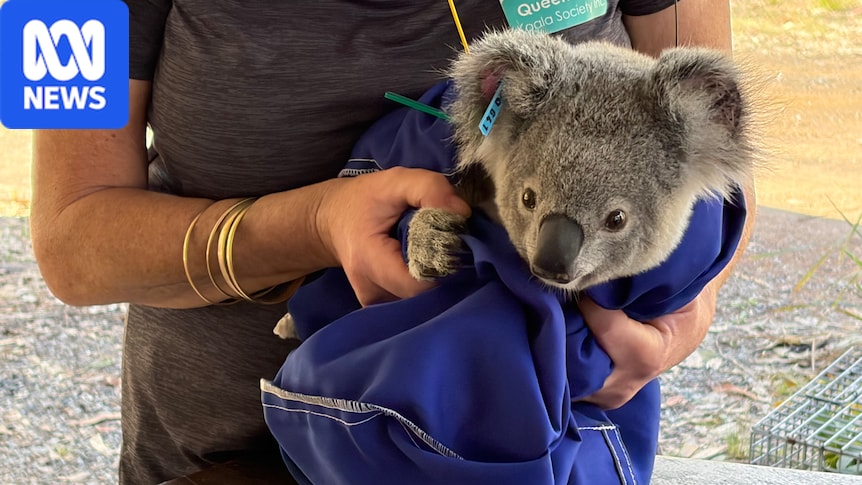
Thermal drones and innovative tracking collars are a "game-changer" for researchers who are addressing declining koala populations across south-east Queensland.Using the technology, they can detect multiple koalas in a day and respond sooner if the animal is sick or injured."We get up early in the morning when there's really good differential between the cool forest and the koalas' heat, and the thermal camera on the drone just glows if you happen to fly over a koala," University of Queensland researcher Dr Sean FitzGibbon said.It's a far cry from how they used to find koalas, just eight years ago."We would go out spotlighting at night with torches looking for eye shine and we would spend days fanned out in a line walking through the bush, tediously looking up trying to spot one," Dr FitzGibbon said."This is way more efficient and means we can get a lot more done."Researchers use an app to monitor the locations of koalas in real-time. (Supplied)Innovative tracking collars are also helping to boost conservation efforts because it allows researchers to monitor the movements of koalas in real-time.The solar-powered, remote system weighs just 20 grams and provides location data which is sent to a mobile phone about four times a day."It's an important advancement in animal welfare … a few times it's saved koalas lives where we found a sick koala that might've died in a few days if we hadn't responded to the GPS signal," Dr FitzGibbon said.Technology helps koala repopulation programThe technology is being used to monitor koalas across south-east Queensland but has been particularly effective in the Brisbane Koala Bushlands at Burbank, where a program is underway to address the declining population.The field-based research program aims to treat sick koalas one-by-one, while supplementing the current population with healthy youngsters.Veterinarian Dr Amber Gillett is part of a program to boost koala numbers at Burbank, in Brisbane's south-east. (ABC News: Liz Gwynn)"We need to act quickly in terms of removing diseased animals, treating what we can and then helping with new genetics and new animals to come in as breeding animals," UQ research fellow and veterinarian Dr Amber Gillett said."We're now trying to bring it full circle because we've seen the population crash and we are hoping it will climb again."Researchers release healthy koalas wearing innovative tracking collars so their movements can be monitored daily on an app. (ABC News: Liz Gwynn)Deliah, is among several young koalas that have been relocated after she was rescued from the Whites Hill Reserve area in Brisbane."They come in for various reasons but almost always they are sub-adult koalas that are trying to find new habitat," Dr FitzGibbon said."So then those little ones cross roads, walk into backyards with dogs or trip into swimming pools … we've had all of those types of koalas rescued and released at this site."A major project is underway to bring back the koala population in the Burbank bushland which has suffered massive losses in the past 20-30 years. (ABC News: Liz Gwynn)Portable vet clinicChlamydia is the biggest threat to koalas at Burbank, which is why every koala found is examined and treated, while briefly anaesthetised, to determine whether the animal can be released back into the wild or whether it needs to go into care.This is all done on site, thanks to a retrofitted caravan which acts as a portable vet clinic.Dr Gillett assesses and treats koalas in a mobile vet clinic. (ABC News: Liz Gwynn)"I can do bloods, I've got a microscope, I've got blood spinners which means I can do all of that in the field, so I have a really good handle on what's going on with the koala," Dr Gillett said."That reduces stress on the koala and reduces the impact on the wildlife hospitals that are always really busy."Chlamydia is the biggest threat to koalas at Burbank. (ABC News: Liz Gwynn)The program, which is a collaboration with the Brisbane City Council, the Queensland government, wildlife rescue groups and animal hospitals, has been running for 18 months and has already led to the birth of two joeys."It's like almost giving birth to my own child in some ways, you are responsible for bringing that animal in and then you see that result," Dr Gillett said."We bring in the right animals and we give them the environment and they can do it themselves, they will bolster their own population."
'Game-changer': Tracking collars help monitor vulnerable koala populations
Full Article
Original Source
Read the full article at Abc →KhanList aggregates and links to publicly available news content. We do not host full articles from third-party sources. Always verify important information with original sources.