The US military campaign to protect merchant shipping from Iranian attacks by asserting direct maritime control in the strait of Hormuz is not an idea unique to Donald Trump’s administration. Almost exactly 200 years ago, in the period 1825-27, a powerful US naval squadron led by Commodore John Rodgers was sent to the Mediterranean to defend American ships from the depredations of Greek corsairs and pirates.For all the new-minted republic’s brave talk of liberty, the US squadron did not assist Greece’s ongoing “regime change” struggle for independence from the Ottoman empire. Its sole, self-serving purpose was to defend US trade, markets and business interests. After abandoning his call for a people’s revolution in Tehran, this, too, is what Trump’s reckless war with Iran has now boiled down to.Although the US has not ratified the 1982 UN convention on the law of the sea, which establishes a legal right of freedom of passage without interference by littoral states, it has historically upheld the principle of freedom of navigation or mare liberum (the free sea) developed by Hugo Grotius, a 17th-century Dutch jurist. Rejecting Iran’s claims, Marco Rubio, US secretary of state, declared in June that “no country is allowed to charge tolls or fees on an international waterway”.Yet Trump has since suggested the US itself may yet do exactly that and impose tolls. Although he later rowed back, last month’s “memorandum of understanding” with Iran accepts that it has a right, with Oman, to monetise transit through the strait of Hormuz. Despite the resumption of US attacks and Trump’s increasingly hysterical threats, the MOU currently remains the only basis for a future peace deal.Two-faced Trump’s equivocal stance reflects a wider breakdown in the “free sea” consensus underpinning maritime law – and hastens the overall degradation of the international rules-based order. Trump believes nation states (or at least the US) have an absolute right to act unilaterally in their own interests, unconstrained by laws, treaties or regard for the “global commons” of the high seas.The destabilising ramifications of this approach, emulated by other countries, grow clearer by the day. This new 21st-century war of the sea does not involve titanic clashes between Bismarck-class battleships or huge naval showdowns such as Jutland and Midway. But its frontlines are the same as ever: defence, security, borders, free trade, money, power.Today’s war of the sea has many aspects. One is the spreading impact of precedents set by the Hormuz standoff. In Yemen, Iran-aligned Houthi militias have begun a copycat blockade of the Bab al-Mandab strait, at the mouth of the Red Sea, in reprisal, they claim, for attacks by Saudi Arabia. Two oil tankers were struck this week, further spooking energy markets and presaging wider escalation.Also potentially fatal for international norms is the post-Hormuz debate in Indonesia about imposing tolls in the strait of Malacca, through which 22% of global maritime shipping passes. Might Turkey adopt the US-Iran approach and charge for passage through the Bosphorus? Or Spain in the strait of Gibraltar? The dire implications for global trade and supply chains are obvious. About 80% of goods traded worldwide by volume go by sea.Friction over seaborne trade aside, overt maritime clashes between regional rivals are increasing, particularly in the South China Sea and the waters around Taiwan. Expansionist China’s creation of artificial, militarised islands on obscure reefs and sporadic confrontations with neighbours such as the Philippines are the root cause. Like the US, Beijing rejects international law when it doesn’t suit it – notably the 2016 ruling by the permanent court of arbitration, which found its claim to sovereignty over most of the South China Sea lacked a legal basis.China crossed another red line last week when one of its missile destroyers undertook a live-fire drill inside Japan’s exclusive economic zone, about 180km (110 miles) from Okinotori, Japan’s southernmost island. Tokyo and Beijing have longstanding maritime disputes. But tensions rose sharply after Japan’s new prime minister, Sanae Takaichi, suggested a Chinese bid to seize Taiwan could trigger a Japanese military response. Few weeks go by without reports of Chinese air and sea exercises in preparation for a not-so-hypothetical amphibious assault on Taiwan.The fact a Russian frigate accompanied the offending Chinese warship off Japan points to another major actor in the global war of the sea. Vladimir Putin’s once-vaunted Black Sea fleet has suffered severe losses, caused by Ukraine’s missiles and drones, since 2022. Its ships no longer control the Black Sea, mostly cowering in port. As if to compensate, hybrid “grey zone” Russian military maritime operations against Ukraine’s European allies are expanding. Baltic undersea pipelines and communications cables have proven vulnerable targets.Russia has also stepped up surface fleet and submarine activities in the North Atlantic approaches, the North Sea and the Channel, where it is suspected of mapping underwater infrastructure with a view to future sabotage. Last Monday, one of its warships went a step further, marking Andy Burnham’s first day as UK prime minister with a rare live-fire drill 70kn (45 miles) south of Plymouth, home of the Royal Navy.It was the latest in a string of hostile actions designed to provoke, intimidate and test British and European defences. Last month, a Russian frigate fired warning shots near a private yacht off the Isle of Wight. The incident seems trivial until it is set in the wider context of a rapidly building Nato-Russia at-sea confrontation. Then it begins to look scary.skip past newsletter promotionafter newsletter promotionThe sense of increasing inter-state maritime lawlessness is fed by numerous other recent incidents, such as the unlawful US sinking of an Iranian warship off Sri Lanka in March, last week’s bitter clash between Chinese and Philippine ships, Trump’s revived threats to forcibly annex the Danish-owned island of Greenland and his bombing of civilian boats off Venezuela. A Chinese nuclear submarine test-fired a long-range ballistic missile in the South Pacific this month to the outrage of Australia, which is itself acquiring nuclear-powered subs.US submarine sinks Iranian warship near coast of Sri Lanka – videoAll this instability is fuelling an accelerating global arms race. Little wonder Burnham’s revamped government faces pressure to greatly increase defence spending, especially on the badly depleted Royal Navy. Current UK plans include upgrades to the Trident at-sea nuclear deterrent.This many-fronted war of the sea tells a bigger story still: of how centuries-old, hard-won maritime cooperation and collaboration protocols are breaking down, of how international legal norms and rules – whether the issue is free trade, offshore defence, sovereignty, borders, fisheries, deep-sea mining or environmental pollution – are sinking beneath the waves.It’s a story about a world where one country can impose its will on others less powerful and less wealthy, rather than seeking their agreement; where the fundamental concept of global commons or shared space is shot to hell. It’s about Lord Palmerston-style gunboat diplomacy writ large. It’s about a world all at sea. Simon Tisdall is a Guardian foreign affairs commentator
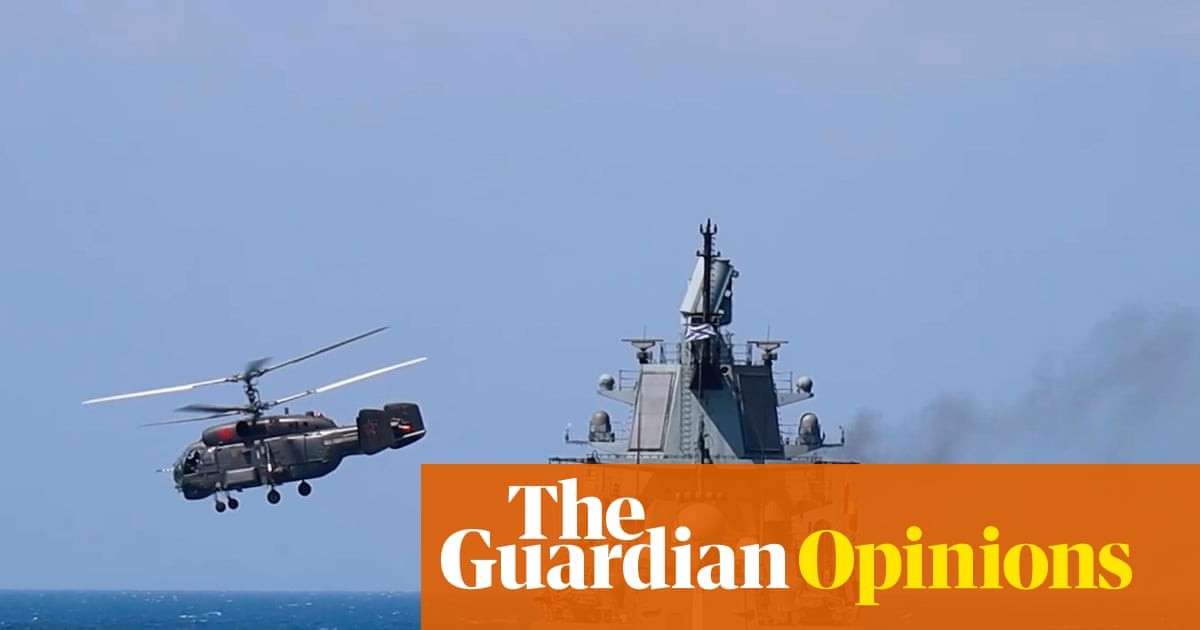
From the strait of Hormuz to the North Sea, a global maritime war rages around us – and more than the price of oil is at stake | Simon Tisdall
Full Article
Original Source
Read the full article at Theguardian →KhanList aggregates and links to publicly available news content. We do not host full articles from third-party sources. Always verify important information with original sources.