
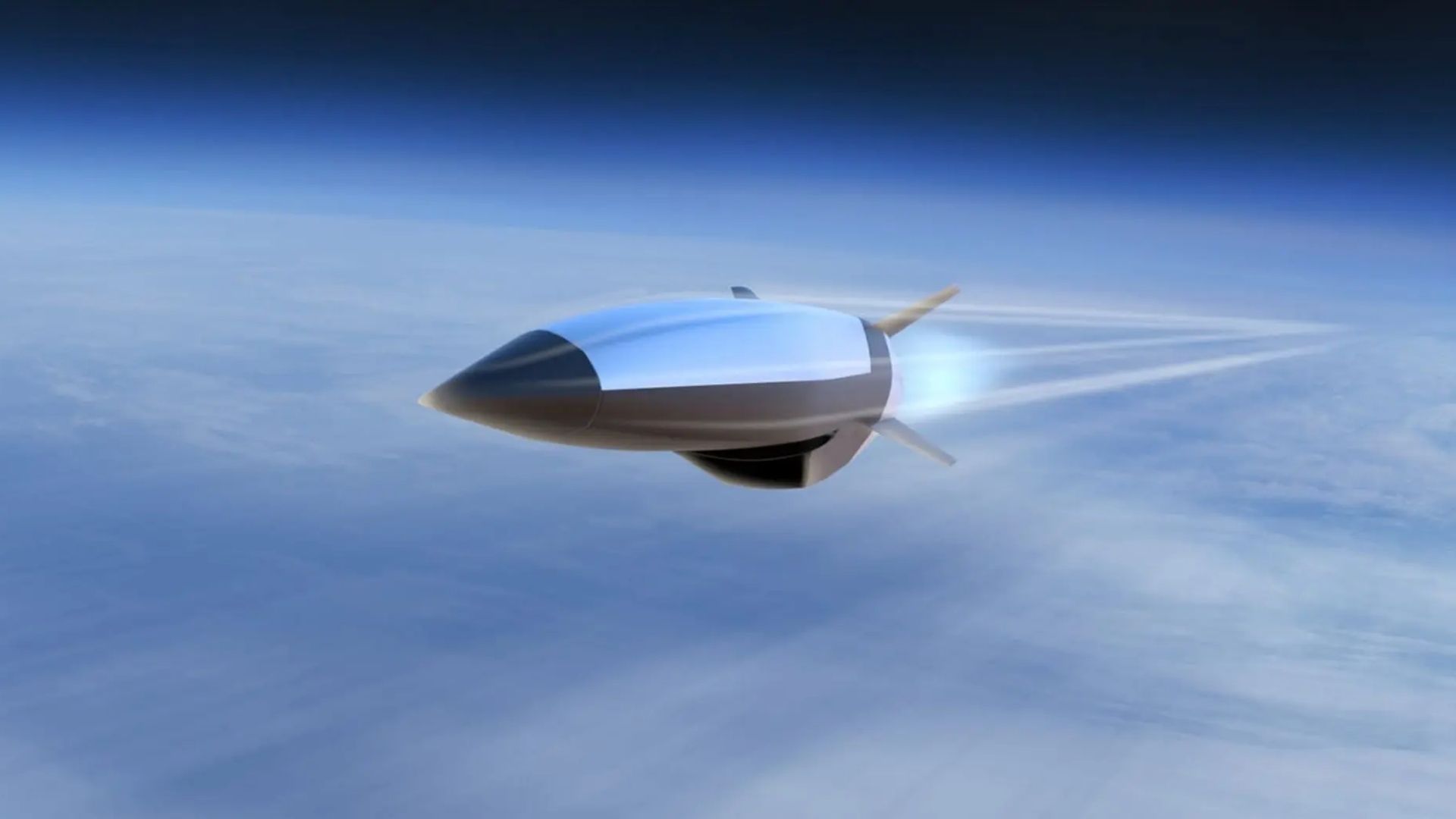
Hypersonic weapons are often described simply as missiles that travel at more than five times the speed of sound. But achieving that speed is only part of the challenge. A weapon must also survive extreme heat, control itself at high speed, and, in the case of a cruise missile, keep its engine operating while traveling through the atmosphere. That is the challenge behind the U.S. Air Force’s Hypersonic Attack Cruise Missile, or HACM. Unlike a boost-glide weapon, which uses a rocket to accelerate a glide vehicle before it travels largely without powered propulsion, HACM is designed to breathe air throughout its powered hypersonic cruise. Its propulsion system uses a scramjet, allowing the missile to maintain hypersonic speeds after its initial boost. What is HACM? HACM is an air-launched, scramjet-powered hypersonic missile being developed for the U.S. Air Force. The service awarded Raytheon a contract worth up to $985 million in 2022 to develop and demonstrate HACM prototypes. The program grew out of the U.S.-Australian Southern Cross Integrated Flight Research Experiment, or SCIFiRE, which explored air-breathing hypersonic cruise missile technology. The idea is to give aircraft another long-range weapon for attacking high-value or time-sensitive targets while keeping those aircraft farther from heavily defended areas. The Air Force has also described HACM as a weapon that could provide fighters with additional strike options while leaving bombers available for other missions. How does a scramjet work? A conventional jet engine uses rotating machinery to compress incoming air before mixing it with fuel and burning the mixture. A scramjet, short for supersonic combustion ramjet, works differently. At hypersonic speed, the missile itself forces air into the engine. The incoming airflow is compressed by the engine’s geometry rather than by a conventional compressor. Fuel is then injected and burned while the airflow remains supersonic inside the combustion chamber. A scramjet does not need to carry an oxidizer in the way a rocket does. It takes oxygen from the atmosphere, allowing more of the missile’s internal volume and mass to be devoted to fuel and other components. But there is a catch. A scramjet generally cannot take a missile from a standstill to hypersonic speed by itself. HACM therefore requires another propulsion stage to get it moving fast enough for the scramjet to operate effectively. DARPA’s earlier Hypersonic Air-breathing Weapon Concept, or HAWC, demonstrated this basic approach. In a 2021 flight, a HAWC vehicle was released from an aircraft, its booster accelerated it, and a scramjet then took over and drove it beyond Mach 5. Why is Mach 5 so difficult? At Mach 5, the air around a vehicle becomes extremely hot as it compresses and is disturbed by the vehicle’s movement. That creates a major materials and thermal-management problem. The missile must simultaneously maintain aerodynamic stability, protect its internal components, and operate an engine in an environment where airflow is moving extraordinarily quickly. DARPA’s HAWC program identified several of the same fundamental challenges: efficient hypersonic vehicle designs, hydrocarbon-fueled scramjets, management of high-temperature stresses, and manufacturing approaches that could make such weapons affordable. Earlier U.S. programs have demonstrated that basic physics can work. In 2023, the Lockheed Martin version of HAWC flew faster than Mach 5, above 60,000 feet and over 300 nautical miles, providing data for subsequent Air Force hypersonic programs. How is HACM different from a hypersonic glide vehicle? The simplest distinction is powered flight versus unpowered glide. A hypersonic glide vehicle is accelerated to high speed by a rocket booster and then separates to glide through the atmosphere. HACM, by contrast, is intended to continue producing thrust during its hypersonic cruise using its scramjet. That gives the two concepts different aerodynamic and propulsion requirements. A cruise missile can maneuver throughout its powered flight. At the same time, its engine continues operating, whereas a boost-glide weapon relies on the energy and trajectory established during its boost phase. The Air Force is pursuing both approaches because they can serve different operational roles. What aircraft could carry HACM? The Air Force has emphasized fighter integration for HACM. The F-15EX Eagle II is particularly relevant because the aircraft was designed with a large weapons capacity and has been described by the Air Force as capable of carrying hypersonic weapons. Air Force units flying the B-1, B-2, B-52, and F-15E also participated in hypersonic weapons familiarization training that specifically included HACM in 2023. The ability to launch a hypersonic weapon from an aircraft adds another layer to its potential reach. The missile does not have to accelerate from the ground, allowing the launch aircraft to contribute altitude and speed before the weapon begins its own flight. When could HACM enter service? The program has moved beyond the early technology-demonstration phase. The Air Force initially planned to deliver a HACM capability with operational utility by fiscal year 2027. More recent Air Force budget documents show HACM receiving substantial continued development and procurement funding. The FY2027 procurement documents classify planned U.S. quantities; however, the public records do not provide a reliable number of missiles being purchased. That makes HACM less about simply proving that a scramjet can fly at Mach 5 and more about turning years of hypersonic research into a repeatable weapon system that can eventually be produced and deployed. The central challenge is therefore no longer just speed. It is building a hypersonic cruise missile that can fly fast, survive the heat, maneuver, hit its target, and be manufactured in useful numbers. Get the latest in engineering, tech, space & science - delivered daily to your inbox.Kaif Shaikh is a journalist and writer passionate about turning complex information into clear, impactful stories. His writing covers technology, sustainability, geopolitics, and occasionally fiction. A graduate in Journalism and Mass Communication, his work has appeared in the Times of India and beyond. After a near-fatal experience, Kaif began seeing both stories and silences differently. Outside work, he juggles far too many projects and passions, but always makes time to read, reflect, and hold onto the thread of wonder.
From rocket boost to scramjet cruise, here’s how America’s HACM could fly at Mach 5+
Full Article
Original Source
Read the full article at Interestingengineering →KhanList aggregates and links to publicly available news content. We do not host full articles from third-party sources. Always verify important information with original sources.