
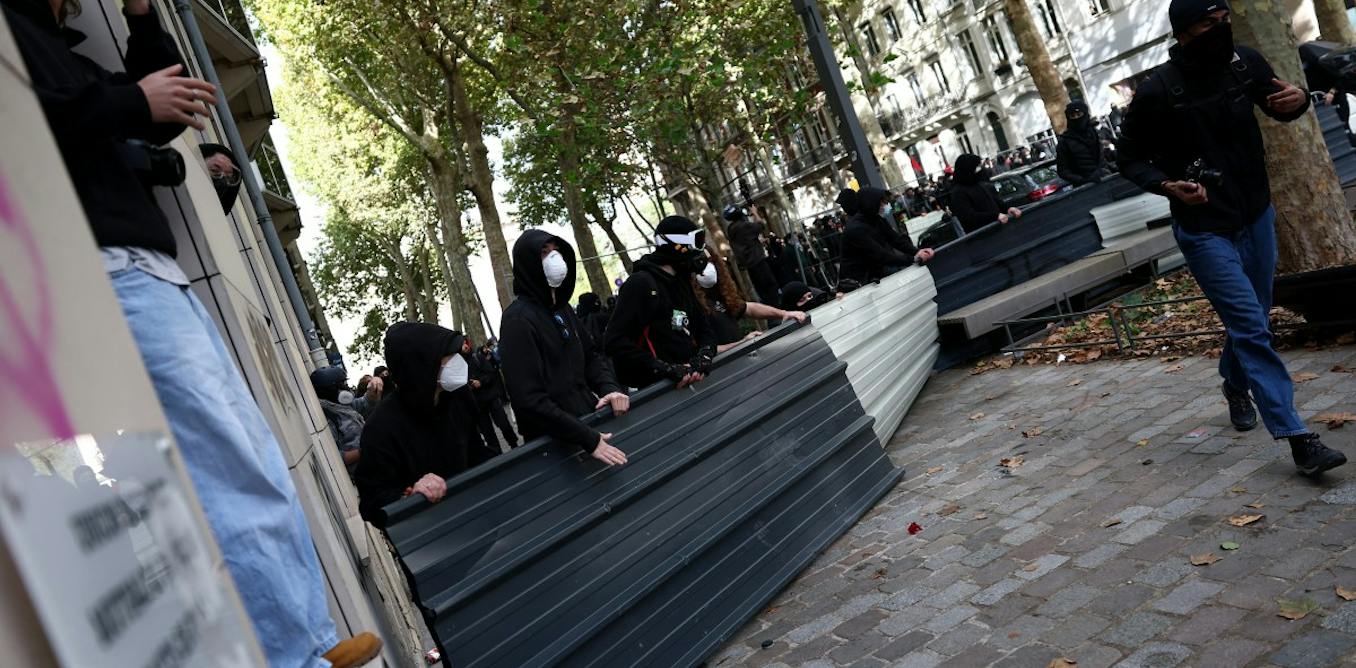
KEY TAKEAWAYS In 2020, during the Covid-19 pandemic, the French government initially discouraged people from wearing face masks that it could not provide, before imposing them first on middle and high schools at the start of the school year, then on elementary schools. In the recent student uprisings, protesters have been using surgical and ‘FFP2’ face masks to protect themselves from tear gas and cover their faces. Prefects in France have banned protective wear and equipment from demonstrations; while the Council of State validated the ban, it stated that it does not apply to surgical and FFP2 masks. On March 20, 2020, Sibeth Ndiaye, then a government spokesperson, stated that she was not able to use a mask. Wearing a mask, she explained, involved “precise technical gestures”. At the start of the 2020 school year, the government made masks mandatory in French middle and high schools then, in November, the measure was applied from elementary school. State property Masks embody many missteps and many demands. As a geographer who pays particular attention to how objects are used and their fate, but also as a teacher, I am struck by everything that a small rectangular piece of material made of plastic fibres incarnates today. To understand how far they have come, let’s start with the shortage of masks. In 2009-2010, the French government had a strategic supply of one billion surgical face masks and 700 million FFP2 variants (these filter masks are a respiratory protection mask with or without exhalation valves that are more protective than surgical masks). Due to a lack of replenishment, at the beginning of 2020 there were only 117 million surgical masks left and no provisions for a strategic supply of FFP2 masks. On March 4, 2020, the same spokesperson for the government still assured that there was no “risk of a shortage”. The very same day, a decree requisitioned mask stocks, reserving them for health professionals and patients. For weeks, the government encouraged the population to refrain from wearing the protective masks that it couldn’t provide, a message that the Tribunal Administratif de Paris found to be at fault in 2022, in light of what the French Senate’s inquiry commission deemed a “knowingly concealed” short supply. Then ensued a volte-face. In the spring of 2020, people were ordered to wear masks on public transport, then in closed public spaces in the summer, and in schools at the start of the school year. The object deemed unnecessary has become mandatory. From that moment on, and for nearly a year and a half, millions of students learned how to wear masks, adjust them and talk with them. The anthropologist Marcel Mauss noted in his 1936 article “Les techniques du corps” that bodily gestures are learned from those we trust, who have authority and that the act “is imposed from outside, from above”. In 2020, wearing face masks was introduced via rules and sanctions applicable to adults and in schools for millions of children. It is precisely this trust in authority, through which gestures are passed on, that the State has since lost among part of the youth. An object associated with the weak It has to be said that the mask never really left the faces of part of Gen Z (young people born roughly between the late 1990s and early 2010s). Masks were still used by those who wanted to escape from view. In Japan, in 2023, nearly half of 15-19-year-olds who wanted to keep their masks did so out of “shyness”, and similar phenomena are being observed in Belgium or Quebec, and also in France, even in my classrooms. We can deduce that the mask discreetly survived the pandemic before returning in force to the streets over the course of the youth-led protest action. Since the start of the 2026-27 academic year in September, masks have featured at high school blockades and during mass protest days where protesters are covering their faces with them or keeping them in their bags, following recommendations found in mini guides for activists, which are circulating profusely on social media. Face masks serve a dual purpose: protecting people from tear gas and allowing them to hide their faces during demonstrations, where footage captured on video and relayed on line reigns supreme. Law, on the other hand, isn’t quite so clear-cut on the matter. In early October, several prefects prohibited protective equipment near high schools, with the prefect of the Hérault (Southern France) even targeting “filter masks”. An urgent order from the Council of State approved the ban, while specifying that it didn’t apply to surgical masks or FFP2 masks. An item that the government had once imposed on the population now escapes today’s ban in principle, but this is not always the case on the street: in Paris, on October 17, protesters had their surgical masks confiscated. In this respect, surgical masks or FFP2 masks play on the legacy left by Covid-19. Before 2020, the public authorities equated covered faces with rioters, to the point of making it a criminal offence in 2019. After months of seeing masks being worn so widely, they have blended into the background, and now the administration has the difficult task of attributing an intention to them. The way masks are used today reflects what French intellectual Michel de Certeau, in his book The Practice of Everyday life (1980) called “tactics” as opposed to the “strategies” of institutions, “the art of the weak”: turning against the state the very object it went to great lengths to impose. A generational object The youth-led uprisings in France in 2026 are not an isolated case. From Kenya in 2024, where I was conducting my research, to Nepal, Madagascar or Morocco, Gen Z are taking action across the globe. Movements are being organised without clearly identified leaders, via messaging platforms under pseudonyms. On the street, masks are an extension of what pseudonyms offer users online. We protest much like we navigate online, leaving little trace behind us. This generation in many countries, and almost simultaneously, is also the first generation to have had the same bodily training what Mauss called “Techniques of the body”. Following the recommendations of the World Health Organization (WHO) and UNICEF, between 2020 and 2022, a very large number of states made schoolchildren and high school students wear face masks. Rarely has an object been imposed with such simultaneity and by the public authorities themselves. The pandemic was global; the movements we are witnessing are global too, and are occurring in the South as well as the North. If there is one object that has unified this generation, it is this small piece of blue, black or white plastic fibres. In France’s case, in just six years, masks have come to embody the improvidence of the state, the rule imposed on everyone in the name of public health and, more recently, young people’s mistrust. A weekly e-mail in English featuring expertise from scholars and researchers. It provides an introduction to the diversity of research coming out of the continent and considers some of the key issues facing European countries. Get the newsletter!
From Kenya to France: how face masks are becoming a rallying symbol
Full Article
Original Source
Read the full article at Theconversation →KhanList aggregates and links to publicly available news content. We do not host full articles from third-party sources. Always verify important information with original sources.