
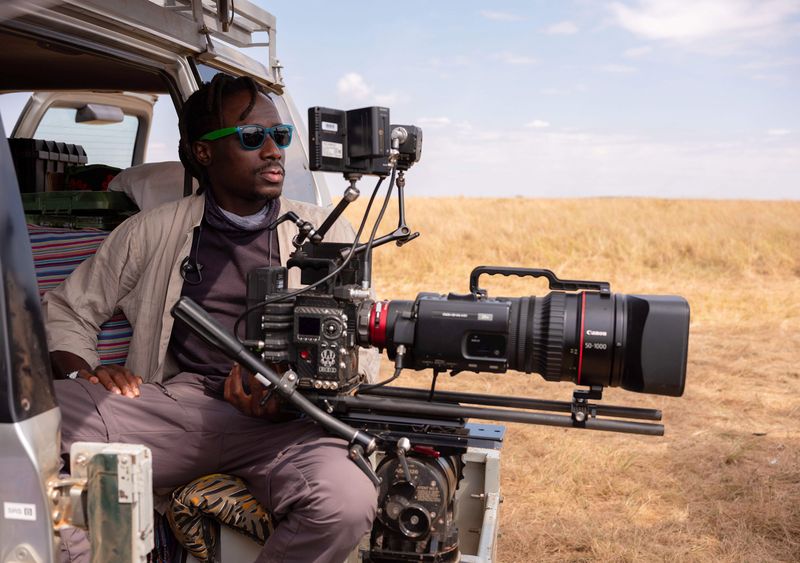
Manu Akatsa was filming two elephant families gathered at a waterhole when he noticed the tension. There was trumpeting, stomping and clouds of dust, but he could not tell what was happening. It was only when he later reviewed the footage with a scientist that he learnt what he had captured: a female elephant taking a calf from another family, a behaviour researchers call “elephant kidnapping”.Akatsa said that without the scientist’s help, he and his film crew would never have understood what they had filmed.At the recent 15th Oppenheimer Research Conference in Midrand Akatsa and fellow National Geographic Explorers discussed the relationship between science and storytelling in a panel titled Beyond the Lens: Reclaiming Africa’s Conservation Narrative. Their examples showed how collaboration can bring science to wider audiences, reveal the human stories behind environmental problems and challenge narrow ways Africans are often presented in conservation films.For Noel Kok, executive director of Nature, Environment & Wildlife Filmmakers (NEWF), changing those representations was one of the reasons the organisation was founded.In films set in Africa, he said, Africans were too often portrayed as “the poacher, the pirate, the ranger, the guide or our people who sing for tourists when they jump off the safari vehicle”.Beyond stereotypesKok said he was proud of the work done by people in hospitality, rangers and guides, but insisted that Africans were “so much more than that”.Changing the narrative, he argued, also meant changing who tells the story. When NEWF was founded, African nature, environment and wildlife filmmakers “were rarer than most of the species you guys were trying to protect on the continent”. The organisation has since grown into a community of 400 fellows across 37 African countries, 216 of whom are divers.But changing the storyteller is only part of the equation. Filmmakers need scientists who can help them understand the behaviour, ecosystems and research behind their subjects. Scientists, in turn, need storytellers who can make their findings accessible to people beyond their professional circles.“Science gives us knowledge, but storytelling gives that science a human journey,” Kok said. “When scientists and storytellers work together that knowledge will move away from the research realm and it will give people something that they can understand, something they can feel.”Noel and Pragna Kok, founders of Nature, Environment and Wildlife Filmmakers. (Photo: National Geographic Society / Anthony Ochieng Onyango) Following the scienceBeninese marine biologist Gérard Zinzindohoué’s experience illustrated what such a partnership can make possible.Zinzindohoué joined one of NEWF’s dive labs, hoping to learn to dive and reach an environment he had studied extensively but never seen. More than 60 years earlier, French researchers had documented deep-water coral reefs in Benin, but the research had not continued. Zinzindohoué wanted to establish whether the reefs still existed and what they could reveal to scientists today.Kok initially tried to persuade him to send a remotely operated vehicle down to collect samples. Zinzindohoué, however, wanted to learn to dive to 70m and retrieve them himself. A university in Germany had offered to carbon-date the samples.So the filmmakers followed him in his pursuit of answers. “We didn’t arrive to document a science story. We were invited to accompany him on a journey,” Kok said.Zinzindohoué needed access to diving and storytellers to pursue his research. The filmmakers, meanwhile, gained access to a conservation story they might otherwise never have encountered. A National Geographic grant supported the work, including efforts to capture the first images of the reefs.National Geographic explorer Gérard Zinzindohoué, left, with boat mechanic Samuel Dossa (centre) and fieldwork assistant Kingeraud Zinzindohoué after completing underwater drone surveys documenting mesophotic coral communities – reefs found at depths of roughly 30m to 150m – on the Benin continental shelf. (Photo: Hervé Ateminnou) For Kok, the distinction lies in what scientists and storytellers choose to communicate. Scientists are often encouraged to communicate their findings and conclusions. Storytellers, he said, are interested in the process: the questions, uncertainty and discoveries that make the journey worth following.Nancy Iraba encountered a similar divide early in her career. As a marine science student in Zanzibar, she wanted people to understand that her work extended beyond fish to the coral reefs, mangroves and livelihoods her research touched.She remembered the excitement of publishing her first scientific paper and sharing the news with her family.“I'm sure scientists in here can attest to how exciting it is when you get your first paper published. So I sent it to my family group, and my mom said, ‘Oh, it’s late. Please sleep’.”The response helped her recognise how little scientific work might mean to people outside the research community unless they could see its relevance to their lives. Scientists, she realised, often work in silos. That shift in thinking eventually led her to become a NEWF fellow.She now uses her science to support the conservation and restoration of degraded ecosystems along Tanzania’s southern coast.Nancy Iraba is a marine scientist, National Geographic Explorer and Tanzania’s first black female divemaster. She is widely recognised for her work in coral reef restoration. (Photo: Anthony Ochieng Onyango) Stories about her team’s work have travelled across borders and appeared in international media, raising awareness and helping attract resources to local communities, she said.For Iraba, reaching beyond scientific circles is especially important when researchers are seeking support for their work.“We keep on talking the gospel to the same people,” she said.Building relationships with storytellers, however, requires trust. Iraba recalled a scientist friend who became so frustrated after journalists took parts of her work out of context that she vowed never to work with them again.Iraba believes scientists should not respond by retreating further into their own disciplines. Instead, they need to invite journalists, writers and artists into their work and learn how to collaborate with them. But building those relationships takes time.Beyond the numbersFacilitating the session, Dr Kimberleigh Tommy, executive director for Africa at the National Geographic Society, noted that while climate change data was abundant, people’s lived experiences were often missing from mainstream narratives.“We know the data is there, but the lived experiences of people that would connect us a lot more to the issue is often missing,” she said.Kimberleigh Tommy guided the panel discussions on African perspectives in conservation storytelling. (Photo: Supplied / OGRC) At the recent 15th annual Oppenheimer Generations Research Conference, National Geographic Society Explorers discussed the importance of bringing science and storytelling together to tell African conservation stories. From left: Dr Kimberleigh Tommy, executive director of National Geographic Society in Africa; marine scientist, Nancy Iraba; Noel Kok, executive director of Nature, Environment and Wildlife Filmmakers; documentary filmmaker Manu Akatsa and visual artist and documentarian, Nyancho NwaNri. (Photo: Supplied / ORC) For Nyancho NwaNri, conservation stories need scientific data but should not end there.In a recently completed National Geographic project on freshwater scarcity in Cape Verde, she looked beyond the country’s annual rainfall of about 250mm to understand what water scarcity meant for the people living there.Aquifers were running low, and a tonne of water cost $12 against a minimum monthly wage of $150. Those figures established the scale of the problem, but NwaNri wanted to understand its daily consequences.“If you’re not getting water from the taps, you’re having to go somewhere to get the water,” she said. That could mean long walks and carrying heavy containers home.A researcher might ask how frequently water flowed from the taps or how many days residents went without a supply. NwaNri approached the problem differently.“I would ask as a storyteller, ‘Where does it hurt?’”Storytellers, NwaNri said, listen for people’s experiences, emotions, hopes and dreams, to reveal the human story behind an issue.In another project on logging and deforestation in Nigeria, she spoke to a logger who explained that he cut trees to survive and feed his family. Deforestation, in his account, was not simply about cutting trees. It was also about family, identity and the pressure to provide.Storytelling, NwaNri said, taps into the data, the community, the lived experiences and the emotions and “brings all of these points of connection together”. But recognising people’s motivations did not mean excusing environmental harm, added NwaNri. Rather, it means examining the pressures behind people’s actions, making it possible to tell a fuller story about why people act as they do and what might persuade them to act differently.Nyancho NwaNri speaks about going beyond the data to draw on community experiences, making conservation stories more engaging and accurate. (Photo: Supplied / OGRC) Kok made a similar point, arguing that conservation stories should get to know the people behind the statistics. A story about a poacher or a logger, he said, should ask who that person is, whether they have a family and what motivates their actions.“Storytelling and immersing yourself allows us to humanise conservation in so many ways,” he said.Filming decisions Akatsa explained that natural history productions require extensive research into animal behaviour before filming can begin. “We need to be able to show that there’s verifiable information and data that this particular animal behaviour is occurring frequently enough. And sometimes the rarer the animal behaviour, the higher the chances are for the show to be commissioned.”Scientists, he said, help crews determine what equipment they need, understand the terrain and decide how far away they should film to minimise interference with the animals. Their role continues throughout production. Elephants, for instance, can be difficult to tell apart, and filmmakers often need to follow particular individuals or families to maintain continuity. Researchers help identify animals, review footage and interpret behaviour that a filmmaker might otherwise overlook.Nature filmmakers often incorporate scientific knowledge into decisions about filming locations and equipment placement in the field to minimise disturbance to wildlife and their natural behaviour. (Photo: Manu Akatsa) Who shapes the story? Akatsa urged storytellers to spend time with communities and pursue stories they believe in, even before funding becomes available. Organisations can provide vital resources, but their policies and missions can also influence which stories get told and how.When communities help shape the process and decide how their stories should be represented, he argued, the resulting work can give organisations a platform to support them rather than dictate the narrative.NwaNri similarly urged storytellers not to wait for an organisation to commission or fund their work before pursuing an idea. Production can be expensive, she acknowledged, but storytellers should start with the resources they have rather than abandon a story for lack of funding.Drawing on her experience working with NGOs, Iraba pointed to another side of the relationship. Organisations are increasingly investing in communications and storytelling, she said, creating opportunities for people with the skills to explain their work and its impact.“In order to be fundable, you need to be findable,” she said, encouraging storytellers to approach organisations that need help communicating their research and impact.But Kok warned against allowing funding to determine the message. An NGO might want to present itself as the saviour in a film to attract donors, he said. Storytellers should push back and negotiate for a more honest portrayal, one that recognises communities as partners rather than passive recipients of help.The challenge, then, is not simply to secure funding or make research accessible. It is to build relationships that preserve the integrity of the science and the agency of the people whose lives the stories describe.Tommy encouraged scientists to meet storytellers, make new connections and explore what their disciplines might learn from each other. Scientists, she noted, can become so absorbed in the pressure to publish that they lose sight of the curiosity and discovery that brought them to their work.“It’s not everybody’s 9-5 that you go out every day and you get to be curious about the world around you. That in itself is a blessing,” she said. “You guys pour your heart into this and I think that those are stories worth sharing.” DMThis story was produced by Roving Reporters in collaboration with Jive Media Africa, science communication partner to Oppenheimer Generations Research and Conservation.
NATIONAL GEOGRAPHIC: It’s only natural — why Africa’s conservation stories need both science and storytelling
Full Article
Original Source
Read the full article at Dailymaverick →KhanList aggregates and links to publicly available news content. We do not host full articles from third-party sources. Always verify important information with original sources.