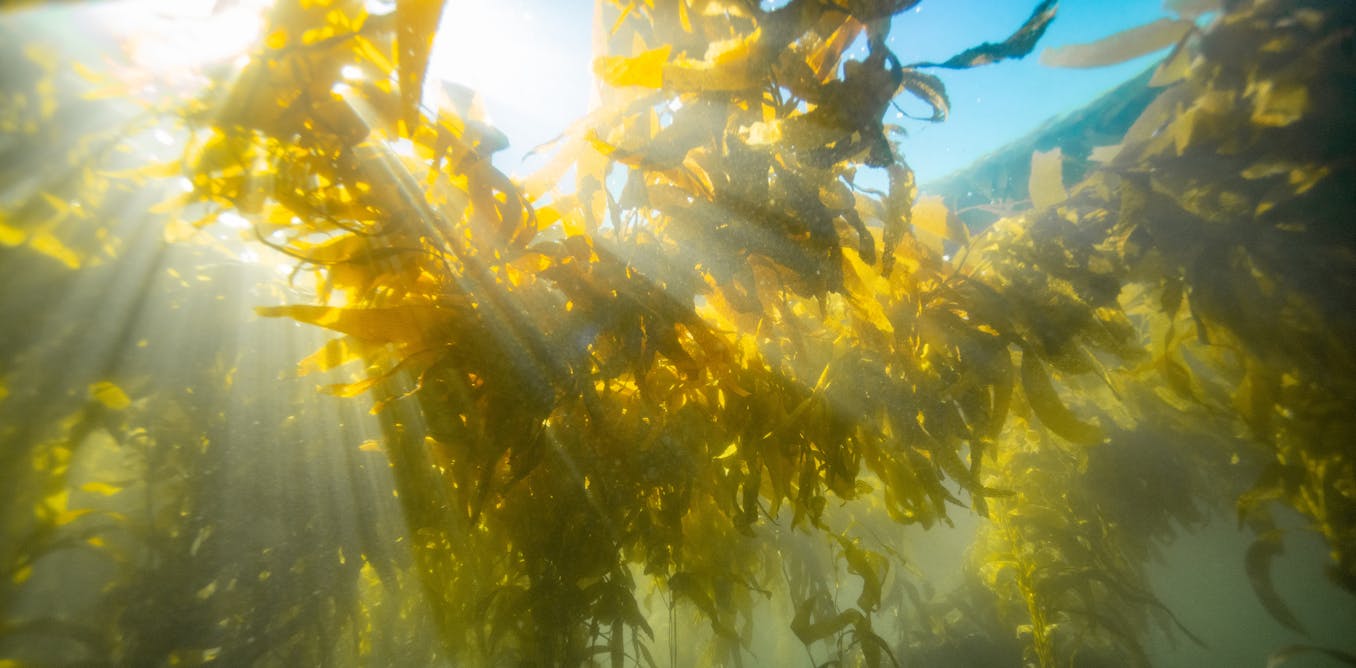
I’ve been fortunate to dive in Tasmania’s giant kelp forests over the past three decades, launching into chilly waters. When diving in these forests, light filters through the golden ribbon-like fronds in beams, lighting the array of fish that sail through like birds in a rainforest. On the seabed, pearlescent abalone shells shine and sunset-orange crayfish prowl, eyes agog. Kelp forms a foundational part of the Great Southern Reef, which extends 8,000 kilometres around southern Australia from Kalbarri in Western Australia to Coolangatta in Queensland. Here, for certain groups of organisms – seaweeds, sponges, crustaceans, chordates, bryozoans, echinoderms and molluscs – as many as 30–80% of species are found nowhere else on Earth. Think the weedy sea dragon, for instance, with its leaf-like fins. The region is a biodiversity hotspot, lesser known than the Great Barrier Reef, but equally worthy. There are also commercially important species such as rock lobsters and abalone that rely on healthy reefs for shelter and food. Giant kelp is found in the southeastern corner of the Great Southern Reef. It has historically been a tourism drawcard. Diving in giant kelp forests is like being transported into the Jack and the Beanstalk fable – which is not really an exaggeration, given its almost miraculous growth rate. Giant kelp can grow 50 centimetres a day in ideal conditions, reaching more than 30 metres from the seafloor. It used to choke boat propellers, hampering anchoring around Tasmania, but in recent decades giant kelp has declined by 95% along the island’s east coast. The reason for its demise: warmer, nutrient-poor waters extending further down the Australian coastline than they once did, as well as the arrival of the invasive long-spined sea urchin, which grazes on kelp and other seaweeds, causing marine deserts called barrens. In 2012, the giant kelp marine forests of southeast Australia became the first marine community to be listed as endangered under the federal government’s Environment Protection and Biodiversity Conservation Act. My husband, Craig Johnson, a marine biologist, was one of the first to document the decline and to think of rearing warm-tolerant giant kelp varieties and reseeding them in the wild, through his work at the University of Tasmania’s Institute for Marine and Antarctic Science. Now, teams of researchers are working on just this, buoyed by the possibility of restoring Tasmania’s iconic undersea forests. Trials have shown that giant kelp forest can return in the space of a year. So nature can heal if given a chance. The dream is that warm-tolerant strains could be successfully reared and replanted at scale, and that these forests would reseed more forests. If invasive urchins could be controlled, the barrens could again be replaced by healthy temperate reefs. In an era of eco-grief, rewilding projects like this are having a moment, even attracting the interest of royalty. On their March 2026 visit to Tasmania, Denmark’s Queen Mary and King Frederik accompanied researchers on a field trip to a remnant stand of giant kelp south of Hobart in the D’Entrecasteaux Channel. They heard from the institute’s Scott Ling about the reseeding efforts. It begs the question: can we imagine ourselves into a brighter future? From moves to restore giant kelp forests in Tasmania to the successful reintroduction of white storks in the United Kingdom, where they are now breeding for the first time in 600 years, the answer might be yes. Tasmanian researcher Scott Ling shows remnant giant kelp to Denmark’s Queen Mary and King Frederik. Tasmanian Government’s Department of Premier and Cabinet Rewilding takes hold In a growing number of places around the world, a vision to bring species back from the brink of extinction is working. Some projects, such as the kelp one, involve selecting and rearing naturally occurring resilient varieties that can thrive in our changed circumstances. Others involve simply reintroducing lost species that were once predominant, such as wolves in forests in northern Europe. Endangered eastern quolls are being reintroduced to a highland property known as the Quoin in the Tasmanian highlands, with confirmation of the successful arrival of pouch young, a sign that the program, which introduced 24 quolls in 2025, is progressing well. This program emerges from the broader vision of Lisa Miller, a zoologist by training, through Wedgetail, a private company investing in restoring ecologically valuable areas around the globe. I’ve seen a quoll only once, on our property south of Hobart, a sleek spotted flash through the bush, so fast I questioned whether it was real. How wonderful if they were to return in numbers, if not yet to the suburbs of Hobart, then to the Tasmanian highlands. Storks bringing luck A world away in Sussex, England, success at an old castle estate is capturing the world’s eye, and its heart. Thanks to the vision of property owners Isabella Tree and Charlie Burrell, a highly successful rewilding effort is transforming Knepp Estate. Myriad species are returning, from white storks to purple emperor butterflies. Thanks to the work of the owners and the research and community organisations with which they have partnered, the list of species flocking to Knepp Castle Estate has a ring of the Middle Ages to it. Knepp has become a breeding hotspot for critically endangered nightingales and turtle doves. Then there are peregrine falcons, sparrowhawks and skylarks. Tree has documented the project in her book Wilding, and captured it too in a hit documentary of the same name. I visited the property in 2023 and met Laura Vaughan-Hirsch, a biologist who manages the white stork project at Knepp. She told me the white storks were initially introduced to Knepp from Poland’s Warsaw Zoo. She showed me a taxidermied specimen, one of that first cohort, its body the height of a human torso, its strong beak silent. During greetings, and at other times, the storks throw their heads back and clatter their beaks in a sound captured on video in the live web cameras stationed in the Knepp oaks – watched by viewers the world over. Since the arrival of those first storks from Warsaw Zoo, the numbers have grown remarkably, with birds arriving from wild populations. Last year there were 19 nests, which produced 45 fledglings. A stork nest at Knepp. sagesolar/Wikimedia Commons People in the local community have been mesmerised by the return of the birds, some of which have started nesting on rooftops in neighbouring suburbs. Also returning are red kites, which were common in the skies above England in Shakespeare’s times. The kites are now attempting to predate on the stork nests and are being driven away by storks – the skies alive with a contest that hasn’t been seen for centuries. It was in 1822 that the phenomenon of long-distance bird migration began to be understood in the West. A white stork was found in Germany bearing an African spear. It remains on display at the University of Rostock in Germany. Prior to that, myths abounded that the birds hibernated. With knowledge of migration comes awareness: birds moving between countries in different seasons could well be the same population. If the population disappears from one area, it disappears from all. Likewise, if a bird species returns in healthy numbers to a region, the benefits can be far-reaching. On my visit to Knepp, I took a tour during an open day, where members of the community were invited to hear about the programs underway. The tour leader was Tony Whitbred, formerly the chief executive of the Sussex Wildlife Trust and now a volunteer with the Sussex Biodiversity Record Centre. He was expecting only a handful of people to accompany him on a walk through the property for the guided lecture. He ended up with an audience of 300. The secret at Knepp has been to restore the environment from the ground up, first introducing wild herbivores that play a role in tilling the soil. Healthy soil led to invertebrate species thriving. Knepp now boasts the largest population of purple emperor butterflies in the UK. Bird populations have followed the increase in invertebrates. People can pay to stay overnight at Knepp in treetop tents, an opportunity to have something of a safari experience and to commune with nature on this unique property just 25km from Gatwick airport. Rewilding has its detractors, with some concerned about the invasion of weed species or the loss of farmland. But in the case of Knepp, the property’s heavy clay soils made the property unproductive before the program began. Wolves on the march and greener cities In Europe, wolves too are on the march, with 21,500 estimated to be living on the continent in 2022, a 58% increase over a decade. The return of boar, deer and other prey species has seen the wolf population expand, along with an increasing number of wolf-human interactions in countries such as Denmark. While not everyone is a fan, the return of top predators results in changes through the food web known as trophic cascades. The effect of predators propagating downward through food webs means that ecosystems function again as they once did. Cities are being rewilded too, to a lesser degree, but where this is occurring, it is being shown to work with species such as platypus, beavers and hornbills returning to city parks around the world. Rewilding projects aim to mitigate biodiversity loss by returning species that have been lost. Research has even shown that rewilding could help mitigate climate change, for instance, with restored wetlands acting as climate sinks. Yet there are challenges to rewilding. In Australia, the immense problem of feral predators such as cats and foxes mean efforts that simply create “safe havens” (devoid of feral animals) for wildlife, while vital, aren’t enough. Feral populations in the wild also need to be controlled if rewilding is to succeed more broadly. Likewise, trying to rear warm-water-tolerant corals to help the vast Great Barrier Reef, while admirable, is labour-intensive and not a perfect fix on its own given the issue of scale. Also, once water temperatures outstrip even these corals’ ability to cope with human-made climate change, other solutions will be needed to address the damage to the reef. But by providing something of a soothing balm of hope, could rewilding (a central theme in my new novel) also encourage further pragmatic action, a green revolution that could spread around the planet? The idea does seem to be catching on, not only for the benefits to the natural world, but for the benefits to humans. For we too, of course, are part of nature. Indeed, concepts of wildness that overlook long histories of Indigenous presence have been criticised. The healing power of nature More and more, researchers are recognising the health benefits from what some call nature bathing. Oxford academic Kathy Willis outlines her research on this subject in her 2024 book Good Nature. Her interest began 15 years ago when she came across a study that showed hospital patients recovered from surgery three times faster if they could see trees through their hospital windows instead of seeing walls. Her research since has shown the scientific link between green spaces and better health, mood and longevity. She covers surprising facts, such as how the scent of cedar boosts cancer-fighting cells in our immune system, and how touching wood can calm us. There is even an academic specialty known as “blue health”. Irish national surf champion and scientist Easkey Britton has documented the science behind our connection with the water and its psychological impact on us. Surfers and scuba divers know this intuitively in their bodies and minds. I, too, have joined a cold-water swimming group in Hobart. I’ve observed that the act of plunging into the ocean and remaining for as many minutes as the sea is warm – 13°C equals 13 minutes of immersion – brings people together. Perhaps part of the feeling of wellbeing comes simply from community. Psychological research tells us that, as individuals, a healthy dose of daydream plus pragmatic action can help us achieve the lives we want to live. There is some evidence that, collectively, imagining a better future can also help us feel closer to one another and move together in that direction. Katherine Johnson’s novel Every Wild Soul is published by HarperCollins.
Friday essay: can rewilding offer us a brighter, greener future?
Full Article
Original Source
Read the full article at Theconversation →KhanList aggregates and links to publicly available news content. We do not host full articles from third-party sources. Always verify important information with original sources.