
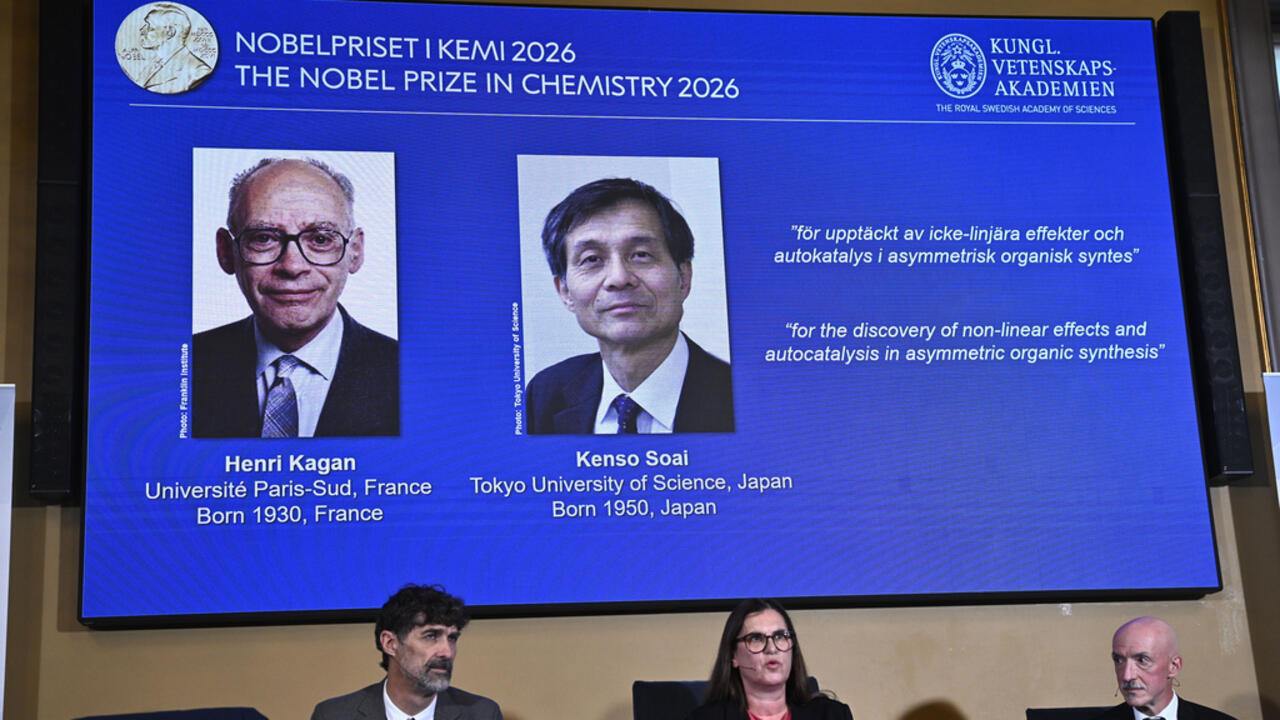
The Nobel Prize in chemistry was awarded on Wednesday to French scientist Henri B. Kagan and Japan’s Kenso Soai for unravelling the mystery of why only one of two forms of certain molecules occurs in nature. Issued on: 07/10/2026 - 14:15 2 min Reading time Many molecules can exist in two mirror-image forms, but in nature only one form often predominates – a phenomenon known as homochirality. Chemists have long struggled to explain how this happens. Kagan and Soai's discoveries helped show how chemical reactions can be steered towards one molecular form rather than the other, work that has proved important in fields including pharmaceutical manufacturing, the Nobel committee said. "They have enabled chemists to drive chemical reactions that lead to homochirality," the jury added. One area of this field, asymmetric catalysis, had already been recognised with a Nobel Prize in 2001. Kagan, professor emeritus at Paris-Saclay University, was not among the recipients then despite being widely regarded as one of the fathers of the technique. The omission prompted protests at the time from France’s Research Ministry. Soai, 76, was out shopping near his home when he was informed of his award. Nobel Prize announcements begin, with hopes of a 'less controversial year' 'Most incredible day of my life' “This is the most incredible day of my life,” the laureate said in a telephone interview with the Nobel Foundation. The professor at the Tokyo University of Science added: "I think our prize should lead people to recognise the importance of molecular chirality. I am therefore particularly happy about that." Like hands, some molecules, known as chiral molecules, can exist in “right-handed” or “left-handed” forms. They have identical physical properties but can have very different biological properties. "Henri Kagan and Kenso Soai have provided a solution to a chemical mystery that is over a century old: how homochirality can emerge spontaneously. The chemical reactions they have developed are spectacular," said Heiner Linke, chair of the Nobel Committee for chemistry. "Their discoveries have been decisive for chemists who design reactions for the manufacture of pharmaceuticals." French economist shares Nobel for 'creative destruction' theory of innovation Literature prize on Thursday The Nobel Prize in chemistry was first awarded in 1901. Jacobus Henricus van 't Hoff from the Netherlands was honoured for discovering the laws of chemical dynamics and osmotic pressure in solutions. In 1911, the Frenchwoman Marie Curie won the Nobel Prize in chemistry, eight years after sharing the physics prize – becoming the first person to win Nobel Prizes in two scientific fields. The accolade in chemistry is the third of the 2026 Nobel science prizes to be awarded. On Monday, the American psychiatrist and neurologist Karl Deisseroth and his German colleagues Peter Hegemann and Georg Nagel were given the honour in medicine for their work in the field of optogenetics. Francis Halzen from Belgium won the 2026 Nobel physics prize on Tuesday for groundbreaking work using Antarctic ice to capture particles originating in the cosmos. In addition to being one of the world’s most prestigious awards, the Nobel winner receives a diploma, a gold medal and a cheque for 12 million kronor – €1 million. After chemistry, it will be the turn of literature on Thursday. The Nobel Peace Prize will be announced on Friday and the economics prize will bring the Nobel award season to a close on 12 October. (with newswires)
Franco-Japanese duo Kagan and Soai win 2026 Nobel Prize in chemistry
Full Article
Original Source
Read the full article at Rfi →KhanList aggregates and links to publicly available news content. We do not host full articles from third-party sources. Always verify important information with original sources.