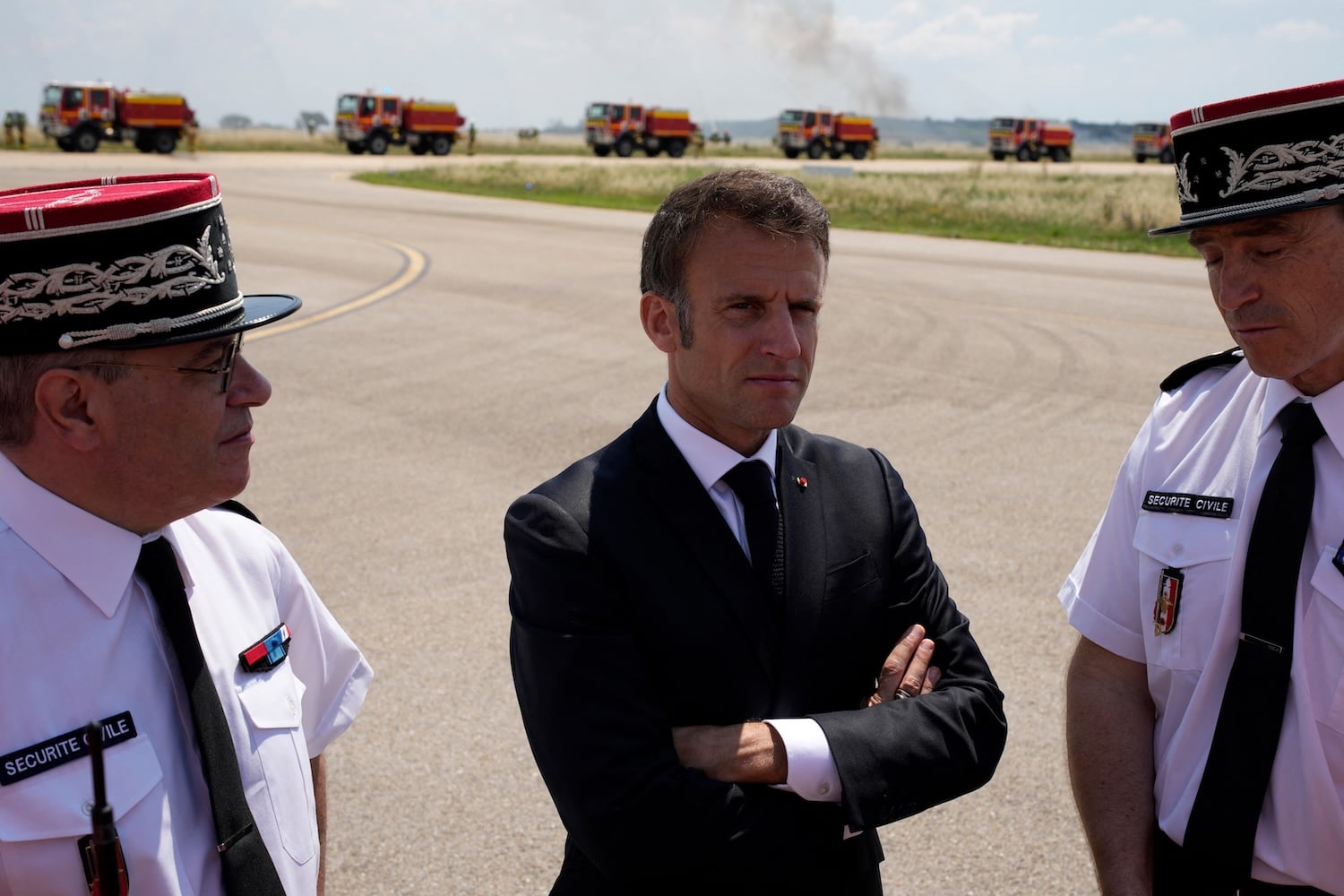
On Friday, July 24, firefighters battling the unprecedented forest fires in southwestern France glimpsed an equally unprecedented phenomenon: a pyrocumulonimbus, better known as a fire cloud. Already common in the western United States and Canada, fire clouds are a storm within a storm, wrought by extraordinary amounts of heat and energy that belch great plumes of fire that spawn fiery tornadoes that carbonize everything and everyone in their paths. Yet a different kind of pyrocumulonimbus, no less unprecedented, has been wreaking havoc on the country’s political landscape. It is a phenomenon where the intensifying friction between the ideological extremes at both ends will create an inferno that will consume the parties sandwiched in between—and perhaps even volatize the foundations of the Fifth Republic. The Fifth Republic, the political home that Charles de Gaulle built for France in 1958, had always been defined as a two-bloc system. The meteoric rise to the presidency of Emmanuel Macron, running as an independent who founded his own party, Republic on the Move, fatefully splintered that tradition—and the snap legislative elections that he called for in 2024 shattered it entirely. When the results were tallied, there were not two, but three blocs: an extreme-right bloc supercharged by the stunning success of Marine Le Pen’s National Front (RN); an unstable (and eventually dissolved) left-wing coalition dominated by Jean-Luc Mélenchon’s extreme-left France Unbowed (LFI); and the scorched remains of Macron’s party, which spectacularly failed to live up to its new name, Renaissance. Since then, the country has witnessed the flailing efforts of its government to pass bills and the fecklessness of a president more attentive to his legacy than to his fellow citizens. With less than eight months from the presidential election, scheduled for April 2027, the firestorms galloping across western France have now cast a macabre glow on the political paralysis in Paris. During the month of July, while the fires consumed homes, farms, and businesses in the Gironde, the political class in Paris has been consumed in a bonfire of vanities, pinning blame on one another rather than preparing for a near future that, due to climate change, promises more and worse of the same. Everyone who is politically someone agrees that France’s human and material resources for firefighting have proved to be dramatically inadequate to battle the infernos. What they vociferously disagree on, however, is whether this lack of material was inevitable. The most hotly debated issue has been over the country’s aging fleet of amphibious firefighting planes, the Canadairs. Though a dozen planes comprise the fleet, five have been out of service since the start of the fires, nearly halving its effectiveness. Inevitably, figures from across the political spectrum have joined in a chorus of criticism, faulting Macron’s government for this shoddy state of affairs. Yet the truth is more complicated. Having made the environment a centerpiece of both of his presidential campaigns, Macron’s political opponents have turned his words into a club to beat him, underscoring the gap between his aspirations and accomplishments. The lame-duck Macron has made their job easier with his claim that no one could have foretold the magnitude of this summer’s heat waves and fires in France. This is paradoxical for two reasons. First, in his response to this summer’s firestorms, Macron has fallen back on the mantra “Qui aurait pu prédire?”—“Who could have predicted?”—first pronounced during the heat waves of 2022. Second, it is odd that a president committed to battling climate change would not know that environmental scientists have, in fact, been predicting such cataclysmic weather events for years. As for the RN, the party to the extreme right of Renaissance, it remains largely mired in the Dark Ages. As an analysis of the party’s recent voting record reveals, it has consistently supported cuts proposed by the government to the civil security budget, which includes the ground and air forces for firefighting. With many members who have continued to deny the reality of climate change and dismissed the increasingly dire warnings of the Intergovernmental Panel on Climate Change, a global group of climate scientists, the RN finds itself caught between the rock of repeated heat waves and the stone of raging firestorms. Predictably, Le Pen and her lieutenants have thus been busy lambasting the scarcity of Canadairs for the fires and scarcity of air conditioners for the heat waves. To the left, no less predictably, the environmental positions are decidedly greener. From the center-left Socialist Party to the extreme-left LFI, the parties have consistently voted to augment the nation’s firefighting resources. Equally important, they have made climate change a centerpiece of their political platforms. Of course, this is the case with the Ecologists, led by Marine Tondelier, but also with the LFI. Mélenchon inveighs against a government that acts, in the LFI’s words, as if the “global ecological crisis is nothing more than a temporary inconvenience,” and that “air conditioners are the answer to heat waves.” He has even proposed reinventing the map of France, transforming the existing political regions into “éco-régions,” with increased powers to respond to climate change. At a recent rally in Brittany, the fiery leader of the LFI declared that his plan would “transform the French Republic into an ecological republic.” According to Mélenchon’s many critics, however, he may well turn France into a demagogical republic. More than two dozen political figures, ranging from the extreme right to extreme left, have either already or are now poised to enter next year’s race for the presidency. At both ends of the political spectrum, the candidates long ago established their ascendancy over their respective parties. On the far right, Le Pen, granted the right to run while a court considers her appeal of a guilty verdict in a case about channeling European Union funds to the RN, has already hit the campaign trail. Tagging along with a strained smile is Jordan Bardella, her second-in-command, who was primed to assume the party’s candidacy only to see it suddenly snatched away and now assigned the role of a Sancho Panza wrapped in a bespoke suit. This will be Le Pen’s fourth crack at reaching the Elysée Palace. On the far left, Mélenchon launched his own presidential campaign several months ago. Having already tried and failed twice to enter the second round, the 74-year-old former Socialist Party politician hopes that the third time will be the charm. The hope is not unrealistic: The most recent polls reveal that Mélenchon, whose 16 percent favorability rating is less than half that of Le Pen’s 35 percent, nevertheless is running neck and neck with centrist candidates Édouard Philippe and Gabriel Attal. (Both served as prime ministers under Macron and neither has sought his endorsement; with barely 1 in 5 of French voters approving of his job performance, Macron has only a poisoned chalice to offer.) In many respects, Le Pen and Mélenchon embody the old saw that extremes eventually meet. Both prefer to think of themselves as leaders of movements and not parties, thus setting themselves against the declining reputation of traditional politics. Both share, as well, little love for the Gaullist republic. Mélenchon has long argued for the creation of a Sixth Republic, one that would sweep away what he describes as the “dangerous” institutions of the fifth iteration. (Importantly, a Sixth Republic ranked high among the demands of the seismic “yellow vest” movement during Macron’s first term—and which threatened to end it prematurely.) Mélenchon insists that the Fifth Republic has passed its expiration date. In fact, it is in advanced state of moldering if, as the LFI website declares, “each generation is a new people” and thus deserves a new constitution. What better underscores this claim than the fact that, during lifetime of the Fifth Republic, women won several rights, including the rights to birth control, abortion, and parity, while the population has grown more interracial? Yet the website fails to note the flexibility of the institutions that have inscribed these rights into the current constitution, just as it fails to explain why the population’s changing ethnic composition requires a new constitution and institutions. Moreover, Mélenchon—who cites Maximilien Robespierre, the revolutionary leader who gave the gift of the Reign of Terror to France—dreams of a republic where all power resides with the legislative branch. This ignores both the bloody horrors of the Terror and the dismal failures of two previous = parliamentary republics, whose paralysis and indecisiveness led to authoritarian coups. (In the first case, the Second Republic gave way to Napoleon III in 1851; in the second case, about one century later, de Gaulle signed the obituary for the Fourth Republic.) Equally unsettling is the expanded role that Mélenchon gives to the use of referendums, the very same populist tool that both Napoleon III and de Gaulle used to maintain themselves in power. Not coincidentally, Mélenchon’s apparent belief that he alone can save France is matched by Le Pen’s sense of destiny. While she does not call for a new republic and constitution, she is eager to seriously fiddle with the existing one. So much so that French legal scholars warn that Le Pen seeks a “constitutional coup d’é.” Like Mélenchon, Le Pen wishes to turbocharge the use of the referendum, which—she believes—will support her efforts to make a new constitutional obligation for “la préférence nationale,” or “national preference.” This seemingly banal phrase would, in effect, abolish birthright citizenship in France and limit social rights, including employment and housing, to citizens. These goals not only violate the republican principles of 1789, but they also violate the laws of the European Union, transforming France into an explicitly racist and rogue nation. As for the so-called “republican rampart” that mainstream republican parties have built against earlier campaigns by Le Pen, this time around, there are fewer bricks and even fewer bricklayers willing to work together. Wedged between today’s ideological extremes is a cornucopia of candidates, few of whom have a realistic shot at making it past the first round. Most of these candidates, bearing various shades of green, hail from the traditional left. While Tondelier, the leader of the Ecologists, admirably and persistently pursues the goal of a unified left, stretching from the center left to extreme left, the bristling antipathy between the former’s Raphaël Glucksmann and the LFI’s Mélenchon makes her task nearly Sisyphean. This hardly bodes well for the future of the Fifth Republic. Brice Teinturier, the director of the polling institute Ipsos, observed that the “overwhelming popular sentiment is that politicians are preoccupied with their internecine battles over 2027 while no one is paying attention to their concerns.” Prime Minister Sébastien Lecornu put this in harsher terms: The real risk, he said, is that the French are disgusted “by this welter of egos so detached from reality.” While the France of the Fifth Republic literally burns, it appears that popular disenchantment with mainstream parties portends that the time-tested institutions and constitution of that republic might so burn as well.
France’s Wildfires Are Swallowing Its Politics
Full Article
Original Source
Read the full article at Foreignpolicy →KhanList aggregates and links to publicly available news content. We do not host full articles from third-party sources. Always verify important information with original sources.