
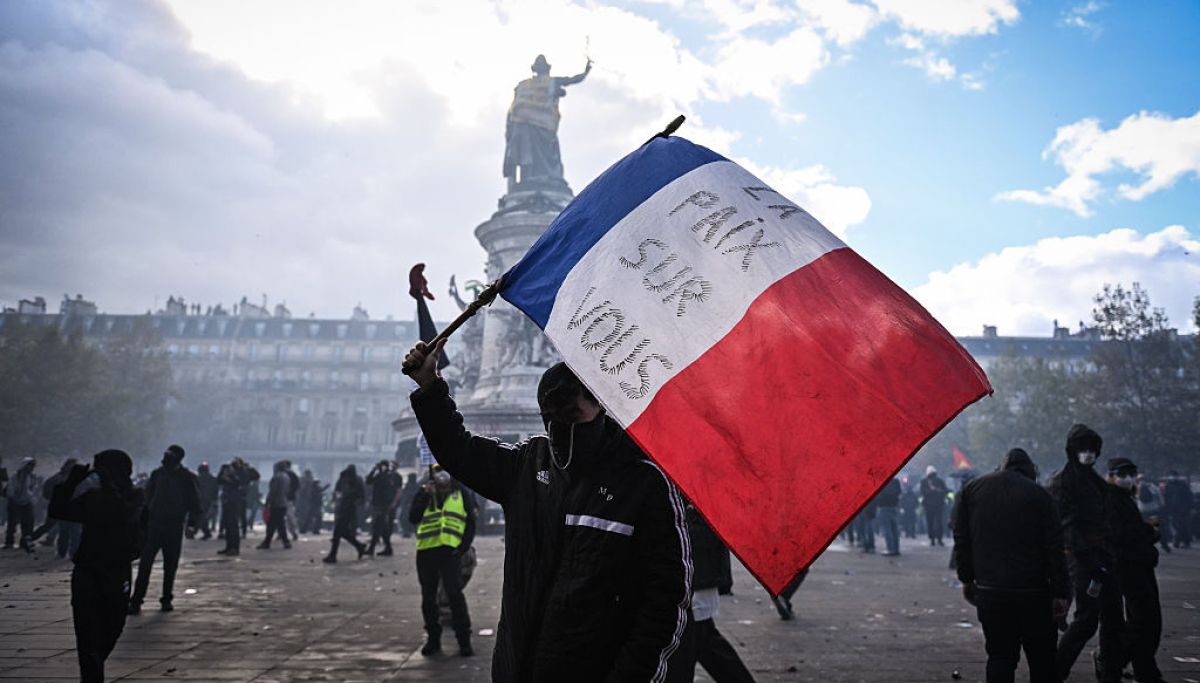
On Oct. 18, Limoges Mayor Guillaume Guérin stood before the ruins of his city’s 143-year-old town hall and described something more troubling than a riot. He told Le Monde that 500 to 600 ultra-left militants had infiltrated a demonstration of 5,000 people. They brought mortars and a 200-kilogram battering ram, knew where to enter, and exploited police shortages. The attack, he argued, was planned; the larger demonstration provided the opportunity.Across France, some 550,000 people marched that weekend, most peacefully protesting the cost of living, pensions, and deteriorating public services. But black-bloc militants, looters, and young men from troubled suburbs exploited the crowds. The result was not a single organized movement but groups with conflicting objectives whose actions reinforced one another.I spent much of my career in Army Special Forces, where unconventional warfare is a core mission. We learned to examine resistance movements by function rather than ideology. Who plans, who fights, who provides support, and who turns street action into political leverage? France is not experiencing a conventional insurgency, but some functions are beginning to align without a national command. Two Wall Street Journal columnists examined France’s unrest. Louise Perry identified three constituencies: organized labor and students, the educated far left, and young men from disadvantaged suburbs. Matthew Hennessey described an alignment of Muslim youth and communist students. Both recognized the contradictions, but neither explored how groups that disagree about everything can strengthen one another in the streets.The ultra-left provides organization and tactics. Young men from the banlieues, France’s disadvantaged suburbs, join confrontations out of anger or opportunities to loot. Most residents stay home. Unions and students bring legitimate grievances and demonstration numbers. They are not knowingly supporting radicals, but their crowds provide cover for violent militants.This is a coalition of effects, not necessarily intent. Its participants need not agree about France’s future as long as each benefits from challenging the present. Unions want economic protections, radicals seek transformation, and alienated youths want opportunities, respect, or revenge. Their interests overlap in the streets but would collide around a governing table.The Palestinian flags at demonstrations illustrate the divide. Some express solidarity with Palestinians; for others, opposition to Western authority. Shared symbols bridge differences without resolving them. The secular, feminist far left and socially conservative religious constituencies may agree about their adversaries while disagreeing about the society they want.France’s labor market protects established workers but struggles to integrate young outsiders. Unemployment and limited opportunities create grievances that neither policing nor political slogans can resolve. Yet those responsible for organized violence are not necessarily those suffering most. That distinction matters.For now, momentum sustains the convergence. Rolling demonstrations postpone disagreements, while confrontations with police become another rallying point. Indiscriminate policing allows radicals to portray themselves as defenders of peaceful protesters. A government that fails to distinguish between the two risks strengthening those it wants to isolate.Macron faces an uncomfortable choice. Concessions to unions could reduce participation, but France’s finances leave little room for promises. Every constituency demands change, yet few accept the sacrifices needed to finance it. Aggressive policing risks further mobilization, while employment reforms take years. He lacks the majority and time to resolve these problems before May 2027.The presidential election raises the stakes. Jean-Luc Mélenchon hopes to translate left-wing anger into votes, while Marine Le Pen’s National Rally benefits from demands for order. Neither needs to organize violence to profit politically. Mélenchon can campaign against the existing order while the National Rally promises to restore security.A Mélenchon victory could expose the coalition’s contradictions. Unions would expect spending commitments financial markets might resist. The secular left would confront socially conservative constituencies over religion, women’s rights, and French republicanism. Groups united by opposition often discover that governing requires agreements they never made.A National Rally victory could prove destabilizing. Le Pen might restore order, but policing cannot repair public finances or create opportunities for alienated youth. Her retirement promises suggest little appetite for painful reform. Revolutionary militants might welcome confrontation with her government as economic grievances persist. Each side could strengthen the other’s appeal.Chile offers a warning. In October 2019, protests over a metro fare increase became a revolt against inequality and political privilege. Students mobilized, metro stations burned, and the government conceded a process for replacing the constitution. Gabriel Boric won the presidency in 2021, but Chileans rejected a left-drafted constitution by 62% the following year and another proposal in 2023.In December 2025, voters elected conservative José Antonio Kast over communist candidate Jeannette Jara. The protest movement transformed Chile’s political agenda without sustaining majority support for its preferred transformation. It won the streets but ultimately lost the country.France could follow a similar course. The unrest may help elect the government many demonstrators fear most, or leave the country too polarized for its next president to govern effectively. A movement need not capture the state to weaken its capacity to act.That matters beyond France. Paris controls the EU’s only independent nuclear deterrent and its only permanent Security Council seat. It remains central to European support for Ukraine and NATO. Mélenchon’s movement has advocated leaving NATO’s integrated military command, while National Rally has questioned European commitments.THE FRANCE RIOTS AREN’T A STUDENT REVOLT — THEY’RE SUPPORTED BY CCP-TIED DARK MONEYRussian President Vladimir Putin does not need to manufacture France’s divisions to benefit from them. A government consumed by domestic confrontation has less political capital for Ukraine, European defense, and NATO. Washington should worry not simply about who wins in 2027, but whether the next president inherits a government capable of fulfilling its commitments.Macron has six months to recover enough authority to prevent France’s divisions from overwhelming its institutions. Radicals have six months to exploit that weakness before an election exposes the movement’s contradictions. Neither side needs to win outright. France may discover that neither side has to win for the country to lose.Ron MacCammon, Ed.D., is a retired U.S. Army Special Forces colonel and former U.S. State Department political-military officer who writes on national security, foreign policy, governance, and international affairs. He has lived and worked in Latin America for more than 20 years, taught international relations at the U.S. Military Academy at West Point, and served with the State Department in Afghanistan and Africa.
France doesn’t have a riot. It has a coalition of instability
Full Article
Original Source
Read the full article at Washingtonexaminer →KhanList aggregates and links to publicly available news content. We do not host full articles from third-party sources. Always verify important information with original sources.