
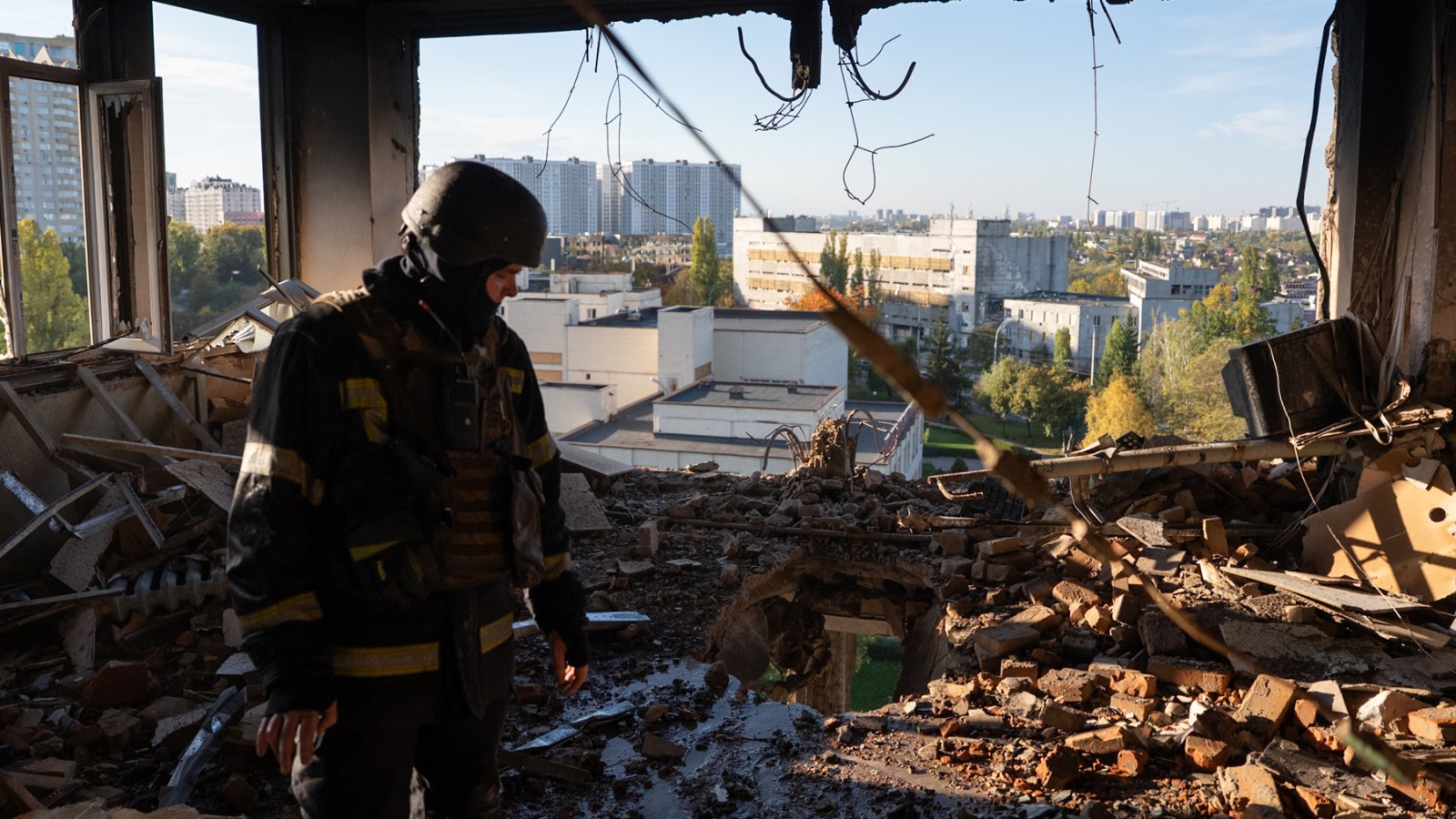
Under constant attack from drones and missiles, Kyiv’s residents are fed up with the American president's deference to Putin A few months ago, Staus was living with his girlfriend and cat in one of the most dangerous neighborhoods in Kyiv. Every couple of weeks, the city would get hit with a Russian ballistic missile attack, and Staus’ apartment was close to a couple industrial sites that he worried would eventually come under fire. And yet, it was a “happy life,” he tells me — privileged compared to many of his countrymen who live in cities closer to the front lines. A few nights a month in a bomb shelter during missile strikes was bearable. But then Russia took that away. Ukrainians get missile forecasts like the weather. Staus says the worst time for attacks was usually between around 12:30 a.m. and 4:30 a.m. But this summer, the attacks increased. The window expanded to 11:30 to 7:30. The strikes started coming every day, not every other week. Air defense supplies dwindled. The forecasts got less accurate. The air raid sirens have changed over the years, too: from a simple klaxon horn to a loud, repeated voice blaring across the city that Staus said gave him a Pavlovian, panicked response. He started spending nights in an underground internet cafe near his apartment, playing computer games and trying to sleep in a desk chair. “You’re not really safe anywhere in the night time,” Staus told me on the phone a few days ago. “Russia made me sleepless. It’s impossible. How long will you last doing that? We’re not superhumans.” While Russia may be the main source of sleepless nights for Ukrainians, there’s another force that keeps many of them awake: Donald Trump. Trump’s support for Ukraine in its war against Russia has been anything but consistent, and in recent months his policies have become less a thorn in Ukraine’s side than a dagger in its back. In October, Trump announced that the U.S. would enter into a trade deal to buy diesel fuel from Russian suppliers, a direct violation of prior sanctions laws and a paradigm shift in the global energy market. Trump justified the move by directly blaming Ukraine for the global rise in fuel prices, claiming that their attacks on Russian refineries were the main destabilizing force, not the turmoil caused by his war in Iran. Ukraines stock of interceptor missiles, like the U.S.-made Patriot, have dwindled, as reserves that the nation was buying at cost to defend Kyiv were used up in the war on Iran. In early October, Trump’s political ally Elon Musk limited Ukraine’s use of the Starlink internet service, which drastically slowed down the speed at which Ukraine’s military could operate offensive and defensive drone munitions. Starlink access was restored last week, after a bipartisan group of U.S. lawmakers pressured Trump. Editor’s picks In Kyiv, government officials and civilians alike are left reeling by the constant shifts in U.S. policy. “You wake up every morning wondering what fresh madness Trump is going to unleash,” Yuliia, a film editor and graphic designer living in Kyiv told me on WhatsApp last week. “It’s absolutely insane. As if having Putin as our enemy wasn’t enough… so much of our lives and our safety now seems to depend on whatever Trump decides to do.” “They say there are three elephants that the world rests on: economics, physics, and what Trump will think in the morning when he wakes up,” Staus jokes. “This guy is literally shaming himself every day.” “What infuriates us most is the lying,” Yuliia says, mentioning a recent episode in which Trump, in a press gaggle, claimed that Russia’s first assault on Kyiv failed because a stupid general drove a column of tanks into the mud. “We completely obliterated those tanks! Every lie spewing from his foul mouth makes me want to howl. It demeans a struggle that has cost us what we hold most dear.” Ukrainian lawmakers are similarly frustrated, though much more diplomatic about it. Earlier this week, I called Ivanna Klympush-Tsintsadze, a member of Ukraine’s parliament who works closely with her counterparts in the European Union, which has been scrambling to fill the gaps in aid left by the U.S.’s inconsistent support. I caught Klympush-Tsintsadze at the end of her work day, close to 7 p.m. in Ukraine. She sounded exhausted, like everyone I’ve spoken to in Kyiv lately. Related Content “The blame of the destruction of my city is first and foremost on Putin,” Klympush-Tsintsadze says. “It’s disturbing, worrisome, and painful that the American administration seems to find comfort in dealing with [him].” Trump, Klympush-Tsintsadze says, is “paving the way for the aggressor to reach their goals.” Those actions, she says, are tacit to “giving up on the partnership” between the U.S. and Ukraine, in deference to an adversary who wants to “blow up the remnants of the international rules.” “I think that nobody can feel safe — not only us,” Klympush-Tsintsadze says. “The result of this war will have an impact on the whole world.” Former U.S. diplomats are also scratching their heads. Dan Fried, a former U.S. ambassador to Poland who helped design the U.S. sanctions policy toward Russia after its 2014 invasion of Ukraine’s Donbas region, says Trump’s shifting policies and chummy behavior with Putin have begun to “alienate” everyday Ukrainians for very little actual gain. “What kills me is the administration has proposed in its more lucid moments a kind of framework for settling the war that could work,” Fried says. “But for it to work you have to be focused and lean on the Russians.” “I’ve dealt in my time with foreign policy problems where you’re screwed — there’s no way forward,” he adds. “This isn’t one of them.” Even then, Fried says, Ukraine is a much more solvable situation than Trump’s quagmire in Iran. But Trump, at least for now, doesn’t seem interested in pursuing a solution or applying more pressure to Russia. On Tuesday, the White House touted First Lady Melania Trump’s efforts in securing a conditional ceasefire for one city in southeastern Ukraine — which did not apply to the rest of the country. Putin, meanwhile, has reportedly invited Ukrainian President Volodymyr Zelensky to Moscow for talks — an offer that is almost certainly a non-starter. Trump, for his part, seems to think he can strongarm both sides into an agreement, recently telling a reporter that he had personally told Russia and Ukraine “you agree” to a ceasefire that, in reality, both countries denied agreeing to. Trending Stories Q: You said Russia and Ukraine agreed to a ceasefire, but both sides said they have not agreed to thatTrump: Well they agreed, you know why? Because I said 'you agree.' That's why. pic.twitter.com/q9OBJH7uBY— Republicans against Trump (@RpsAgainstTrump) October 12, 2026 On the streets of Kyiv, the diplomatic logjam fueled by U.S. policy means only that the incessant bombing will continue. On Monday night, Zelensky said on X, Russia launched 16 ballistic missiles and more than 280 drones at the city, blaming some of the damage on his country’s shortage of Patriot missiles. In daylight, the city center is quieter than usual, as many with the means to do so have fled to the suburbs. And yet, Yuliia says, “Life goes on.” “People still go out, sit in cafes, go to parties, take their babies out in strollers, give birth in maternity hospitals,” Yuliia says. A few months ago, she and her husband welcomed their second child. “Sometimes I wonder if we’ve all just lost our minds, or if we’ve somehow learned to adapt to something that should never feel normal.”
Ukrainians are Furious with Trump’s Chaotic Policies: ‘Every Lie Makes Me Want to Howl’
Full Article
Original Source
Read the full article at Rollingstone →KhanList aggregates and links to publicly available news content. We do not host full articles from third-party sources. Always verify important information with original sources.