
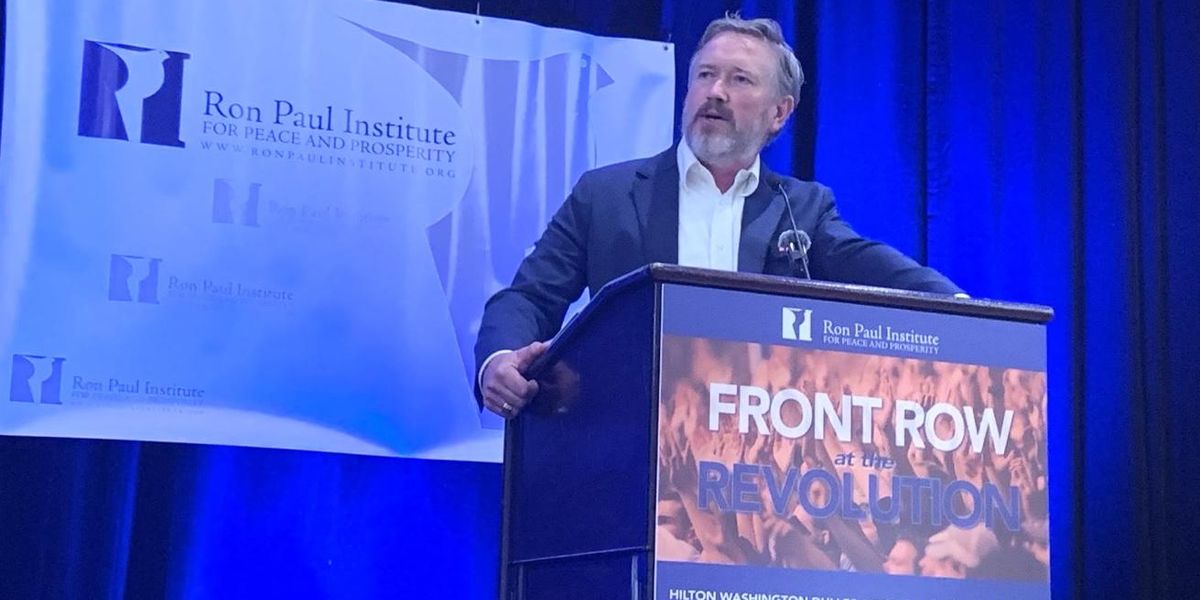
In his first non-Congressional public speech since his Republican primary loss to Ed Gallrhein, Thomas Massie brought some of the loudest energy to the Ron Paul Institute’s Washington conference on Saturday. He was full of jokes and promise for the future.Massie said he was not interested in mourning the defeat and declared that he was, in a way, happy he had lost. When addressing what he planned to do next, he joked that “you could scan my head” for an answer and still come up empty because he had not yet decided himself. One possibility, however, was firmly off the table: another run for Congress. Massie said he once held out hope that Congress could fix itself. His years inside the institution had convinced him otherwise.The energy with which he was received was indicative of his standing at the conference and within the broader antiwar movement. His name was invoked repeatedly throughout the day. His May 19 defeat followed more than $32 million in campaign spending, making it the most expensive House primary in American history. Pro-Israel groups spent more than $15 million to oust the representative after years of clashes over his foreign aid and U.S. policy stances on Israel.Beyond Massie’s dissent in Congress, former National Counterterrorism Center director Joe Kent and former State Department official Josh Paul offered the conference two examples of dissent from inside the Executive Branch.Paul resigned as director of congressional and public affairs from Biden’s Bureau of Political-Military Affairs in October 2023, saying he could no longer participate in the expedited transfer of American weapons to Israel without consideration of civilian harm. Kent made a similar break with the current admin this March. He resigned as President Trump’s counterterrorism chief, declaring that Iran posed no imminent threat to the United States and accused Israel and its American supporters of pushing Washington into this latest war. Together, the two offered the conference’s clearest illustration of the remarkable coalition taking shape around opposition to US Middle East policy. One resigned from a Democratic administration over Gaza and the other from a Republican administration over Iran.Israel, unsurprisingly, was one of the dominant subjects of the day, with speaker after speaker challenging one aspect of Washington’s relationship with the country or another. Former Ohio representative Dennis Kucinich accused “traitors” in Washington of having surrendered American sovereignty, proclaiming: “We cannot reclaim our nation unless we first reclaim our sovereignty.” He added a sober warning about the threat of blowback borne out of our nation’s actions in the Middle East: “We will pay for the violence we are abetting in the future.” The day before, during the scholar’s seminar, journalist Brian McGlinchey voiced a similar warning reminding the scholars of how Israel’s operation Grapes of Wrath motivated the fanaticism of 9/11 hijacker Mohammad Atta. Josh Paul offered a more optimistic note regarding AIPAC. He declared that the influential pro-Israel lobbying organization was once a name that could make “knees in Washington shake.” Today, that name is increasingly becoming politically toxic.Institute for Peace and Diplomacy scholar Michael Vlahos placed these developments inside a much broader diagnosis of American decline. Drawing connections with the Western Roman Empire’s fall, Vlahos linked permanent war abroad with institutional decay, elite enrichment, and the concentration of power at home. The analogy outlined another theme that surfaced repeatedly throughout the conference: foreign policy failure, in Iran and elsewhere, is inseparable from the domestic dysfunction many Americans feel in their homes and communities.Speakers pointed to the $40 trillion federal debt, inflation, military overstretch and executive overreach as consequences of a political system increasingly unable to impose limits on itself. Massie was especially blunt about a Congress that allowed the executive branch to dominate decisions over war and peace. He argued that lawmakers had effectively allowed two branches of government to collapse into one, making Congress a "vestigial order.”That diagnosis creates a harder question for the movement represented in the room: Where do we go from here? Opposition to intervention may be finding new constituencies and prominent figures from both Republican and Democratic administrations have broken with their parties over war. But there remains little agreement about what political vehicle can translate that dissent into power and a viable path forward.Ron Paul, now decades removed from the presidential campaigns that first brought many in the room into antiwar politics, ended the conference by sharing some wisdom in his characteristic happy warrior fashion. He discouraged hopes for a third-party effort, arguing that authoritarian institutional barriers made such a path exceedingly impossible. His broader message was more cheerful: keep fighting, but remember to have fun doing so.
Former US officials light up Ron Paul anti-war ‘revolution’
Full Article
Original Source
Read the full article at Responsiblestatecraft →KhanList aggregates and links to publicly available news content. We do not host full articles from third-party sources. Always verify important information with original sources.