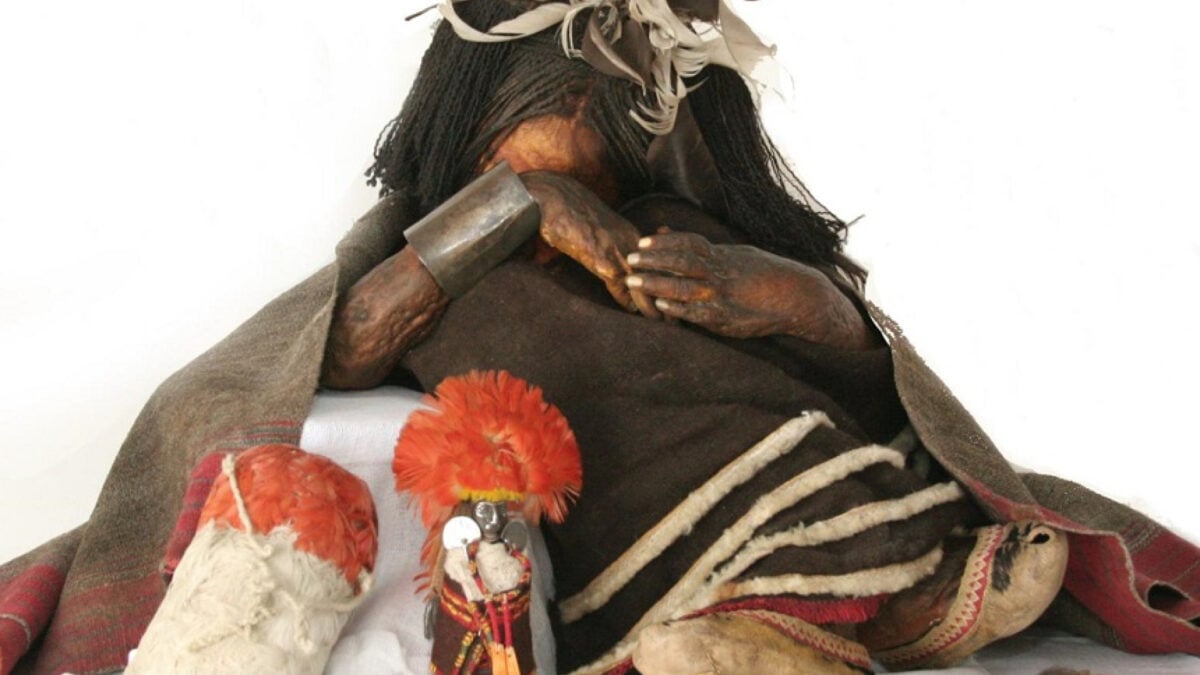
In 1954, looters found the mummified remains of a small boy. Soon, archaeologists took over and eventually concluded that the boy, about 8 years old, likely died of hypothermia during an Inca ceremony in the high Andes, about 17,716 feet (5,400 meters) above sea level. But things might have played out very differently than we believed. In addition to the boy, dubbed the Boy of Cerro El Plomo, researchers revisited two mummified girls, ages 9 and 18, from Cerro Esmeralda in the Atacama Desert, Chile. According to a recently published Science Advances paper on their findings, a comprehensive analysis overturns previous assumptions about how these Inca children passed. The new interpretation is that the Boy of El Plomo was killed from blunt force trauma to the skull, whereas the signs of strangulation for the Cerro Esmeralda girls probably happened postmortem, and their cause of death remains a mystery. “This study enabled us to re-examine exceptionally important heritage contexts, applying new research questions, new technologies, and ethical conservation criteria,” Verónica Silva-Pinto, the study’s lead author and a doctoral researcher at the University of Valencia in Spain, said in a statement. Life after death The three children were likely involved in Capacocha, one of the most important ceremonies of the Inca Empire. In the paper, the researchers explained that the children weren’t “merely offerings.” Rather, the Inca believed that the rite would send them into the “sacred world,” where they would become divine intermediaries between the living and the gods. Accordingly, the El Plomo boy, for example, was “well adorned with exquisite Inca textiles and jewelry” and carried trinkets made of gold and silver—typical Inca offerings to the gods, according to a 1998 NOVA documentary. What’s more, according to the paper, individuals chosen for Capacocha likely embarked on a long pilgrimage. It was from this background knowledge that the researchers designed their study, using CT scans, forensic analysis, and literary reviews of Inca history and culture to revisit the life of the long-dead children. Tracing a young life One key part of the study involved isotopic analyses of the mummies’ hair and skin, which “provide exceptionally detailed information about people’s lives in the past, particularly regarding diet, mobility, and changes that occurred during the final months of life,” Domingo C. Salazar-García, the study’s co-author and a researcher at the University of Valencia, said in the statement. According to this analysis, the El Plomo boy probably traveled between 1,615 and 1,740 miles (2,600 and 2,800 kilometers) nine months before his death, whereas the Cerro Esmeralda girls, in their last three months, traveled between 560 and 745 miles (900 and 1,200 km). The radiocarbon dates indicated that the boy was sacrificed around 1480 and the girls died around 1450. Final moments reconstructed Notably, the latest investigations revealed a previously unknown indentation on the skull of the El Plomo boy. The details are grim; simulations suggested that a blunt, star-shaped mace was the best “match” for the weapon that caused this head trauma. The researchers said it’s difficult to determine hypothermia as a cause of death, making this skull injury the more likely explanation for the boy’s demise. Visualization of skin and cranial injury in the El Plomo child. © Silva-Pinto et al., 2026 On the other hand, the researchers couldn’t find conclusive evidence that the Cerro Esmeralda girls suffered serious physical injuries when they were alive. The marks on their necks, previously believed to be signs of strangulation, are more “consistent with compression caused by textiles or clothing” after their passing. In other words, we are now unsure how exactly the girls died. Further analysis also found a dilated esophagus and a stomach filled with food, in addition to some food residue on their clothing. The team posited in the paper that the children were fed shortly before their sacrifice, and whatever caused their death might have made them vomit. Either way, after death, their bodies were arranged in a “lifelike, sleeping posture” preserved in time, thanks to the freezing conditions at high altitudes. A rebirth of interpretations Experts who were not involved in the study gave it a mixed review, Live Science reported. For example, bioarchaeologist Dagmara Socha, of the University of Warsaw in Poland, said that the study is “interesting and potentially valuable.” However, she added that isotopic analyses alone do not represent irrefutable proof of pilgrimage, and “some of the interpretations go beyond what can be reliably concluded from the available evidence.” The young women of Cerro Esmeralda. Credit: Administrative Archive, Regional Museum of Iquique–CORMUDESI. The study authors also acknowledge some of these concerns. In the statement, the team noted that the mummies were subjected to multiple alterations from discovery, autopsies, and the loss of certain anatomical structures. Regardless, the work “deepens our understanding of the sociopolitical and religious dimensions of Capacocha and its ritual entanglements within ancient Andean traditions,” the researchers concluded in the paper.
For Decades, Scientists Thought They Knew How This Inca Child Died. They Were Wrong
Full Article
Original Source
Read the full article at Gizmodo →KhanList aggregates and links to publicly available news content. We do not host full articles from third-party sources. Always verify important information with original sources.