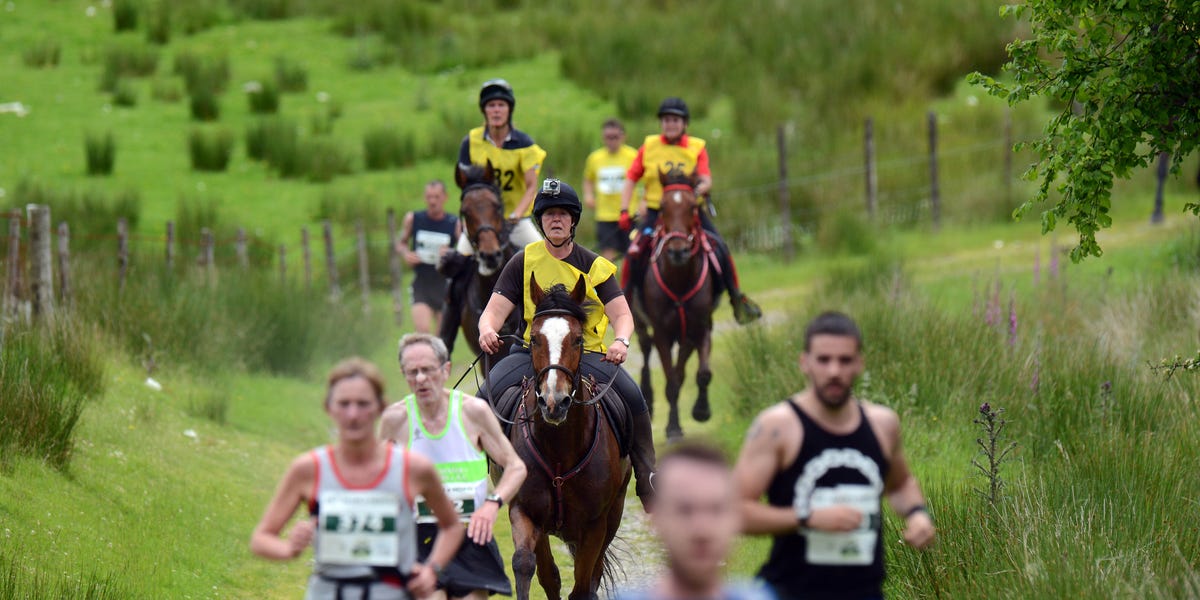
A horse can outrun a man. Everyone in the bar could agree on that. But at what distance, and under what conditions, would a human stand a chance? At what point are four legs no longer better than two? If the race unfolded over mountainous terrain, they wondered, would the horse's advantage disappear?For the first 24 years of the Man vs. Horse Marathon, the outcome was never in doubt. The mounted side of the race crossed the line first at Llanwrtyd Wells, Wales, every single time, from the inaugural race in 1980 through 2003. The debate that started it all had played out at the Neuadd Arms Hotel, where landlord Gordon Green bet a group of local huntsmen that a man could outlast a horse over rough, uneven ground. The huntsmen took the other side, and Green turned the disagreement into an annual fixture. Pour enough pints into a pub argument, and eventually someone proposes settling it outside.Then, something shifted. Since 2004, five different runners have crossed the finish line ahead of every horse in the field: Huw Lobb, who beat 565 runners and 47 horses to end the 24-year streak, followed by Florien Holtinger in 2007, Ricky Lightfoot in 2022, Daniel Connolly in 2023, and Dewi Griffiths in 2025. When three of those five wins came within a single four-year stretch, observers started to wonder whether the balance of nature had finally tipped in man’s favor.But last month, a hooved competitor took the title back. Rachel Lima and her mount, Zameel, won the 2026 edition in 2 hours, 31 minutes, and 37 seconds, on a newly redesigned 23.5-mile course that climbed to 4,000 feet. Connolly was the fastest runner on the day, but he crossed roughly eight minutes behind Lima.Even in defeat, the runners had unsettled the huntsmen’s old argument. What used to be automatic now has to be earned, by horses and humans alike.The physiology behind the closing gapHorses, for the most part, are built for raw speed, capable of hitting close to 90 kilometers per hour in a flat sprint—a number that puts them closer to a moving vehicle than to most other mammals. Usain Bolt, by comparison, topped out around 44.7 kilometers per hour setting the 100-meter world record in Berlin in 2009. Over a single mile of open ground, there's no contest.But testing that gap over a single mile of open ground was never the point of the Neuadd Arms debate. The course Green settled on winds through a bog, river crossings, steep climbs, and rough moorland over approximately 22 to 23 miles, depending on the year; across that distance, the terms of the argument change entirely.But the most crucial difference between the two species might not be speed at all: It's temperature. Humans cool primarily by sweating, while horses rely more on panting and overheat faster under sustained exertion. Some researchers argue that on a hot enough day, a fit human could outlast a horse over a full marathon distance for exactly that reason; not because the horse is slow, but because its cooling system becomes the limiting factor before its legs do.The organizers of the Man vs. Horse race have more or less confirmed this in practice. When a cob named Branny beat the field in 2024, it was the first time a horse had won in three years. One rider pointed to the weather as the reason; runners had won the previous two years because hotter conditions favor them, since riders ease off to protect their horses.That single variable, more than training or course design, appears to be the biggest reason the race has tightened. It isn't really about grit, but consideration for the animals. Riders have to think about two bodies on race day. Runners only have to think about one.Terrain still mattersThe course itself plays a role, too. Runners traversing the Welsh countryside tend to make up ground on steep climbs and through marsh and water, terrain where a horse's size and weight become a liability rather than an asset. Horses, in turn, reclaim the advantage on flat, open stretches, where stride length and top speed take over.Organizers redesigned the course for 2026, with runners and riders climbing to 4,000 feet across tarmac roads, forestry tracks, farm trails, bridleways, open moorland, and river crossings, which may help explain why this year's race, despite the horse win, still finished closer than the blowouts of the 1980s and 1990s.Mid-race vet checks add another wrinkle. Horses get pulled off course for health checks, and any horse that doesn't recover fast enough can be held back, no matter how fast it was running before. Runners face no equivalent checkpoint.A closer race, not a settled oneAfter a stretch like 2022 to 2025, it was tempting to think humans had solved the Man vs. Horse Marathon. But the overall record still says otherwise. This year's edition was the 45th run since 1980, and horses have now won 40 of them. What's meaningfully changed, however, is the margin of victory. The blowouts of the race's first quarter-century have given way to finishes decided by single-digit minutes rather than the wide gaps of a generation ago, and on the right day, in the right heat, a strong trail runner has a real shot.The jackpot prize structure tracks that shift. Any runner who beats the first horse and rider takes home a prize that starts at £500 and grows by £500 for every year it goes unclaimed. When Huw Lobb finally broke the streak in 2004, he collected a check for £25,000, worth about $45,500 at the time. After Griffiths won in 2025, it reset. Going into 2026, it stood at £500, and a horse made sure it will grow again next year.There's little glory for the horses that lose this race, and not always much more for the men who win it. One species gets sent off to stud for victory. The other just goes back to the bar where this all started.Jeff Kirshman is a writer, editor, and content strategist based in Chicago. His work has appeared in Runner's World, ESPN, The Classical, and the Casper Star-Tribune, and has been featured in the "Best American Sports Writing" anthology series. Outside of work, he's an avid runner and adventure traveler who has completed 10 marathons, including three Boston qualifiers, won the Great Wall of China Marathon, and summited Mount Kilimanjaro, though he'd trade it all for a reliable jump shot and the ability to parallel park on the first try.
For 24 Years, Horses Dominated the Man vs. Horse Marathon. Now, Humans Are Starting to Win
Full Article
Original Source
Read the full article at Runnersworld →KhanList aggregates and links to publicly available news content. We do not host full articles from third-party sources. Always verify important information with original sources.