
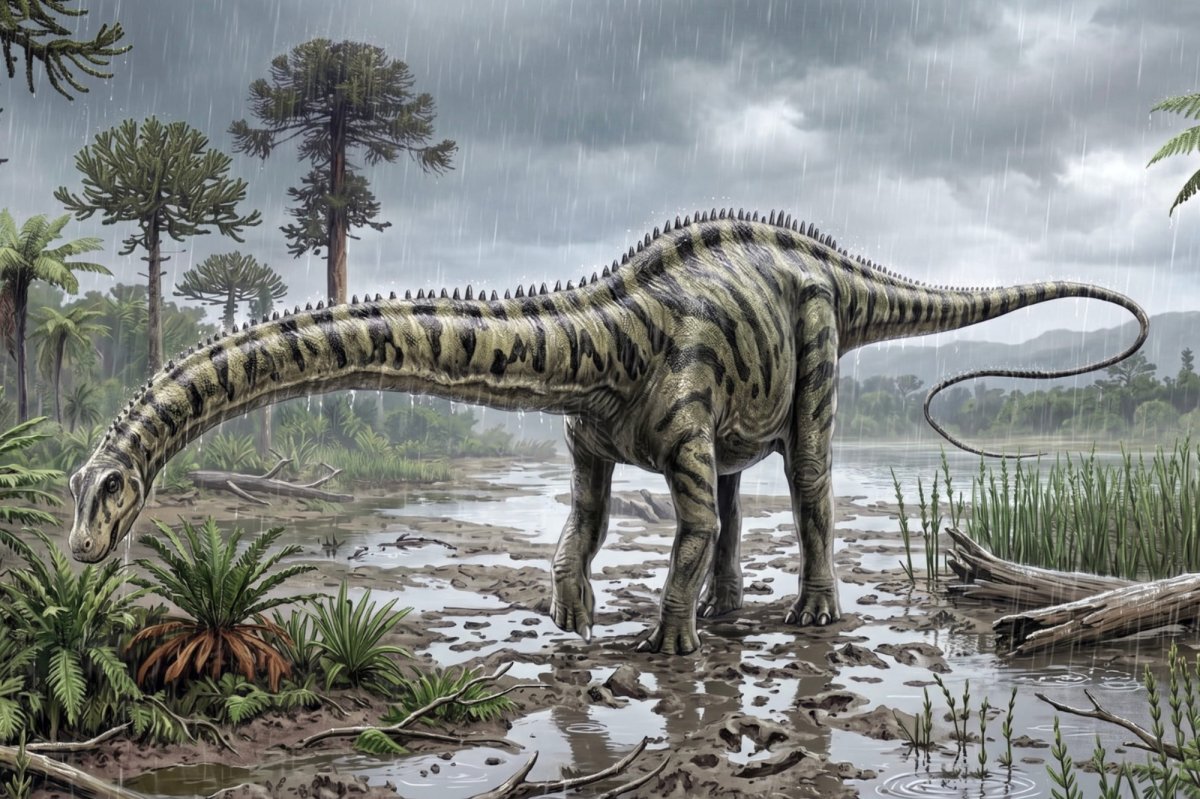
Until now, all Diplodocus remains had been found in the U.S. Illustration: Carmelo López Get the Popular Science daily newsletter💡 Breakthroughs, discoveries, and DIY tips sent six days a week. By signing up, you confirm you are 16+, will receive newsletters and promotional content and agree to our Terms of Use and acknowledge the data practices in our Privacy Policy. You may unsubscribe at any time. Diplodocus is a famous genus of giant sauropod dinosaurs with small heads and long, whip-like tails that lived in the Late Jurassic period (155 to 145 million years ago). Since its discovery in 1878, all confirmed Diplodocus remains have been unearthed from the Morrison Formation fossil hotspot in the western United States. Now, however, paleontologists have identified Diplodocus remains in Spain. The remains came to light in the El Castellar municipality of the Spanish city of Teruel, and represent the first evidence of Diplodocus beyond the borders of North America. They consist of 14 well-preserved tail vertebrae and several chevron bones (bony arches in the tail). Through traditional anatomical comparisons and advanced phylogenetic analyses, the researchers confidently categorized them as Diplodocus and a close cousin of Diplodocus hallorum. “As we looked more closely at the anatomy, we began to identify a combination of features characteristic of Diplodocus species. Then, as we carried out different evolutionary analyses, they kept pointing in the same direction,” Sergio Sánchez Fenollosa, lead author of the Journal of Vertebrate Paleontology study and a graduate student in biodiversity and evolutionary biology at the Joint Paleontology Foundation Teruel-Dinópolis research foundation, said in a statement. “With each new result, the picture became clearer: we were looking at a Diplodocus.” Dinópolis is a huge paleontological museum and theme park in Teruel, about 200 miles east of Madrid. This particular individual dates back to around 150 million years ago. Its place of death indicates that during the Late Jurassic, dinosaurs could migrate from between North America and Europe, probably making use of temporary land bridges that sometimes emerged in the proto-North Atlantic Ocean. During the Jurassic (201.4 to 145 million years ago), the ancient supercontinent Pangea started pulling apart into the Laurasia and Gondwana landmasses, and the Atlantic Ocean also started forming. Diplodocus are a subgroup of sauropods, which were among the longest land animals to ever walk the Earth. The recent finding sheds light on Iberian Mesozoic (252 to 66 million years ago) ecosystems and sauropod dinosaur diversity in the European Jurassic, Fenollosa explained. “The Diplodocus from El Castellar was approximately 25 meters long [82 feet] (comparable in size to its North American relatives), making it another of the giant sauropods of the Spanish Jurassic,” said Alberto Cobos, co-author of the study and managing director of the Joint Paleontology Foundation Teruel-Dinópolis. Its remains are now on display at the Aragones Museum of Paleontology at Dinópolis. 2026 Popular Science Home of the Future Awards 39 products that will improve your everyday life.
First Diplodocus fossils found outside of United States
Full Article
Original Source
Read the full article at Popsci →KhanList aggregates and links to publicly available news content. We do not host full articles from third-party sources. Always verify important information with original sources.