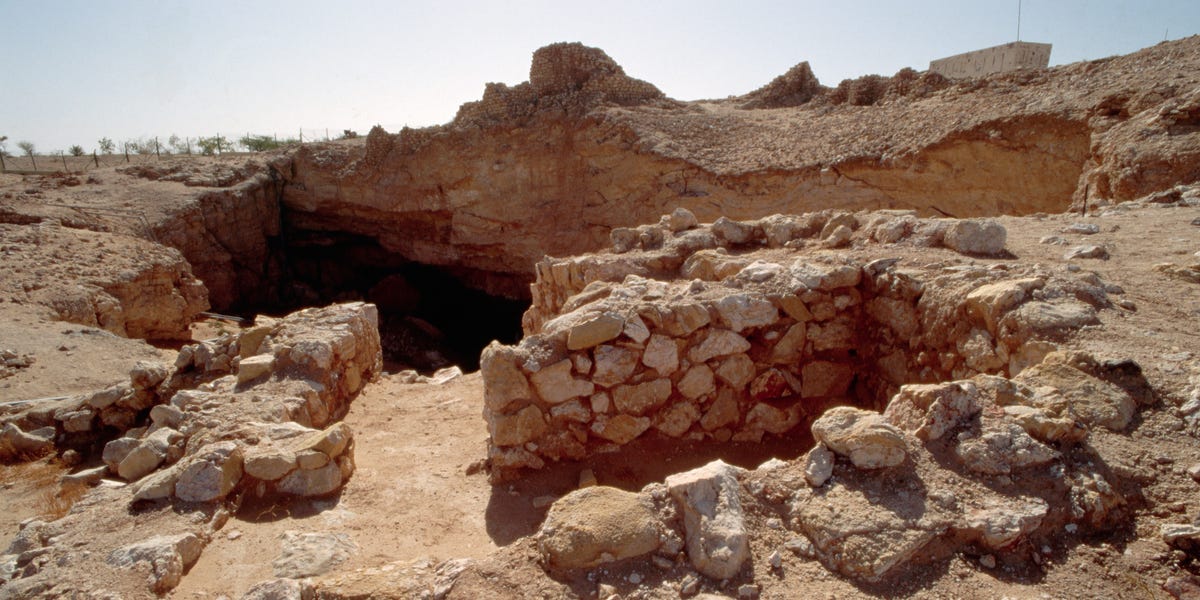
3 min readHere’s what you’ll learn when you read this story:Arabian folklore is filled with mentions of Ubar—a prosperous and mighty city destroyed by time and buried by shifting sands. Known as the “Atlantis of the Sands,” explorers spent centuries hoping to discover the once-wealthy metropolis. In the 1990s, famous explorers claimed that they’d found Ubar, but questions remain. Somewhere beneath the dunes of the Arabian Desert—or so the legend goes—lies a city that God himself destroyed. For nearly a century, some of the world’s most famous explorers have chased it. One team even claimed to have found it. But like the desert itself, the truth keeps shifting.The legend begins in ancient Arabian folklore. Ubar was said to be a wealthy, fortified oasis city along the incense trade route, its water sustaining impossibly tall towers as caravans of frankincense and myrrh passed through on their way from southern Arabia to the Mediterranean. Then, it vanished—divine punishment for its greed and immorality.The narrative is certainly compelling enough on its own, but the historical record also seems to suggest that a desert oasis once thrived in the Empty Quarter, the world’s largest continuous sand desert.Western fascination with Ubar began in 1931, when British explorer Bertram Thomas set out to become the first European to cross the Empty Quarter. His Bedouin guides told him stories of the lost city, and Thomas was hooked—he recorded the caravan tracks they claimed led to Ubar on his maps and published his findings in The Geographical Journal, dubbing the city the “Atlantis of the Sands.”That set off a search that attracted the likes of Lawrence of Arabia (Thomas Edward Lawrence), British explorers Harry St. John Philby and Wilfred Thesiger, and American explorer Wendell Phillips. All were on the hunt for this Atlantis of the Sands, but they all came up empty.Then, in the 1980s, filmmaker and amateur archaeologist Nicholas Clapp assembled a team that included adventurer Sir Ranulph Fiennes and archaeologist Juris Zarins. Using NASA satellite imagery, they traced ancient caravan trails converging on a site in Oman called Shisr. In a twist worthy of a movie script, it seemed to be the filmmaker who lead the way to excavations that eventually revealed fortified settlements, collapsed towers, and the remnants of a permanent well.“Guided by ancient maps and sharp-eyed surveys from space, archaeologists and explorers have discovered a lost city deep in the sands of Arabia,” according to a 1992 New York Times article about the explorers, “and they are virtually sure it is Ubar, the fabled trading center of the rich frankincense trade thousands of years ago.”There was just one problem: Shisr had never been lost.Thesiger had written about the site decades earlier. Oil company geologists had documented its ruined fort in the 1940s and dismissed it as a candidate for Ubar. The fortress itself was likely built in the 1500s, though Clapp’s team argued it sat atop a far older settlement. Saudi officials publicly questioned the claims, and UNESCO classifies Shisr as a medieval settlement. Nothing found there proves it was ever more than a well-defended trading post, let alone a fabled metropolis.The Clapp team wasn’t dissuaded. In a 2007 study published in Remote Sensing in Archaeology, the explorers wrote that Shisr held artifacts from Persia, Rome, and Greece, along with an octagonal fortress tied to the incense trade. And while they found no evidence of a sandstorm, they did find a sinkhole—one that had swallowed the main gate—likely caused by residents draining the groundwater dry. Zarins offered a more nuanced defense to PBS: historical texts describe Ubar as a region and a people, not a single city. Shisr, he argued, could still be a piece of the puzzle.With trade moving toward sea routes instead of over a waterless desert and the groundwater drying up, Shisr likely sank into oblivion, and its demise may very well have laid the foundation for the legend of Ubar. But if there’s an Ubar to find, it may still sit among the sands of the Empty Quarter.Tim Newcomb is a journalist based in the Pacific Northwest. He covers stadiums, sneakers, gear, infrastructure, and more for a variety of publications, including Popular Mechanics. His favorite interviews have included sit-downs with Roger Federer in Switzerland, Kobe Bryant in Los Angeles, and Tinker Hatfield in Portland.
Explorers Spent Centuries Hunting the ‘Atlantis of the Sands.’ A Film Crew May Have Found It.
Full Article
Original Source
Read the full article at Popularmechanics →KhanList aggregates and links to publicly available news content. We do not host full articles from third-party sources. Always verify important information with original sources.