
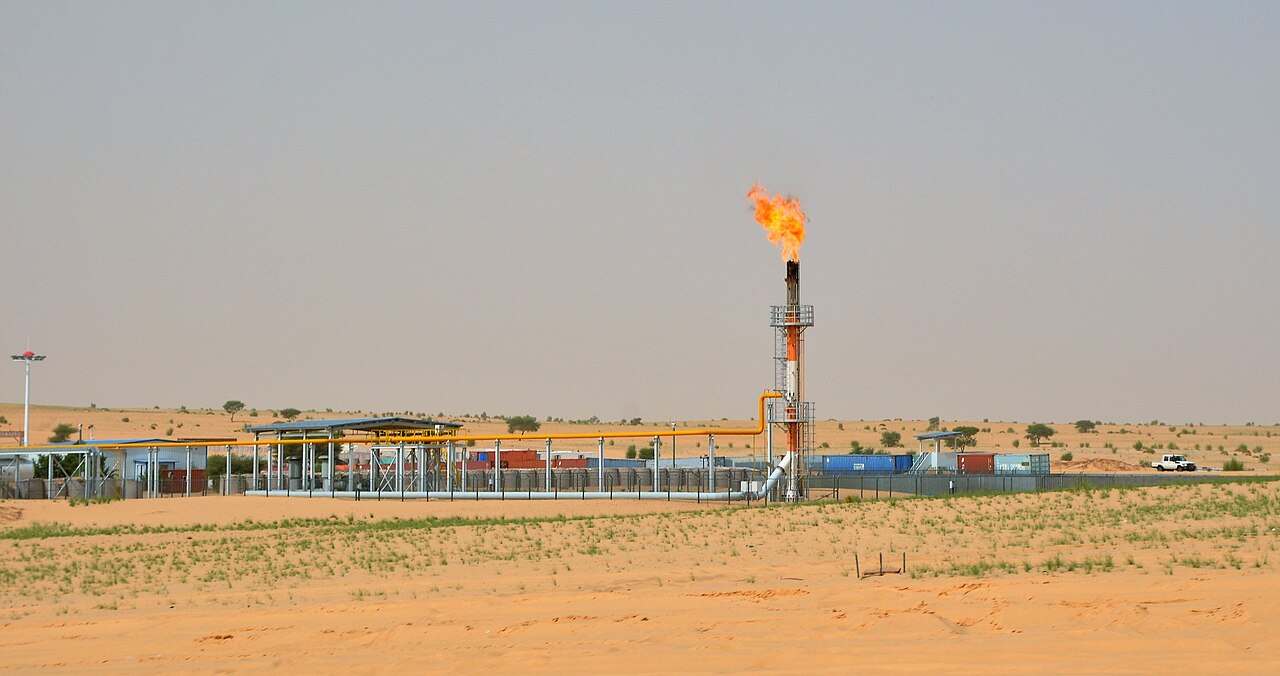
An oil well in southern Niger has been spewing crude oil and gas into the air since Sept. 25, damaging nearby installations and raising concerns about the potential impact on wildlife. Authorities reported the situation was still not fully under control four weeks later. “An environmental incident of exceptional severity occurred at the Goumeri W8 oil well,” Abdoulkarim Mohamed Ali, general secretary of Niger’s Ministry of Petroleum, said in a statement broadcast on Oct. 12. The disaster was “characterized by the ejection of large quantities of crude oil and gas to heights of more than 10 meters,” or 33 feet. As the statement was read on state TV, striking images showed crude oil erupting from the well like a geyser and spilling across the site. According to Ali, the situation was still “not fully under control” and could even get worse. “The platform, shared with the Goumeri W3 and W4 oil wells, has sustained significant damage, also compromising the integrity of these two neighboring installations,” the statement added. Initial findings ruled out the possibility of a criminal or terrorist act, though the cause of the eruption remains unknown, the statement said. A field mission including the petroleum minister and the environment minister was deployed on Oct. 14 to assess the situation. The team was able to meet the engineers working on the disaster, as well as a team sent by the Algerian government to assist. The Goumeri W8, W3 and W4 wells are part of the Agadem oil block, operated primarily by CNPC Niger Petroleum SA, a local subsidiary of state-owned Chinese oil company China National Petroleum Corporation. Agadem is located in the south of the country, close to the border with Chad and Nigeria. The desert region provides important habitats for three threatened species of Sahara Desert antelope: the Egyptian dorcas gazelle (Gazella dorcas dorcas), the slender-horned gazelle (Gazella leptoceros), and the addax (Addax nasomaculatus). Although the true environmental impact of the disaster is not yet known, the massive release of crude oil could have negative consequences for threatened biodiversity. An investigation has been opened to determine the exact causes of the accident and establish responsibility. Mongabay contacted Niger’s Ministry of Petroleum and CNPC Niger Petroleum SA for comment, but did not received a response by the time this story was published. Banner image: Gas flaring at an oil installation of the China National Petroleum Corporation Niger in the Agadem block, 2 kilometers (1.2 miles) north of the hamlet of Melek. Image by NigerTZai via Wikimedia Commons (CC BY-SA 4.0). Credits Topics
‘Exceptionally severe’ oil well eruption in Niger raises fears for threatened desert wildlife
Full Article
Original Source
Read the full article at News →KhanList aggregates and links to publicly available news content. We do not host full articles from third-party sources. Always verify important information with original sources.