
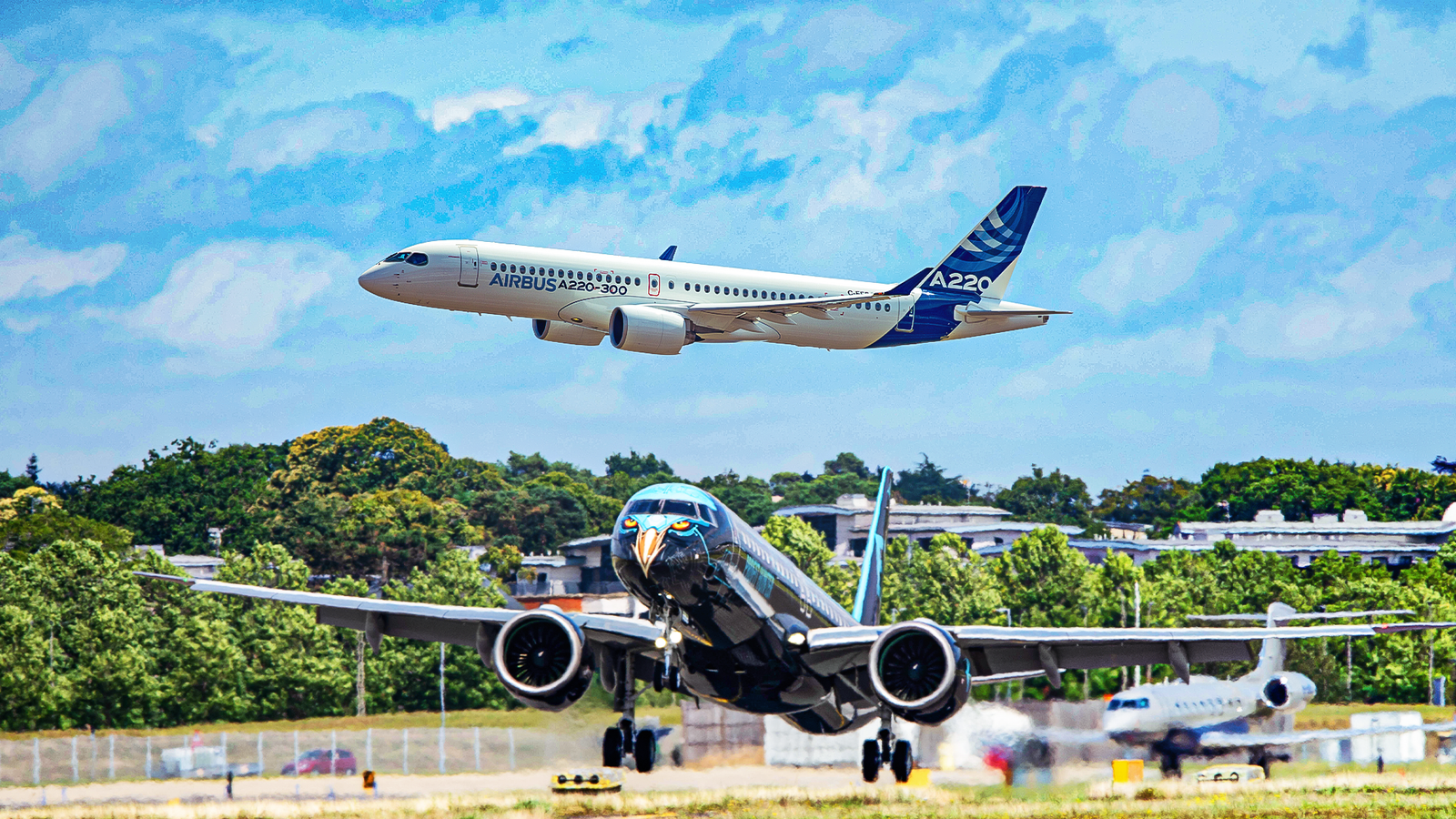
Published Sep 14, 2026, 5:01 PM EDT Prachi is a London-based journalist with extensive experience in the aviation industry. She has worked for several leading industry publications, covering a broad range of topics. Her expertise lies in aircraft maintenance, emerging technologies, and advanced air mobility. She is currently pursuing a PhD in Journalism, focusing on data journalism and its potential to transform conventional aviation reporting. When it comes to commercial aircraft, the rivalry between Airbus and Boeing usually gets most of the attention. The two manufacturers have spent decades competing in both the narrowbody and widebody markets. Their aircraft families go head-to-head for airline orders worldwide. But another interesting competition has been developing at the smaller end of the market. Embraer has built a strong position here with its E-Jet family, which gave airlines an option between traditional regional jets and larger narrowbody aircraft. The family quickly became a familiar sight worldwide after entering service in the mid-2000s. Things became even more interesting when Bombardier introduced the CSeries. The aircraft was designed for the same general market as the larger E-Jets. It also featured a clean-sheet design and newer technology. The program later became the A220. That brought Airbus into direct competition with Embraer in a segment where the Brazilian manufacturer had already spent years building its presence. Embraer Decided To Look Beyond The ERJ145 Credit: VanderWolf Images | Shutterstock Back in the 1990s, Embraer made a decision that would change the direction of its commercial aircraft business. At the time, the company had found success with its ERJ145, a 50-seat regional jet that entered service in 1996. But it knew there was a limit to how far it could take the ERJ platform. In fact, the case for a larger aircraft became even stronger in 1997, when American Airlines sought proposals for both 50-seat and 70-seat regional jets. Embraer won the 50-seat requirement with the ERJ145, but Bombardier secured the larger portion with the CRJ700. This showed the Brazilian planemaker that its existing product range left it vulnerable as airlines started looking beyond 50 seats. The company therefore started looking at a larger aircraft that could fill the space between small regional jets and the larger aircraft offered by Airbus and Boeing. Initially, Embraer considered developing the aircraft from the existing ERJ145 design. The proposed 70-seat aircraft would have retained parts of the existing jet, including its nose and cockpit, but would have had a wider fuselage and a new wing. This project was expected to cost around $450 million. By February 1999, however, Embraer had abandoned the derivative plan and decided to develop a completely new aircraft instead. Indeed, a clean-sheet design was more expensive to develop, but it gave the manufacturer much more freedom. The company could use a wider fuselage with four-abreast seating and develop a common design that could be stretched into different variants. The E-Jet Family Quickly Expanded Across The 70- To 100-Seat Market Credit: Wirestock Creators | Shutterstock Embraer officially introduced the E-Jet family on June 14, 1999, at the Paris Air Show. The manufacturer initially announced two aircraft, the E170 and E190, covering different capacities in the 70- to 100-seat range. The E170 was the first of the family to enter commercial service, doing so in March 2004 with LOT Polish Airlines. The E170 was the smallest member of the family and was followed by the slightly larger E175 in July 2005. The E175 entered service with launch customer Air Canada. The planemaker then moved further up the range with the E190, which entered service with JetBlue, taking the E-Jet family into the networks of mainline carriers. It later completed the original family with the E195. The E-Jet family has since seen significant success; several airlines worldwide have added the aircraft to their fleets. According to ch-aviation data, around 603 E175s remain in active service. Specification(s) Embraer E170 Embraer E175 Embraer E190 Embraer E195 Length 98 feet, 1 inch (29.90 meters) 103 feet, 11 inches (31.68 meters) 118 feet, 11 inches (36.24 meters) 126 feet, 10 inches (38.65 meters) Wingspan 85 feet, 4 inches (26 meters) 85 feet, 4 inches (26 meters) 94 feet, 3 inches (28.72 meters) 94 feet, 3 inches (28.72 meters) Range 2,150 nautical miles (3,982 km) 2,200 nautical miles (4,074 km) 2,450 nautical miles (4,537 km) 2,300 nautical miles (4,260 km) Maximum Takeoff Weight (MTOW) 38,600 kg (85,098 lb) 40,370 kg (89,000lb) 51,800 kg (114,200 lb) 52,290 kg (115,280 lb) Typical Seating 66 to 78 passengers 76 to 88 passengers 96 to 114 passengers 100 to 124 passengers Republic Airways, SkyWest Airlines, and Envoy Air are among the largest operators. Around 59 E170s also remain in airline fleets. S7 Airlines, Envoy, and SkyWest are among the operators. Embraer also has a backlog of 171 E175s. The larger E-Jets have also remained in service. Around 113 E190s are currently active with airlines. Aeromexico is one of the operators. Around 28 E195s remain in active service. LOT Polish Airlines and Helvetic Airways are among the operators. Embraer Recently Delivered Its 2,000th E-Jet Credit: Guilherme Amancio Moreno | Shutterstock Furthermore, by the late 2000s, the market was starting to change. Embraer continued to receive orders for the E-Jet family, but airlines were becoming more interested in larger and more fuel-efficient aircraft. Bombardier's CSeries was another new competitor in the same market. Embraer therefore began looking at ways to update the E-Jets. Later, in 2013, it launched the E2 family, which consists of three variants: the E175-E2, E190-E2 and E195-E2. The manufacturer kept the basic E-Jet design but introduced new engines, redesigned wings, and updated systems. The E190-E2 entered commercial service with Widerøe in 2018. The E195-E2 followed with Azul in 2019. Meanwhile, the E175-E2 program is on hold and is not expected to resume in the near future. Overall, the original E-Jet family and the E2 have helped Embraer build a large presence in this part of the market. Embraer E2 Jet Family Top 5 Operators Embraer E190-E2 Embraer E195-E2 Scoot (9) Porter Airlines (54) Helvetic Airways (8) Azul Linhas Aéreas Brasileiras (47) Royal Jordanian (4) KLM Cityhopper (25) Virgin Australia (4) Binter Canarias (16) Fuerza Aérea Mexicana (4) Airlink (South Africa) (6) According to the Brazilian planemaker, the E-Jet fleet has served more than 90 airlines across over 60 countries to date . It has also accumulated approximately 48 million flight hours and carried more than 2.85 billion passengers. On September 2, the manufacturer delivered its 2,000th E-Jet family aircraft. The aircraft was an E195-E2 for Azul Linhas Aereas, Brazil's largest airline by number of destinations served. The A220 Entered A Market Already Led By The E-Jets Credit: Karolis Kavolelis | Shutterstock There is no doubt that Embraer has built a strong position in the smaller narrowbody market with its E-Jet family. But the A220, formerly the Bombardier CSeries, also serves a similar part of the market and has taken a very different path. Back in the early 2000s, Bombardier was a major player in regional jets through its CRJ family. However, it lacked a modern aircraft between the regional-jet market and the larger narrowbody aircraft from Airbus and Boeing. The company saw an opportunity for a new aircraft in the 100- to 150-seat range and started studying the idea in 2004. In 2008, Bombardier launched the CSeries family with two variants: the CS100 and CS300. The aircraft entered commercial service in 2016. Airbus later took control of the program and renamed the aircraft the A220-100 and A220-300. The A220 brought a new design, new engines, and a new wing. It has since gained a reputation for its efficiency, range, and passenger cabin. However, the A220 arrived in a market where the Brazilian planemaker already had a large customer base. The E-Jets had entered service more than a decade earlier, and many airlines had already built their fleets around the family. The E-Jet family also had a particular advantage in the US regional market because of airline scope clauses. These clauses limit the aircraft US regional airlines can operate for their mainline partners. The A220 also had a difficult start. At one point, according to the Financial Post, the CSeries program went over a year without a firm order. Boeing's anti-dumping petition against Bombardier after Delta ordered the CSeries created another challenge. These issues made it harder for the aircraft to build its order book in its early years. The A220 Has A Lead On Paper But Still Has To Catch Up Credit: Markus Mainka | Shutterstock That said, the A220 program took a major turn in 2018 when Airbus acquired a majority stake in the CSeries program. The European manufacturer brought the aircraft into its global sales and support network. It also announced plans for a second final assembly line in Mobile, Alabama. This gave the program a stronger financial position and better access to Airbus' global customer base. As a result, orders started to increase. As of May 2026, the program had passed 1,000 firm orders. Notably, in May, AirAsia placed the largest single firm order for the A220, for 150 A220-300 aircraft. In July, at the Farnborough International Airshow, BermudAir also announced an order for ten A220-300s. Evidently, the A220 now holds the larger share of the market for the next-generation smaller narrowbody aircraft. Its order book is larger than that of the E2 family. Embraer's E2 program passed 500 orders in June 2026 and had more than 200 aircraft in operation at the time. However, the wider E-Jet family is still much larger because it includes the original E170, E175, E190, and E195, which have been in service much longer. Two Decades Of E-Jet Operations Give Embraer An Advantage Credit: InsectWorld | Shutterstock To conclude, since the A220 entered service in 2016, the smaller narrowbody market has become increasingly competitive. Embraer had already built a strong position in the segment with the E-Jet family, and the 2,000th delivery shows the scale of that presence. The E2 family specifically has given the manufacturer a new-generation aircraft for the same broad market. The A220 currently has the larger order book among the two next-generation families. The gap is notable, but Embraer continues to receive orders for the E2 as the aircraft finds a role with airlines that need flexibility on routes where a larger narrowbody may offer more capacity than required. Its commercial aircraft backlog stood at $15.1 billion after the second quarter of 2026, with 465 aircraft still to be delivered. Both planemakers are also working to strengthen the support networks around their respective aircraft. Embraer is expanding regional maintenance infrastructure. Airbus is also expanding its A220 support network, including introducing the first A220 full-flight simulator in the Asia-Pacific region in Singapore. The A220 and E2 are therefore still competing for airline requirements in the same broad market, but from very different positions. The A220 leads the order book among the two latest-generation families. Embraer, however, has something the A220 cannot gain simply through a larger order book: two decades of E-Jet deliveries, operators, and support infrastructure. That is what makes the competition interesting. The A220 still has to build the same level of presence that the E-Jet family has developed over more than 20 years.
Embraer Just Delivered Its 2,000th E-Jet While Airbus' A220 Fights To Catch Up
Full Article
Original Source
Read the full article at Simpleflying →KhanList aggregates and links to publicly available news content. We do not host full articles from third-party sources. Always verify important information with original sources.