
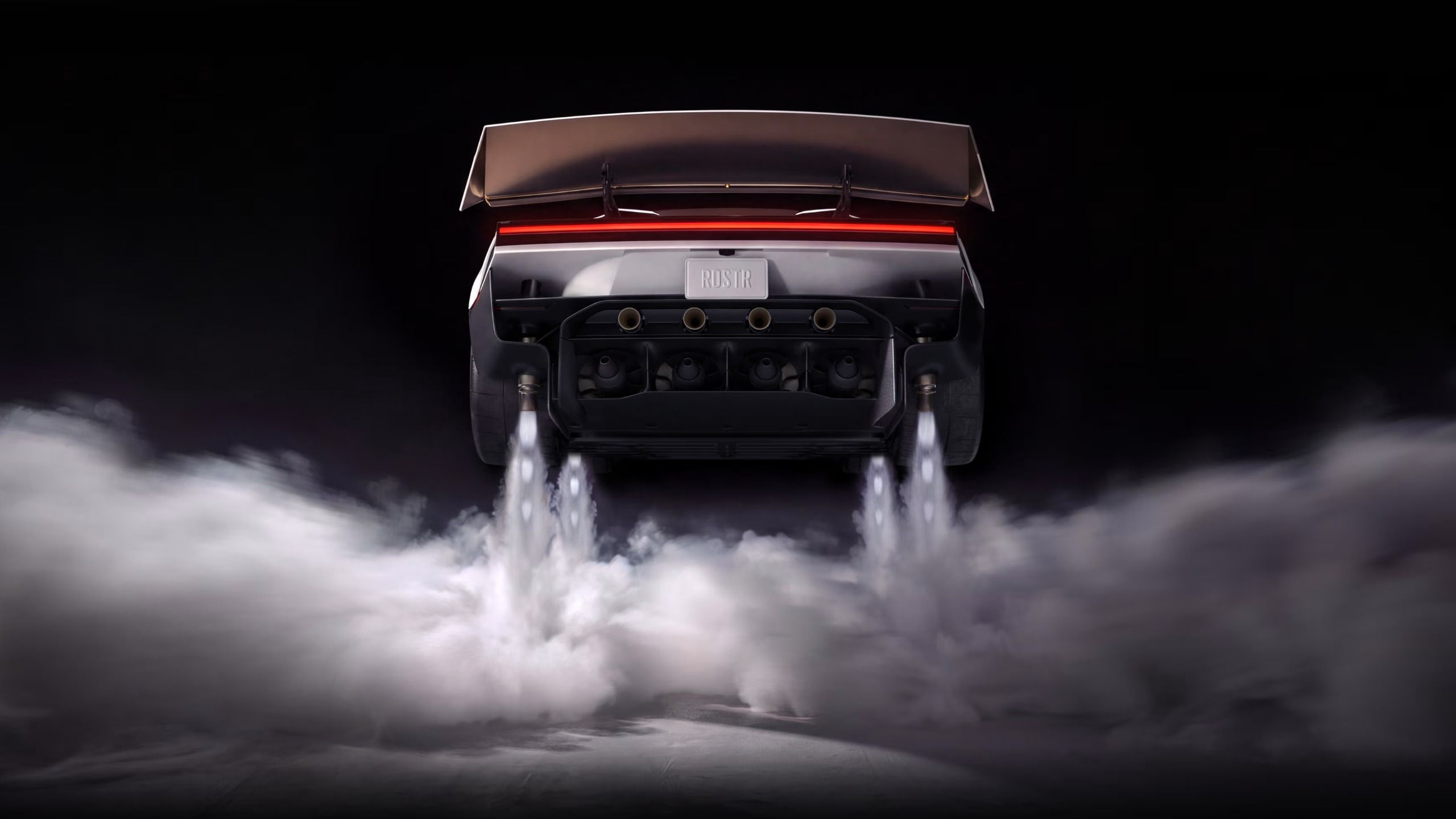
(Image credit: Tesla) This week, Elon Musk hosted the reveal of the new Tesla Roadster — nine years in the making — from the SpaceX rocket testing facility in Waco, Texas. The choice of location was apt, because this electric supercar can fly. Sort of.The event lasted less than 30 minutes and kicked off with the Roadster driving up a vertical ramp, clinging to the side, and coming to a standstill. Upside down. The car proceeded to reverse back down the ramp, before accelerating up it again, flipping off into mid-air, stabilizing, and flying down to the ground.Later on in the demonstration, the car launched itself into the air and barrel-rolled over a line of other Tesla cars — including the semi — before landing again. In the words of Tesla's VP for Engineering, Lars Moravy, "We borrowed some technology from SpaceX."You can watch the entire launch as it happened below:That SpaceX technology Moravy is referring to includes a fan-based suction system on the bottom of the car, capable of pulling up to two Gs of force. Meanwhile, the air-based manoeuvrability comes from two high-pressure air tanks and 10 nozzles placed around the car that act as thrusters. Each tank is 600 liters, containing around 250 kilograms of air — which can be recharged without the need for any chemical propellant.So, yes. Elon Musk has delivered on his promise of creating a flying car."I should say that this is not necessarily a safety-optimized car. But it takes the fun meter to 11 out of 10," the billionaire told the assembled crowd at the launch event.Get instant access to breaking news, the hottest reviews, great deals and helpful tips.“The car has obviously attitude control thrusters and main thrusters in the rear,” Musk said. “So, it can basically fly like a rocket and it could do rolls, it could do crazy gymnastics, whatever you want really.”Musk promised the Roadster will be an "actual car that's on the roads" but later on the company acknowledged that, at least the flying version, won't be road legal. An update posted to the company's website revealed there will be three models of the Roadster when it allegedly goes into production in 2028:Performance: This 'road ready' variant seats two passengers and features active aerodynamics and a multi-mode suction system that maximises downforce for next-level performance on and off the track.Thrust: This is the 'race ready' version that's set to go on a limited release and pairs the multi-mode suction system with the cold-gas thrusters in the rear that send the car from 0-60mph in under a second.Rocket: Tesla's 'air ready' model is strictly invite-only and boasts the suction system paired with the cold-gas thrusters positioned around the vehicle, allowing it to to support: "forward and upward acceleration as well as lateral rotational movement. So yes, it can fly."Tesla Roadster: Aircraft (and rocket) influenced design (Image credit: Tesla)Leaving aside the fact that it can take to the air and "kickflip" over other vehicles, the Roadster is a car that takes inspiration from the Lockheed SR-71 aircraft. “It's a nice clean aesthetic. Like I said, we leaned into a little bit of some of the aerospace aesthetics, said Tesla’s chief designer, Franz von Holzhausen.The seats inside are part of the chassis as a means of keeping weight down and the car features a steer-by-wire system. It has a steering yoke, electronic brakes and throttle controls.Tesla's aim was to have it accelerate from 0-60mph in under a second and, during the demo, the car cleared the hurdle at 0.81 seconds. Musk claimed there's more to come: “As you increase force and decrease mass, you get more acceleration,” he said. “So, the production car will actually do better than that – we'll just ride the limit of don't detach the retina of the human in the car.”20 years in the making (Image credit: Tesla)The event marked 20 years since the debut of Tesla's original electric roadster and the company has made no secret of its intentions to move into fully autonomous vehicles in the future. This new Roadster, however, is set to be the exception."This will actually be long-term the only manually driven car that Tesla makes,” Musk told the audience. “And so if you're going to have only one manually driven car, let's take it to the limits and way past the limits.”Tesla's achievement is jaw-droppingly impressive but, as ever with the company, take its timeline with a pinch of salt. Originally unveiled as a four-seater in 2017 with deliveries predicted to begin in 2020, we're only really seeing this car now, six years later. And there's been no mention yet of price, maximum range or charging speed.But really, does that matter right now? Tesla just gave us a flying car. Follow Tom's Guide on Google News and add us as a preferred source to get our up-to-date news, analysis, and reviews in your feeds. More from Tom's GuideI drove the Chevrolet Trax and Hyundai Venue for a week — here’s the sub-$30K SUV I’d buy with my own moneyFitbit Edge vs Fitbit Charge 6 — which Google fitness tracker wins?Apple holding event Oct. 28 for first touchscreen MacBook Pro — what we know Jeff is UK Editor-in-Chief for Tom’s Guide looking after the day-to-day output of the site’s British contingent.A tech journalist for over a decade, he’s travelled the world testing any gadget he can get his hands on. Jeff has a keen interest in fitness and wearables as well as the latest tablets and laptops. A lapsed gamer, he fondly remembers the days when technical problems were solved by taking out the cartridge and blowing out the dust.
Elon Musk just unveiled a flying car — watch the Tesla Roadster's incredible launch as it happened
Full Article
Original Source
Read the full article at Tomsguide →KhanList aggregates and links to publicly available news content. We do not host full articles from third-party sources. Always verify important information with original sources.