
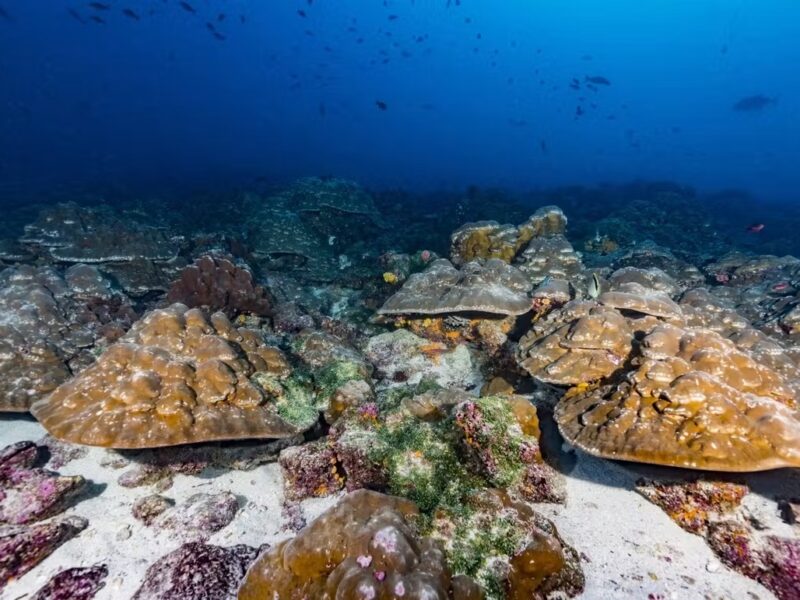
Scientists documented changes in sea temperature by coral growth over time to evaluate the intensity of bygone and more recent El Niño events.(CN) — El Niños have come and gone for ages, but recent findings suggest extreme weather events caused by their effects are 40% stronger in the last few decades than in the 19th century.In a study published Thursday in the journal Science, researchers at the University of Michigan examined ancient and modern corals from the Galápagos Islands to determine the intensity of El Niño events in the last 40 years as compared to those from the pre-industrial era about 1,000 years ago.Before 1850, El Niño events were not as strong in terms of fluctuating temperatures and winds, with the scientists concluding that human-driven climate impacts such as an increase in greenhouse gases leads to stronger El Niño events.“We don’t see a time in the past where El Niños have been as strong as today, and we show that the strength of El Niño changes in parallel with the warming of global temperature,” Julia Cole, a lead author of the study, professor and chair of the U-M Department of Earth and Environmental Sciences said in a statement. “Our findings tell us that the big El Niño events of the last 40 years are not normal in the context of the last 1,000 years.”An El Niño is a climate pattern. Often called a “natural phenomenon,” it occurs every few years. As the tropical Pacific warms and trade winds weaken — under normal conditions, trade winds along the equator blow east to west and push warm water to Australia — the warm water moves eastward toward South America, setting off the event.After warm water is pushed toward South America, large-scale air movement sends strong rains from Indonesia to the central Pacific while inducing drought in western Pacific, furthering weakening the trade winds. Conditions under El Niños can continue for up to two years and can affect weather worldwide.“This event is superimposed on global warming, and it’s likely to supercharge the temperature increase that we would normally see from greenhouse gases,” said Cole. “There are forecasts that we might get as hot as 1.7 or 1.8 degrees Celsius above pre-industrial temperatures, which is quite a bit higher than the current record."To understand El Niño effects across time, the scientists examined 13 coral samples, including living corals and ancient specimens from boulders in the Galápagos Islands, where El Niño has outsized impacts. Corals grow 1-2 centimeters a year by secreting layers of calcium carbonate. The researchers evaluated the chemistry of the layers and collected data of seawater temperatures when they grew. The results showed variations in temperatures in the Galápagos, showing strong El Niños in the past 40 to 50 years.Additionally, the researchers used climate models that simulated the past 1,000 years to examine if natural processes could have created strong El Niños back then. The models indicated that no shifts from natural processes could make such changes.The research underscores the need to alleviate global warming, Cole added.“El Niño is a really big source of climate extremes, and so if it’s getting stronger, the impacts are getting stronger. Impacts like droughts, floods, wildfire and food insecurity,” she said.“No country has the resources to be fully protected from these impacts. This is one more reason we need to move away from fossil fuels, the root cause of the problem.”Subscribe to our free newslettersOur weekly newsletter Closing Arguments offers the latest about ongoing trials, major litigation and rulings in courthouses around the U.S. and the world, while the monthly Under the Lights dishes the legal dirt from Hollywood, sports, Big Tech and the arts.Additional Reads
El Niño events much stronger in past several decades
Full Article
Original Source
Read the full article at Courthousenews →KhanList aggregates and links to publicly available news content. We do not host full articles from third-party sources. Always verify important information with original sources.