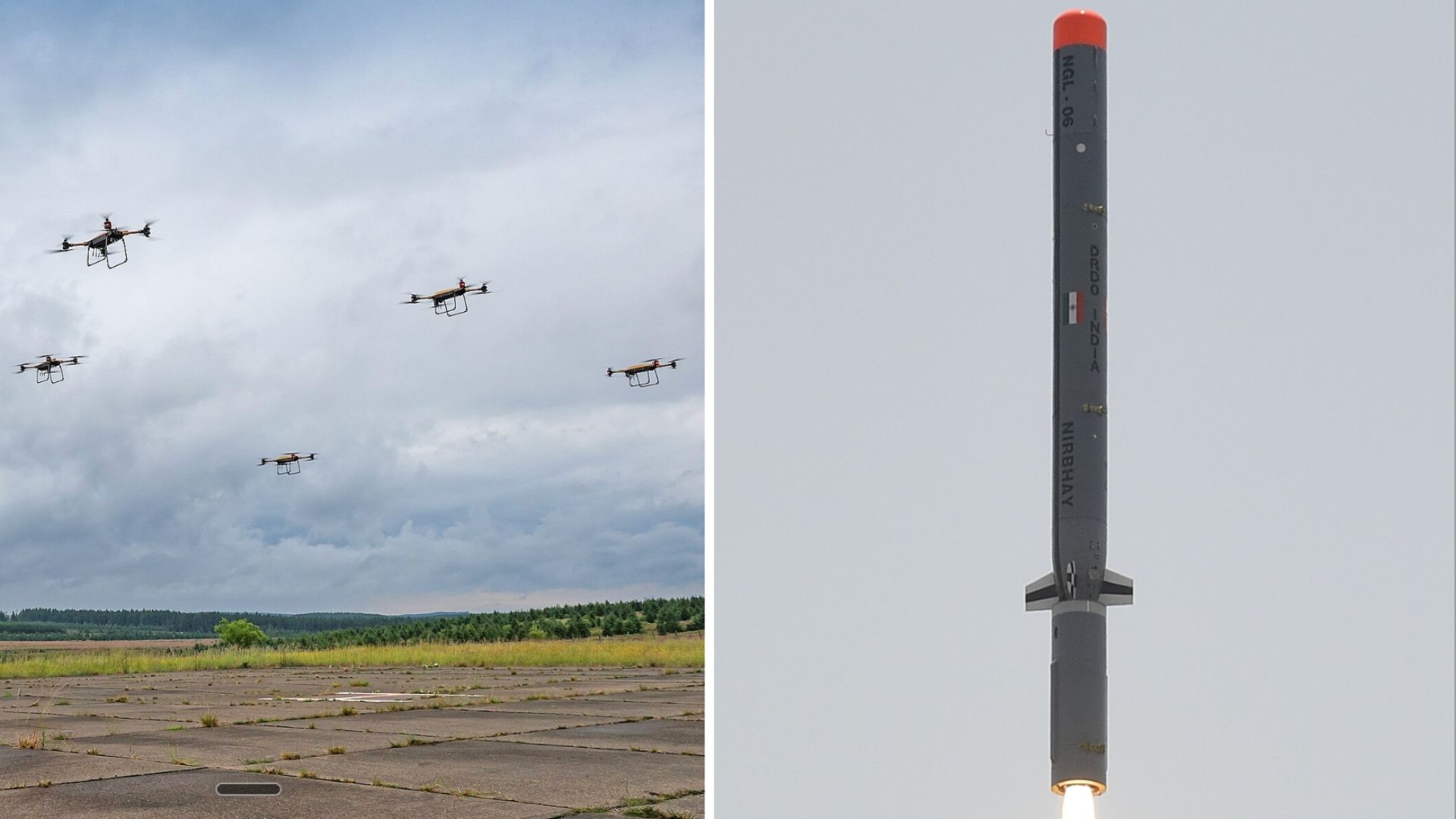
Drone swarm (L) and Cruise missile (R)1, 2 Drone swarms and cruise missiles are both designed to make life difficult for modern air-defense systems, but they do it in very different ways. Cruise missiles rely on long range, precision, low-altitude flight, and powerful warheads. Drone swarms, meanwhile, trade individual capability for numbers, coordination, and the ability to saturate defenses. So how do they actually compare? 1. Range Cruise missiles have a clear advantage when it comes to long-distance strikes. The US Navy’s Tomahawk, for example, can travel roughly 900 nautical miles, or around 994 miles (1,600 kilometers), depending on the variant. That allows it to attack targets deep inside hostile territory without requiring the launch platform to get close to enemy defenses. Small drones used in swarms generally have much shorter ranges. Their endurance depends heavily on battery capacity, propulsion, payload, and communications. Larger unmanned aircraft can travel farther, but they also become more expensive and move away from the low-cost swarm concept. Advantage: Cruise missiles 2. Payload and destructive power Cruise missiles also carry considerably more destructive power per weapon. A Tomahawk can carry a roughly 1,000-pound-class warhead, making it suitable for attacking hardened military facilities, command centers, air-defense sites, and important infrastructure. Most swarm drones carry much smaller payloads. Their strength instead comes from distributing weapons across many aircraft. A single drone may cause limited damage, but dozens attacking simultaneously can threaten multiple targets or repeatedly strike the same area. Advantage: Cruise missiles 3. Cost and scalability This is where drone swarms become particularly attractive. Modern cruise missiles can be sophisticated and expensive weapons involving advanced propulsion, navigation, guidance, sensors, and warheads. Swarm concepts instead emphasize large numbers of smaller and potentially attritable platforms. DARPA’s Offensive Swarm-Enabled Tactics program, for instance, explored operations involving as many as 250 autonomous air and ground systems. That means militaries could potentially put many more drones into the air for the cost of a comparatively small number of sophisticated cruise missiles. Advantage: Drone swarms 4. Penetrating air defenses Cruise missiles are specifically designed to make interception difficult. They can fly at low altitudes, exploit terrain, and approach targets using carefully planned routes, reducing the time available for enemy radar systems to detect and respond to them. Drone swarms create a different problem. Instead of making each aircraft exceptionally difficult to intercept, they can overwhelm a defense system by presenting numerous targets simultaneously. Air defenses may have to detect, track, prioritize, and engage dozens of incoming objects at once. However, drones can also be vulnerable to guns, electronic warfare, and short-range air-defense systems. Advantage: Depends on the defense being faced 5. Guidance and coordination Cruise missiles are highly precise but generally operate as individual weapons following programmed routes and guidance information. Drone swarms potentially offer something more dynamic. True swarming involves multiple systems communicating, sharing information, and coordinating their behavior. Some drones could search for targets while others conduct reconnaissance, attack, or relay information. This distributed approach could allow a swarm to adapt more effectively as conditions change. The drawback is that communications and coordination can create vulnerabilities to electronic warfare and jamming. Advantage: Drone swarms for coordination; cruise missiles for self-contained reliability 6. Battlefield roles Ultimately, the two weapons are suited to different jobs. Cruise missiles remain better suited for deep, high-value precision strikes where range and explosive power are essential. Drone swarms are potentially more useful for reconnaissance, saturation attacks, locating enemy defenses, attacking dispersed targets, and overwhelming defensive networks. Conclusion The most effective future approach may therefore combine both. Drone swarms could expose or distract enemy defenses, forcing them to expend interceptors and reveal their positions. Cruise missiles could then strike the most important targets. Rather than replacing cruise missiles, drone swarms may become another layer of the modern strike arsenal. Cruise missiles provide range and destructive power. Drone swarms provide mass, flexibility, and coordination. Recommended ArticlesGet the latest in engineering, tech, space & science - delivered daily to your inbox.Atharva is a full-time content writer with a post-graduate degree in media & amp; entertainment and a graduate degree in electronics & telecommunications. He has written in the sports and technology domains respectively. In his leisure time, Atharva loves learning about digital marketing and watching soccer matches. His main goal behind joining Interesting Engineering is to learn more about how the recent technological advancements are helping human beings on both societal and individual levels in their daily lives.
Drone swarms vs cruise missiles: Range, cost, power compared
Full Article
Original Source
Read the full article at Interestingengineering →KhanList aggregates and links to publicly available news content. We do not host full articles from third-party sources. Always verify important information with original sources.