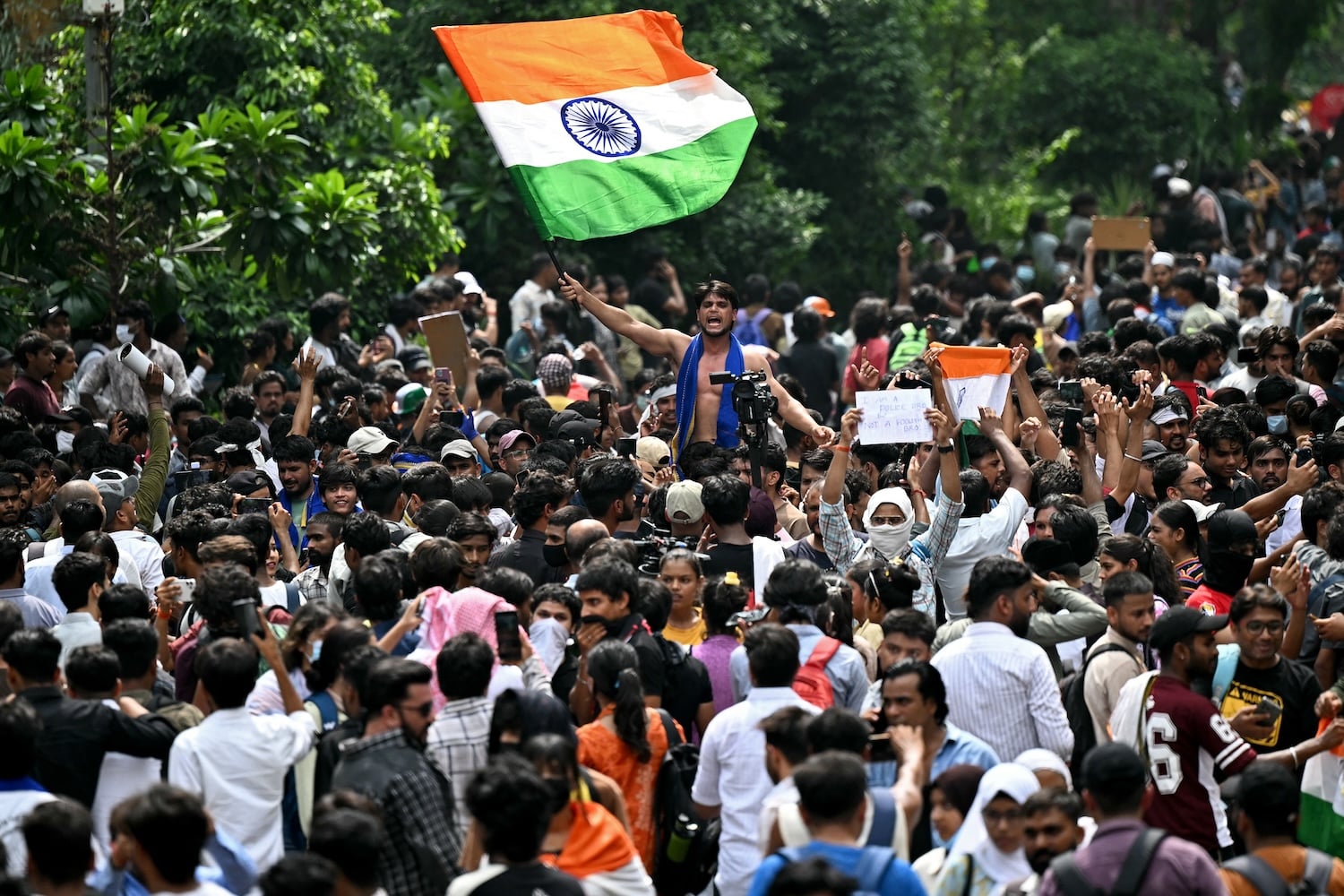
Welcome to Foreign Policy’s South Asia Brief. The highlights this week: India’s Cockroach movement winds down protests after the education minister resigns, violence surges around an election in Pakistani-administered Kashmir, and the resignation of Bangladesh’s president leaves few allies of former Prime Minister Sheikh Hasina in government. Modi Gives In to Protest Demands The protest campaign led by the Cockroach Janta Party—one of the largest such movements in Indian Prime Minister Narendra Modi’s 12 years in power—reached a conclusion over the weekend after the government agreed to some of the demonstrators’ demands. However, while the crisis has ended, it arguably has left Modi more politically vulnerable than ever before. The Cockroach movement is one of just a small number that have significantly challenged Modi and his Bharatiya Janata Party (BJP) government. It exposed the level of fury that many young people harbor toward a leader and party that have banked on their strong popularity to win three straight national elections. The rhetoric of the protesters was angry and sometimes profane. This also marks one of the few times when Modi’s government has given in to a domestic opponent. The only other instance of such major concessions was when New Delhi withdrew agricultural reforms that had triggered the mass farmers’ protests in 2020-21. Modi is seen as a tough leader who doesn’t make U-turns or acknowledge mistakes, even amid backlash. This unflinchingly resolute image has been undercut. The resignation of Education Minister Dharmendra Pradhan, the protesters’ core demand, delivers a sharper blow to Modi, though. Pradhan is an influential figure who is very close to the prime minister. The government prides itself on stability, and its cabinet ministers have largely remained the same since 2018. Pradhan’s departure upsets that trend. Further, the Cockroach movement upstaged the government online—a sphere where Modi and the BJP have dominated, a strength that helped the party secure the critical youth vote when it came to power in 2014. But the Cockroach Janta Party, which began satirically, is an online juggernaut, picking up millions of followers and garnering widespread support through memes. Of course, youth-led change movements often leverage the internet to their advantage. But the Cockroach Janta Party’s achievement is especially significant because it seemed to beat the BJP at its own game. The Cockroach protest campaign will likely have a galvanizing effect on other civil society movements in India. It has already spawned a copycat: A new group calling itself the E20 Janta Party is railing against ethanol-blended fuel and calling for the resignation of Indian Transport Minister Nitin Gadkari. Farmers have also launched fresh protests over a proposed U.S.-India trade deal. Unlike during his first two terms, Modi is now governing in coalition. In a worst-case scenario, one of his top coalition partners could conclude that public pressure and resistance are making the administration too vulnerable and pull out. But in the end, that isn’t likely—Modi is famously resilient. (I have described him as a “teflon” politician.) Still, the Cockroach movement has done a number on Modi’s government—and, remarkably, it has done so just weeks after the BJP scored a series of state election victories. A key signal awaits early next year, when BJP stronghold Uttar Pradesh—India’s most populous state and biggest electoral prize—holds elections. If the Cockroach Janta Party’s impact is strong enough to hurt the BJP in a critical state election, that will be of considerable concern to New Delhi. What We’re Following Violence in Pakistani-administered Kashmir. Security forces opened fire on protesters on Monday during the first phase of voting in Pakistani-administered Kashmir’s regional assembly election. At least 20 people were killed. Local officials have provided a different version of what provoked the violence, accusing armed protesters of firing on security forces at voting stations. This comes after at least 40 people were killed in unrest in Pakistani-administered Kashmir in the lead-up to the election, dating to last month. In an effort to reduce violence, local authorities suspended mobile and internet services. The region has been volatile for months, with residents expressing anger about issues ranging from food costs to government repression. One of the central players in the crisis is the Joint Awami Action Committee (JAAC), which has demanded the abolition of a dozen seats in the local legislature that are reserved for those who have fled Indian-administered Kashmir. The JAAC alleges that Pakistani politicians use the seats for their own interests. The local government has accused the JAAC of trying to sabotage the election and banned the group under anti-terrorism laws. Many of this week’s deaths were reportedly caused by security forces opening fire on JAAC supporters trying to march to the local capital, Muzaffarabad. The violence is a tragic reminder that challenges in Kashmir are about more than territorial disputes. Bangladesh’s president resigns. Bangladeshi President Mohammed Shahabuddin submitted his resignation on Friday, citing health reasons for departing almost two years before his term was due to end. According to the constitution, the speaker of parliament will serve as president until a new one is indirectly elected, which must happen within 90 days after the resignation. In Bangladesh’s parliamentary system, the presidency is a ceremonial role. But Shahabuddin’s resignation is significant because he was one of few remaining allies of former Prime Minister Sheikh Hasina in the government—which is now led by the Bangladesh Nationalist Party (BNP), a bitter rival of her Awami League. Hasina was ousted amid mass protests in August 2024. Unsurprisingly, the resignation has become embroiled in controversy. Local media reported that Shahabuddin was pressured by the BNP government to quit after Shahabuddin spoke to the former prime minister by phone in May. The government has said relatively little, and Shahabuddin himself rejected the allegation that he stepped down under pressure. Resorting to retributive politics would be a disturbing sign for the BNP government, which took office in February. Bangladeshi Prime Minister Tarique Rahman has emphasized the importance of political reconciliation and unity, and his government has expressed less hostility toward Hasina and the Awami League than the interim administration that preceded it. Mounting public health crises. In Pakistan as well as Sri Lanka and Bangladesh, epidemics of HIV and dengue fever, respectively, are worsening. A hospital in Pakistan’s Sindh province reported at least 10 new HIV-positive cases this week. This comes after other hospitals reported new cases, including another in Sindh that reported this month that 78 children at the facility were infected. Sri Lanka, meanwhile, has reported 79,000 cases of dengue this year, including more than 23,000 so far this month. Finally, on July 23, Bangladesh’s government reported 450 new cases of dengue over a 24-hour period—bringing the number in July to just under 6,000 new cases, nearly 50 percent of this year’s total. Specific explanations in each country—the poor handling of needles and blood in Pakistan and a cyclone that increased mosquito breeding grounds in Sri Lanka—have been cited for the surges. But these countries are also grappling with financial challenges that have constrained efforts to bolster public health. Pakistan and Sri Lanka have two of the most precarious economies in South Asia. They are experiencing some macroeconomic stability but are just a few years removed from a debt default (Sri Lanka) and near-default (Pakistan). FP’s Most Read This Week The Western Myth of Russian Greatness by Christian Caryl Odysseus at the End of Civilization by Bret Devereaux There’s Only One Way Out of Trump’s Reckless War by Philip H. Gordon Under the Radar This week, Maldivian President Mohamed Muizzu announced that beginning next year, his government will present an annual award to people and organizations making significant contributions to preventing tobacco use—adding to its already-robust anti-smoking policies. In November, the Maldives announced a complete ban on tobacco for anyone born in or after 2007—including buying, selling, or using the substance. It is the only country in the world to have such a generational ban; New Zealand did at one time, but it was repealed in 2023. The anti-tobacco policies are striking in South Asia, where smoking rates remain quite high despite falling in recent years. According to the World Bank, nearly one-quarter of adults in the region—and nearly 40 percent of men—use tobacco. (That suggests that the Maldives’ ban may be ignoring an important demographic.) The tobacco ban, which also forbids the use of e-cigarettes and vaping, extends to tourists, too. Consequently, the Maldives is making a gamble. Tourism revenue is critical for the economy, so it wouldn’t want to discourage visitors.
Does Modi Have a Cockroach Problem?
Full Article
Original Source
Read the full article at Foreignpolicy →KhanList aggregates and links to publicly available news content. We do not host full articles from third-party sources. Always verify important information with original sources.