
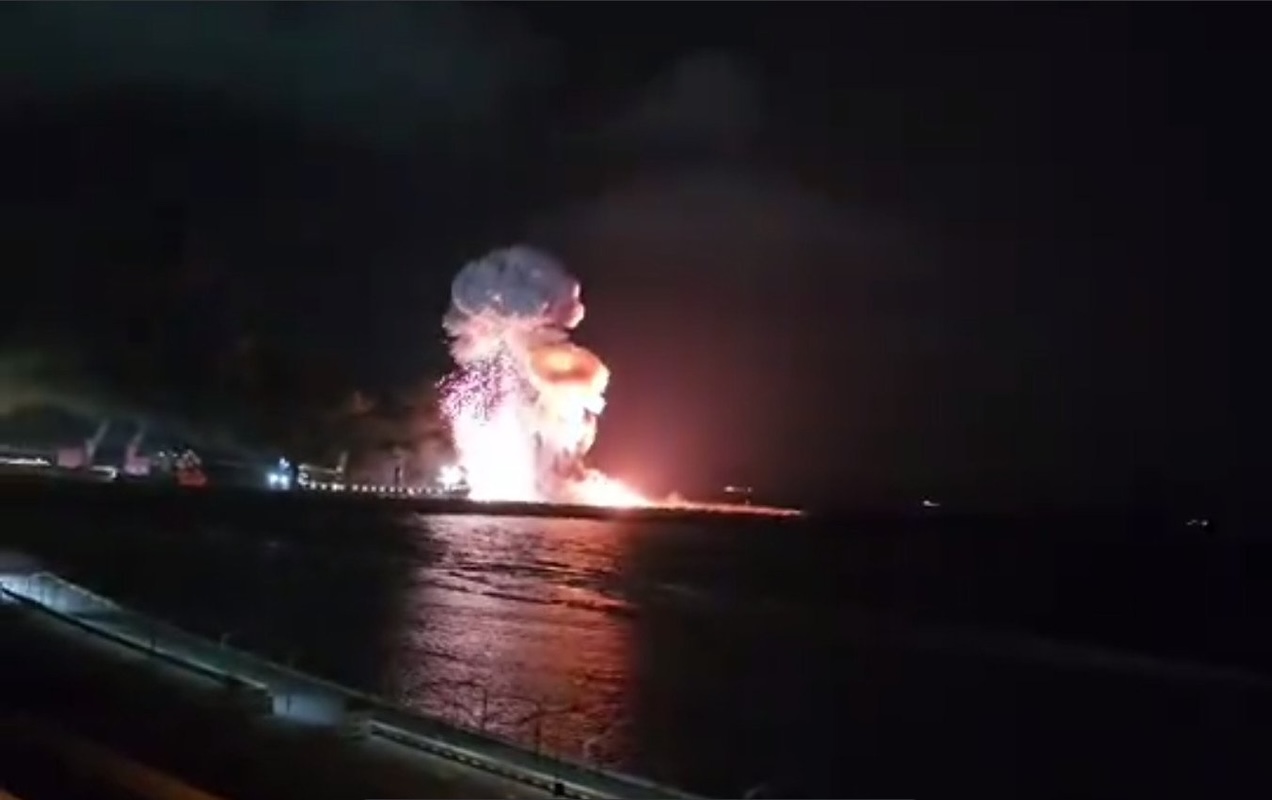
I will not lead this weekend update with Jared Kushner’s astonishingly revealing and frightening interview from this past week. Lots of people have written about that, and I’ve made a few comments online. I will not ignore it entirely, but include a section at the end of this update about a few parts of it that have not gotten the attention they deserve. However, before that, I wanted to have a deeper dive into some other elements of the war that really rose to the fore during the week. First is the war at sea, which continues to be revealing and, if anything, is growing in scope. There were different operations this week, from the Mediterranean to the Baltic, which showed this expansion and, moreover, should give all naval powers food for thought. Building on this, the second part will look at the reaction to these attacks. It is fascinating that states, in this case European ones, on the one hand want to limit what Ukraine can do but on the other do not provide the aid Ukraine needs. At some point, perhaps soon, this circle might be impossible to square. And finally, there will be some thoughts on the Jared Kushner interview this week, which might be the most ghastly interview (both for its ignorance and its ethical void) that a US diplomat has ever given. I will keep that until the end, to delay the indigestion for readers as long as possible. Before I get into this, however, I did want to draw your attention to my latest interview with a representative from Come Back Alive. On Wednesday, I sat down with Oleksiy Moskalenko and we focused on Ukrainian air defense efforts, in particular against newer Russian jet-powered drones. It will give you some idea of what Ukrainians are facing this winter. Watch now. Do not forget the war at sea At times people overlook the fact that Ukraine is fighting this war with a good deal of restraint. It is certainly not fighting the kind of unlimited war that Russia is fighting against it – attacking civilians, gas stations, and other such targets. Moreover, Ukraine is also not attacking legitimate military/strategic targets that it could under concepts of international law (if such a thing still exists in the world of Trump, Putin and Xi). The most obvious of these targets is Russian shipping on the high seas, in particular but not limited to Russian oil shipments, which remain the economic lifeblood of the Putin regime. Remember, Russia needs to ship out whatever oil, primarily crude but also some diesel, that it can, to raise money. Now it is even having to ship in refined oils as its own refining capacity is being deconstructed by the Ukrainians. That shipping on the high seas is absolutely a legitimate target. It is the kind of strategic target that all sides in World War II attacked with gusto, and arguably it is the kind of target that the USA is still attacking today as it tries to enforce a blockade on Iranian oil shipments. That is because such attacks can be extremely effective. If, for instance, the Ukrainians were able to shut off half of the oil shipments Russia loads out (or receives), it would devastate both Russian income generation and the ability of the Russian economy to function. It would be a massive benefit to the Ukrainian war effort and would complicate Russia’s in a number of ways. Not only would it make Russia much poorer, it would mean the Russians would have to divert a much larger percentage of their dwindling pool of resources to try and defend such shipping – and that might actually be beyond Russian capabilities. For instance, one normal practice would be for the Russians to provide convoy protection for the tankers carrying their oil. This is what became standard practice in World War I and II (and which the USA has tried to do in a new form as it attempts to get shipping out of the Strait of Hormuz). However, I doubt the Russians have anything like the warships needed to undertake an even limited convoy effort. Moreover, what the Ukrainians showed this week is that if the Russians even tried, it would probably lead to unsustainable losses for the Russian fleet. This is a long way of saying that Ukraine could be attacking Russian strategic shipping at sea and it would be strategically extremely damaging to Russia – but so far it has mostly held back. I will discuss the reasons for that holding back next, but will now discuss how this week shows what the Ukrainians could do if they wanted. We have seen attacks as part of the war at sea this past week, ranging from the coast of Libya to the Baltic – and showcasing the extreme vulnerability of shipping, from warships to commercial vessels. The attack off the coast of Libya, near the town of Benghazi, saw the Ukrainians, on November 22, cripple one of the newest and most advanced warships in the Russian navy, the Merkury. The Ukrainians also attacked a merchant ship, the Angara, which was being used to transport weapons to Russian paramilitaries or Russian-backed Libyan forces. Here is a video of the attack that the Ukrainians released. And here is a still picture of the Merkury after the attack. The vast majority of the hull is under the water. Salvaging and repairing the ship (even if that were possible) looks like no easy task, The Merkury is one of the newest ships in the Russian Navy, a corvette that was just commissioned in 2023 and designed to operate in littoral waters and conduct anti-submarine warfare. It was sunk by Ukrainian sea drones, one of the great Ukrainian technological successes in the war (the Ukrainians are now world-leaders in sea drones). Zelensky claimed that seven sea drones were used in the combined operation on the Merkury and the Angara. The video above will give you an idea of how they operated. Indeed, in the Zelensky tweet, there is a video of the attack on the Angara, which shows them in operation even more clearly. How the sea drones got there is still being discussed. They have a long range, so could have been deployed from a great distance, but also could have been brought relatively close to the target by a disguised merchant ship. Another notable thing about the attack was that it happened only one day after the Ukrainians attacked (allegedly) a Russian cargo ship, the Sparta II, in the Gulf of Finland. I say allegedly because the Ukrainians for political reasons have not taken credit for the attack, but it would be hard to imagine anyone else being responsible. Here is some background on the Sparta II, and yes, this is an absolutely legitimate target of war. The ship is the Sparta II, a 121-metre Russian-flagged dry cargo vessel owned by Oboronlogistika, a company whose own website says it provides logistics services to the Russian defence ministry. It is under US Treasury sanctions, and Ukraine’s military intelligence has classified it as a vessel that has carried weapons and military equipment. It left St Petersburg for Kaliningrad on November 20, according to vessel-tracking data cited by Reuters. Here is a picture of the Sparta II after the attack. It certainly is not as damaged as the Merkury, but it is not clear if it is still functional. Now the Sparta II was struck by what looks like two air drones/UAVs. The ship burned for a day, the crew was evacuated and last reports were that it had to be towed back to port. How the attack was launched is also under discussion. They could have been two long-range drones launched from Ukraine itself, flying all through Belarus/Russia before reaching the Gulf of Finland, or they could have been carried in a larger mother ship drone and then released closer to the target. Hopefully we will know more about this soon. Two key points emerge when you think of both of these operations occurring in one week. Russian strategic shipping in even the most important parts of the world for Russia is becoming exceedingly vulnerable. These are some of the most valuable war and commercial shipping vessels that Russia possesses and Ukraine was able to hit them close to the Russian shore (Gulf of Finland) and on the Libyan coast. Just as importantly, they were assaulted by a range of systems, air and sea drones, showing that Ukraine is broadening its attack options and the range at which it can operate. The kicker is that if the Ukrainians wanted to up this campaign against Russian oil shipments, they could do some very serious damage. They have not done this so far (see second story), but it is always a possibility. Indeed, the Ukrainians have certain advantages in running such a campaign, especially in that Russia can only ship oil in and out of a few major ports, providing a natural bottleneck. Remember, you don’t have to attack ships anywhere on the high seas, you have to attack them somewhere – and they have to come out of one port and come into another. What Ukraine showed this week is that it can do both effectively. The reaction to Ukrainian sea attacks The Ukrainian operations this week in the war at sea, not surprisingly, caused a great deal of international reaction – primarily European. The Russians, of course, had to chip in as well in a way that shows the effectiveness of both attacks. When it came to the Merkury, the Russians gave their typical “nothing to be seen here” reaction which they often give when the Ukrainians have done something particularly damaging. Kremlin spokesperson Dmitry Peskov gave as bland a statement as possible when asked about the operation. Our defense ministry is handling this, and any information, if deemed appropriate, will also be provided through the defense ministry. But, of course, we have taken note of Zelenskyy’s statement on this matter. Later, when pressed about this attack and the attack in the Baltic, Peskov gave a pretty bland warning. His exact wording when discussing both was that this was a “very dangerous trend.” The sea attacks bring home the reality that the Russians’ escalation abilities, particularly in the war at sea, are limited. They are already regularly attacking Ukraine’s main port area around Odesa – and, to be frank, the Russians are probably desperate to do anything to limit any Ukrainian expansion of the war at sea. A general increase in this campaign will hurt Russia more than Ukraine. And it is not like Russia can escalate its attacks on Ukrainian civilian and economic targets. They are already doing everything they can here, when they can. They are already attacking everything they want when they have the systems to do so (thanks USA) and therefore the ability to escalate is rather limited. So the Russian reaction, tepid as it is, points out the problems that the war at sea presents to the Putin regime. The European reaction was also a little different than has sometimes been understood. The Finnish reaction to the attacks on the Sparta II was quite robust. Finnish President Alexander Stubb came out and placed the ultimate responsibility for the attack on Russia, for starting the war in the first place. Note: Even though the Ukrainians have not taken responsibility for this attack, the Finns have stated that they believe the Ukrainians are responsible. And they are right of course. The Finnish Prime Minister seemed to go even farther, supporting Ukraine’s right to make such attacks, saying: “Ukraine has the right to fight back against the aggressor.” This is notable, even though the Finns probably are keen not to see a full-throated naval war in the Baltic, considering that many of the Russian vessels moving through there are carrying oil. The Italian reaction seemed much more equivocal. Italian PM Giorgia Meloni (who has been a strong rhetorical supporter of Ukraine – though whose record on physical aid is more mixed) came out and indicated that she was opposed to Ukrainian actions that would expand the war into the Mediterranean. You know my support, and the Italian support for Ukraine. But I think that the war should not and cannot be expanded to the Mediterranean. I think that we must be very clear about this….I think we must do our best to continue to help Ukraine defend itself, but we must also defend the security of our borders and our citizens, and so I have been and intend to continue to be very clear about this with President Zelenskyy and Ukraine. It is hard to know how serious she was in this warning, or whether it was political performance. If you look at what Zelensky said, specifically about the Merkury attack in the Mediterranean, he believes he had partner support. In an interview with the BBC, Zelensky defended the attack, intimating that it was not quite the surprise to Ukraine’s partners many thought. Zelensky defended the move, calling the warship Merkury an “absolutely fair goal.” He accepted that such strikes were “very dangerous” but said Ukraine’s forces “never attack” without co-ordinating with its partners. The reality, of course, is that the longer the war goes on, and the less Ukraine is aided to have a decisive result, the less likely it will be that outsider influence will govern Ukrainian reaction. We have seen this very recently with the oil refinery attacks. The US government has gone to great lengths to try and bully the Ukrainians into stopping these attacks, and partially succeeded for a while. Now the Ukrainians are back at it, and doing the attacks more than before (with enormous strategic effect). The Ukrainian Strategic Air Campaign On Russian Oil Is Maturing: A Primer We might see something similar soon with the war at sea. It is probably a good thing that Ukraine’s European neighbors understand that. A country fighting for its existence will not pay much attention to countries that are not helping it. Nor should they. The Kushner interview: two parts you might have missed OK, now the sick-making part of the update. The interview that Jared Kushner gave to Mathias Doepfner, owner of Politico, exploded this week. You can watch the whole thing here if you really want to. Many of the horrible parts of the interview have already been commented on by others. The description of Putin as a “grandmaster of politics,” a “historic” character, was indicative of Kushner’s outlook (as was his insulting of Zelenskyy and Ukraine). Overall, the interview revealed two things. Kushner has adopted the Russian view of the war (and international relations in general), hook, line, and sinker. He believes what the Russians have told him about NATO expansion, the reasonableness of Russia’s desires and the intransigence of Ukraine. The second big reveal was that Kushner is entirely out of his depth. He has that special arrogance of the truly dim but entitled. He does not seem to realize that he is where he is not out of any ability that he possesses, but because he was born into great wealth and married the daughter of a man who would become president. He honestly seems to think he is a man who understands and can undertake diplomatic negotiations effectively, when really he is an ethical void and simpleton who is leading US diplomacy into a dark hole. The fact that Kushner would give this interview while proudly displaying in the background a national security medal bestowed upon him by his father-in-law shows how much he lacks self-awareness. Kushner probably thinks he deserves that medal. The two best examples of how far he is out of his depth are his utter incoherence on Trump’s diesel deal with Putin and his extraordinary meditations on the history of US-Russian relations. I do apologize for the long quotes I am including below but, to understand the depth of the problem, you really need the detail. The diesel deal discussion starts around the 20th minute, makes no sense, is conflated with the US pressure on Ukraine not to attack Russian refineries and degenerates into an excruciating word salad. Starting at 20:16, this is how it goes. With regard to the diesel deal, look, you know, the, you know, energy infrastructure, if they’re hitting that in both countries. I mean, hitting energy grid for energy grid, uh that’s a localized issue. Um, you know, Ukraine started hitting the Russian refineries. And what happened from there was Russia put an export ban on diesel and diesel prices went up, uh, substantially, which was hurting American farmers and and fishermen and and other industries. So, President Trump, um, you know, made, tried to see if we could, you know, stop that to to keep the the gas prices down. I saw a lot of people going crazy. The net benefit to Russia of lifting the diesel sanctions was probably you because again they were selling the diesel somewhere, uh, so maybe it’s an extra you know 20, 30 million a month. I mean Europe’s bought over $250 billion, uh, in energy, uh, you know, from Russia during this conflict so I think Europe’s actually paid more money to Russia than they’ve given to Ukraine during this conflict if the data that I’m seeing is correct. So the diesel deal was was something to help, um, you know, to help American farmers and I think that’s something President Trump obviously wants to do. He’s still the president of America. So, in Kushner’s presentation the diesel deal was done to help US farmers and fishermen, but om the other hand it was not going to make any income for Russia ($20-30 million a month is laughable)? None of this makes sense. The real impact would have been the exact opposite. The diesel deal would have made almost no difference for US fuel prices, but would have been a major advantage to Russia by ending one significant sanction and opening up a new source of income for Putin. Then there was Kushner’s view of US-Russian relations over the previous 25 years which makes the US the bad guy throughout and makes the Russians blameless. Here is his rambling discussion of that (starting just after the 26th minute). Note that the “he” in the first paragraph is the very reasonable Vladimir Putin, whose desires for a positive relationship with the USA are always being thwarted by bad Americans of both parties. Apologies for the length, but he is so inarticulate and lies so often, that you need to see the whole thing. I think, look, you go back through history over the last, you know, 25 years. Um, I think the the Bush foreign policy had a lot of mistakes and he actually spoke, uh, with us about that time where, uh, after 9/11 he was looking to cooperate and be very helpful with America with some of the issues they had and he he described a very positive relationship he had. Uh, but then Bush started the NATO expansion eastward and he said that was really, uh, something that you know he thought was a mistake and not, uh, in the spirit of their agreement and that hurt the relationship. Uh, then he [Putin] spoke about us with, uh, President Obama, how, you know, they tried very hard to have a good relationship and they had, um, you know some good dialogues on different things. I think at that point, uh, Russia even was invited to join some of these NATO meetings to discuss, you know, a joint defense, uh, cooperation together. Um, and then, uh, he was basically saying that the ambassador at the time started campaigning, you know, in the streets against him and rallying some of the other ambassadors and he saw that as a as a as America taking a very strong position in their local, um, you know, politics. And that was something also that was, uh, that was seen from him to be, you know, inappropriate and then in our first, in President Trump’s first term, we were investigated for colluding with Russia which turned out to be totally not true and so that created an environment, um, of of a lot of anti-Russian sentiment and and um and then uh you know and then obviously, you know, we were able to get through that after two and a half, you know, horrible years where the world was lied to and manipulated. I personally, you know, did almost 30 hours of testimony and, uh, before Congress, I was accused of all kinds of horrible things that turned out to be completely not true. Um and uh and so after that, we started finding ways to work with the Russians. Then we ran into COVID and uh and President Trump obviously, you know, you know, the term ended. Uh and then under President Biden’s term, uh, you know, he, you know, invited NATO, Ukraine to join NATO. That was a statement that was made uh and then the war started and it’s been what it’s been since. So, Putin was good but George W Bush and the US ambassador to Moscow under Obama were very bad. The former was bad because he allowed NATO to expand to protect democratic European states and the latter was bad for interfering in Russian domestic politics. But Putin, of course, never intervened to help Trump in US domestic politics. Never! Finally, Kushner either just lies or simply is ignorant and states that Biden invited Ukraine to join NATO before the Russian full scale invasion. That is just nonsense. The Biden administration worked extra hard to keep Ukraine out of NATO, and even after the full-scale invasion the Biden administration was determined not to establish a realistic timeline to have Ukraine join the alliance. Now, however, the lead US negotiator with Ukraine and Russia believes the Russian propaganda version of events not over the US version – but over the objective truth. Hopefully you can see what I mean about how Kushner speaks complete Kremlin propaganda. The US is led by a pro-Russian, anti-American regime. There can be no more doubts (not that there should have been by this point). Kushner has made that very clear. Phillips O’Brien is a professor of strategic studies at the University of St. Andrew. This article was originally published on his Substack, Phillips’s Newsletter. It is republished with permission.
Do not forget the Ukraine War at sea
Full Article
Original Source
Read the full article at Asiatimes →KhanList aggregates and links to publicly available news content. We do not host full articles from third-party sources. Always verify important information with original sources.