
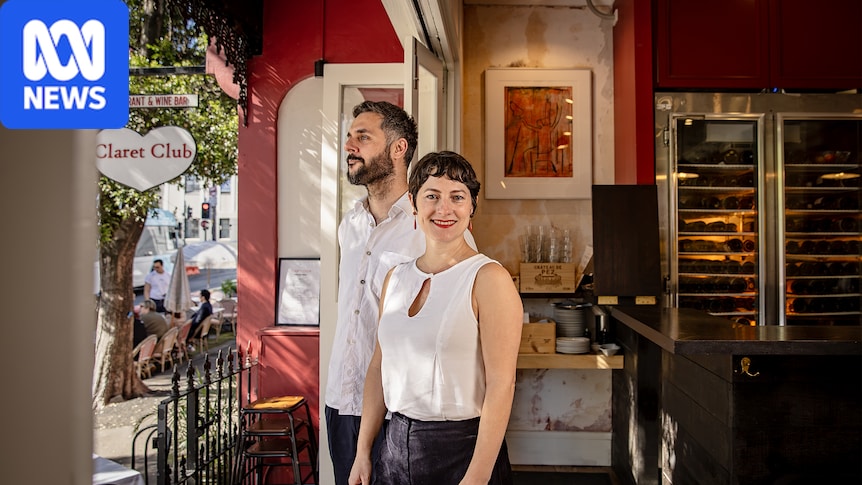
The work is relentless and the earnings unpredictable: So what keeps an independent restaurant owner in the game? It's a Thursday morning and Bridget Raffal, co-owner of Claret Club, a restaurant and bar tucked into an old terrace on the edges of Sydney's CBD, is bracing for the worst.One of the kitchen's two heat lamps has broken. Without it the venue's two chefs will struggle to keep food warm until a waiter can ferry their carefully prepared plates of risotto and quince and walnut clafoutis to customers."At first we thought it was just a broken bulb so we ordered one — a very expensive bulb," says Bridget, looking like she doesn't know whether to laugh or cry. "Now we think we have to replace it"The bar's regular handyman, Christian, is on the phone and begins explaining Bridget's options. Her facial expression suggests none of them are great."I just want the best and cheapest," she says after she hangs up the call. "That's always what everything comes down to here — do we try for a quick fix or a long-term solution?" Harry Hunter and Bridget Raffal are co-owners of Claret Club in Sydney's Darlinghurst.(ABC News: Teresa Tan)Hospitality has never been an easy job, known for long hours, low margins and high personal risk. But in 2026 the industry is in extreme crisis, facing a tornado of unfavourable conditions. According to CreditorWatch, one in eight restaurants and cafes closed between July 2025 and July 2026, almost double the average of other sectors. Analysts blame inflation, cost-of-living pressures, skyrocketing costs and damaging policy decisions.A generation ago, average net profit for a restaurant or cafe was around 10 per cent, says John Hart, national president of industry peak body Restaurant and Catering Australia (RCA). By the end of 2025, that had shrunk to 2.5 per cent. Now, with minimum wage increases and costs such as the recent policy shift that means restaurants must absorb card bank fees, profit has dwindled to almost nothing for many operators. "Twenty or 30 years ago I warned this would be what I called a 'culinary Armageddon'," Hart says.Rising food and wage costs are partly to blame, but Bridget and her partner and co-owner Harry Hunter say their biggest issue is cost-of-living pressures, which reduce customer attendance and spend."We run a tight ship," Bridget says. "We just need more people through the doors." Harry stands at the front of the restaurant watching passers by on Stanley Street.(ABC News: Teresa Tan)Independent venues, where the staff know your name and your drink order, where you can drop by for a meal and a chat after a long day at work, and where every inch of atmosphere is created by intuition and imagination, rather than AI — have never felt more important to the fabric of our cities and towns."'Commensality' — the idea of eating together to reinforce kinship links — is part of what brings a group together," says Teresa Davis, associate professor of marketing at the School of Business Analytics and Marketing and co-founder of the Australian Food, Society and Culture Network at the University of Sydney. "It builds and reinforces the social fabric."Independent places like Claret Club do this particularly well. Their intimacy means customers connect not just with each other but with the people who bring the food and wine to the table.Today, when the world swirls with uncertainty, upheaval and unrest, independent restaurants feel like a lifeline. As a place to unwind and find community, independent restaurants can feel like a lifeline.(ABC News: Teresa Tan)"The experiences of being able to hang out with your friends, being able to escape from whatever it is for a little bit … being around people that you don't know, being treated well — all of that feels more essential than it ever has to me before," New York Times food reporter Brett Anderson recently told The Daily podcast.The ABC spent two days and nights at Claret Club, an independently-run venue in Sydney's Darlinghurst, to witness exactly how much grit and grind it takes to stay open in today's crushing climate, and how much we stand to lose if places like it disappear altogether.11:40amThe heat lamp issue has been set aside. Chefs Andy Buchanan and Fernando Vargas will have to make do with the remaining lamp for tonight's service, and the waiters and food runners will need to work twice as fast as usual. Sous-chef Fernando Vargas and head chef Andy Buchanan prep for dinner.(ABC News: Teresa Tan)Bridget and Harry have begun discussing marketing and social media. There's a wine event upstairs tonight, and another scheduled next week with tickets still available."Should I do a last-minute social media push on it?" Bridget wonders."I'll write an EDM on Sunday and send it out on Monday," offers Harry, fluent in the shorthand for Electronic Direct Mail, something few restaurateurs would have thought about a generation ago."I thought it would be nice if we could have Sunday off together?" suggests Bridget.Sundays are the one day the couple tries to spend away from Claret Club and their other venue, the wine bar Where's Nick in Marrickville. They have a regular ritual of gathering with friends for a quiz at another wine bar, or cooking something special at home, music on and glass of wine in hand.Harry shakes his head. "I have to be here for a photo shoot anyway so I may as well do it then." A small flutter of disappointment flickers over Bridget's face.Bridget says she'll post about the Plat du Bar special the team changes every week: a single-plate dinner and glass of wine that can be eaten at the bar."They're a good boost for mid-week sales and they're also culturally important for us," she says. "Solo diners come in for it which we love. People are on their way home from work and instead of going home and standing in front of the fridge and eating a piece of cheese and feeling sad, this is our way to say, 'Come in, let us take care of you'."But, she adds, "the marketing girl hasn't always been so diligent at remembering to make the posts."Who is the marketing girl? "Ha! Me. I'm the marketing girl!" Bridget is in charge of the restaurant's social media and has to work hard to keep customer's coming through the door.(ABC News: Teresa Tan)The 'marketing girl' has to work harder than ever to keep the customers coming through the door as people tighten their belts. "If people weren't desperately struggling to pay their rent and mortgages they'd be able to afford to go out and support restaurants and our city would be more vibrant because of it," Bridget says.There is also plenty of competition for the money people do have, particularly when hundreds of restaurants are accessible at people's fingertips from the sanctuary of a sofa at home. The food delivery industry — platforms like Uber Eats and DoorDash — is worth 1.8 billion according to IbisWorld data. DoorDash research shows nearly three-quarters of Australian consumers think of ordering delivery as "an act of self-care", something to comfort themselves after a big week or to celebrate a special occasion, which is exactly the role that a restaurant like Claret Club is trying to play.MiddayA new problem. Bridget takes a call about a leak in the restaurant's roof. There's also a leak in the roof at Where's Nick. Both are the landlords' responsibility but it's still up to Bridget to coordinate the repairs. She calls her team at Where's Nick to ask if the Claret Club can borrow their stand mixer. "Our bread maker fell off the bench and getting it fixed is better than trying to get a new one," Bridget says.1:00pmClaret Club isn't open for lunch on Thursdays, but outside, Stanley Street is starting to get busy with the lunch time trade. The white tablecloth tables across the road at Bill and Toni's have a scattering of customers ordering red-sauce spaghetti and tiramisu. Junko, who runs the Japanese restaurant next door to Claret Club (they share a swag of festoon lights across their adjoining terraces) pops in to say hello. Christian the builder arrives, to nut out the heat lamp conundrum. Everyone greets him with hugs."It's a real little village here," says Bridget. "Bill and Toni's have sent people our way. The pub guys [The Lord Roberts, opposite] are great, the Bones Ramen guys are friends. There's a WhatsApp group where we all share information about the best plumber, the best ice supplier. Our ice maker broke and — thousands of dollars later — we still don't have an ice maker. So, we borrowed one from a neighbour." The Lord Roberts pub across the road from Claret Club helped out when the restaurant's own ice machine broke.(ABC News: Teresa Tan)That, she says, is one of the loveliest things about running a truly small, independent restaurant business. Everyone's hanging in there together.Stanley Street has a long history of togetherness. It was one of Sydney's first true Italian precincts. Family-run Beppi's — famous for its hand-harvested mussels and veal saltimbocca — opened 70 years ago this year (and still stands today). If Beppi's was out of your price range, by the early 1970s you could head to Bill and Toni's, for huge plates of cheap spaghetti and cups of cordial.Back then, Darlinghurst was a low socio-economic area, dominated by boarding houses. Today it's full of chic, renovated terraces, and residents with money to spend. The Claret Club team simply wish more of them would walk through their doors.3:10pmHarry gathers the team in the small alcove next to the kitchen for a blind wine tasting. It's something they do regularly, as he and Bridget want the team to be able to talk with customers about new bottles.Everyone scribbles notes as they swill dolcettos and gamays, describing what they taste. The staff take notes as they taste a new selection of wine.(ABC News: Teresa Tan) Bridget has a deep knowledge of wine which she uses to select bottles to cellar.(ABC News: Teresa Tan)Claret Club has a strict policy about wine distributors trying to book themselves in for time with Bridget or Harry in the hopes of getting their wares onto the list."We do not take tasting appointments if you haven't been into the venue and spent money with us," says Bridget. "It's about taking the time to get to know us, and to think about how their wines will fit in. Emails are not a relationship."3:50pmTen minutes until doors open, and Harry is still finishing the wine tasting. Someone presses play on tonight's playlist and a dramatic Italian version of Take My Breath Away from Top Gun fills the room."Harry loves a playlist," says Bridget. "We call this one 'Italian bangers'."4:40pmGuests have slowly begun arriving in the downstairs bar, but there are still plenty of spare seats. Guests are arriving but there is room for more.(ABC News: Teresa Tan)6:00pmAn older couple steps inside. They stand at the entrance, looking slightly perplexed, and Bridget approaches right away. Her body language radiates warmth as she directs them to a table and points out the wine list scrawled on the mirror. She realises they are French, and switches to French herself so they feel even more comfortable.It's impressive to witness how 'on' a restaurant host needs to be, from the moment the first customer arrives until the last leaves. At every interaction Bridget's face is curious and interested, her body leans forward and every reply comes with smiles and wide-open arm gestures. It's easy to think a restaurant professional is merely passing on information about food and drink, but a good one makes you feel you're the best thing to have walked through the doors that night. Bridget has worked in hospitality all over the world and puts every part of herself into making guests feel welcome.Bridget has hospitality in her bones."I grew up in a house that was totally centred on food and wine," she says. "The dinner table was where all the conversations happened. We never had a TV in the kitchen or anywhere near the dining table. Food was how we all came together."She worked as a barista from the age of 16, then as both a chef and front-of-house, everywhere from France (hence her ability to speak French) to the Netherlands. In Amsterdam, Bridget's favourite moments were always spent around the dinner table with friends."You'd buy a bottle of three-euro Montepulciano from the supermarket and if it was a really special occasion, you'd splash out on a five-euro," she says, laughing. "The point was shopping for great food, having a glass of wine in your hand and making a meal with friends."This, she says, is the sort of atmosphere she and Harry (who previously worked at Bentley Group and Dinner by Heston) wanted to recreate with their own venue."We wanted to run a place that reflects the values we care about, particularly treating our staff with respect, so they feel valued and protected. We couldn't do that if we worked for other people."But autonomy can come with costs. Not only does endless worry over revenue and long hours make for stressful work, but it can be difficult for hospitality workers to take care of their physical and mental health. Bridget tries to make it to the gym three times a week to clear her head."We also try to do team beers maybe once a week, as a bit of a download and for connection," she says, but she steers clear of the heavy-drinking culture that is common to the industry. "I have a huge workload and focus is pretty important to me. I can't afford to be hungover."7:50pmThe wine dinner upstairs is in full swing, and Matt Prokop and restaurant manager Utsav Shah are run off their feet to serve 22 guests. The missing heat lamp means they have to get the meals upstairs extra quickly before food goes cold. Downstairs is still quiet. A group of 22 enjoys a meal with wine pairings explained by a sommelier.(ABC News: Teresa Tan)Bridget hides herself into a nook, just outside of the customers' line of sight, and tries to catch up on paperwork."I hate getting a laptop out during service — it's been drilled into me that you don't do that. But we are here for such long hours, if I don't do it now I'll never be able to do it."Harry rushes past with wine bottles but pauses to drop a kiss on the top of Bridget's head. It's a small, private moment, one of the rare chances they have to connect in their long days. Claret Club co-owners Harry Hunter and Bridget Raffal are also a couple. It's important to find little moments to share together during a busy workday.(ABC News: Teresa Tan)9:04pmThe wine dinner guests have moved on to their main courses. Claret Club food has old-fashioned elegance to it: fish pies, rich with cream and potato. Beef rib braised in Barolo, served on polenta."It has a simplicity, and references to Elizabeth David," Bridget says, noting the iconic British cookbook author. Claret Club's food is inspired by iconic British cookbook author Elizabeth David.(ABC News: Teresa Tan) Bridget and Harry join the waitstaff in running plates of food to diners.(ABC News: Teresa Tan)The wine dinner guests seem thrilled. Many remember Chef Andy from Melbourne's upscale Dinner By Heston (now closed), and several drop by to thank him for the meal.This, says Bridget, is a big part of the reason they do what they do. "Our customers are often well-travelled and when they rave about our food we think, okay. This is it. What we're doing is working." When the guests stop by to thank Claret Club chef Andy it must mean the restaurant is doing something right. (ABC News: Teresa Tan)10:00pmThe kitchen team is beginning to wipe down benchtops and sweep the floors. Sommelier Matt had planned to knock off early but two customers appear at the door. He goes immediately to greet and seat them."We want to build a reputation for being open later at night, for being somewhere you can come at any time," Matt explains later."Our thing is, 'last guest out the door and we're done' — whatever time that is." Claret Club sommelier Matt Prokop says the restaurant's attitude is to stay open until the last guest wants to leave. (ABC News: Teresa Tan)After being seated the two men change their minds. It seems they wanted more of a pub atmosphere than a wine bar where they're practically the only customers. Matt directs them to The Lord Roberts over the road."That's okay, we don't have to be for everyone," he says.10:40pmThe chefs have left and Bridget has pulled the doors of the venue closed, but a few stragglers from the wine dinner are still hanging out at the bar. Harry and the remaining staff give their guests the same level of attention as when they first arrived: they're excitedly discussing the wines they drank and what they enjoyed. After a long day Bridget pulls closed the restaurant doors.(ABC News: Teresa Tan)11:40pmThe last guest has left, and Bridget pours a glass of Barolo for herself, and hands a beer to Harry. They drink as they bring in tables from outside and clear the linen from the tables inside. After the last guest leaves there's a moment to pause before pack up begins.(ABC News: Teresa Tan)"Are you ready to go home?" Harry asks Bridget."Yep, I think it's about time. That's a nice early finish," she says, "Twenty to midnight."But then a friend and fellow hospo worker turns up at the door and suggests they all go for a drink. Matt brightens and everyone else agrees."You need a bit of time to decompress otherwise it's just this dystopian feeling of sleep, work, sleep, work," Matt says.Together they head to a local bar. Claret Club sommelier manager Matt Prokop catching up after service with former employee Eva: "You need a bit of time to decompress".(ABC News: Teresa Tan)MidnightThe team has ordered giant steins of lager. They share war stories about the night — who ordered what, who did or didn't like a dish.There's no sense of hierarchy and everyone chats freely, with no indication that the owners are more important than the workers. A long day is a long day, for everyone involved."Did you see that guy who drank all his wines at the wine dinner, and then leant over and drank all of his neighbour's wines as well?" chuckles Matt.Harry does a quick calculation about the wine dinner revenue."It was a lot of effort for not a lot of money. The tickets were under $200 for all those wines. So, we brought in about $3,000."Cozzie livs," he finishes with a sigh, ruing the cost of living in that distinctly Australian way.Cozzie livs be damned. Matt and Harry agree that there's time for "just one more beer". At 1:10am, they call it a night.The restaurant landscape changes constantly, as it must if it hopes to survive. It wasn't long ago that it was relatively rare to eat outside the home in Australia. Migrant communities in the mid-20th century ran small shops, trattorias and cafes, and by the 1980s restaurants of all kinds became more common, including American fast food.Since COVID, the hospitality industry has arguably experienced more upheaval than ever before. Food ordered in-venue still makes up the largest revenue stream but data from point-of-sale software platform Lightspeed shows it's fallen from 31 per cent in 2024 to 20 per cent in 2025, as takeaway, delivery and catering take a larger share.Younger demographics, with less money to spend, are looking for social interaction with a smaller price tag, such as relatively cheap frozen yoghurt and ice cream parlours.Then there are the policy and societal problems that kneecap the sector: wage rises, capped migration, inflation and unfavourable tax pressures, which industry body the Australian Restaurant & Cafe Association (ARCA) says are causing carnage.It suffered a recent blow: the Reserve Bank banned businesses from adding card surcharges to customers' bills. That cost is likely to be passed to customers as higher prices.The last thing Bridget wants to do is make Claret Club less accessible, but she also knows they won't be able to absorb the costs.Revenue challenges mean Bridget and Harry can't hire extra people to share the burdens they shoulder themselves. "Our jobs are full-time hosts, reservations, operations, bookkeeping," says Bridget. "We write two wine lists, do HR for both venues. Combined it's around nine or 10 full-time jobs. We can't keep working like this. A good week for me is 60 or 65 hours. But it can easily be 90."In Canberra, another restaurateur Louis Couttoupes was forced to close his independent venue, Onzieme, in May this year. Unlike at Claret Club, he says filling seats was never a problem."Because Canberra has such a big public service workforce ... people's incomes are more reliable and predictable," he says.Instead, Onzieme was felled by the pressures of finding and retaining qualified staff, without them being poached by larger restaurant groups acting "as this vacuum cleaner for staff because they can offer more money", he says.Those left in the pool tended to be wildly underqualified for the roles Louis needed to fill. "I got to the point where my lease was up and I looked ahead at the next five years and thought, 'I can't see this getting any better'." So what happens to a city's soul if the only hospitality venues that remain are large groups, with focus-tested menus and cookie-cutter concepts? The sorts of places Bridget calls 'Disneyland' restaurants?For starters, there is likely to be far more homogenisation, as restaurants look to buy in 'value-added' food products: items that are cheaper, easy to prepare, pre-packaged and exactly the same as those served by the restaurant next door. "We've all seen the explosion in restaurants where everything is steak frites, seafood pasta," says RCA's John Hart. "We can all practically recite the menus."Couttoupes offers a grim warning. The big groups will dominate, and the little guys will vanish altogether. "Small businesses are more connected to their staff, customers, suppliers and producers," he says. "If you lose them, then with it goes diversity, creativity and passion."This idea of creativity, however, is where a venue like Claret Club may eventually eke out a small advantage.Chef Andy still orders in beautiful red mullet, rather than easy-to-source, pre-cut barramundi or Murray cod. The restaurant's truffle supplier drives over the Blue Mountains with a haul especially for them. Sous-chef Fernando prepares beautiful red mullet. No pre-cut barramundi at Claret Club.(ABC News: Teresa Tan)Bridget uses her expert sommelier skills to buy and cellar bottles when they're young, which means she can hold onto them and sell them at a minimal mark-up compared to others who buy at peak price. This, says John Hart, is what diners will increasingly seek out as the 'Disneyfication' of restaurants becomes more prominent."The ones that take ingredients and provide a dining experience that's something very special," he says, are the sorts of places we will yearn to go.As long as the market conditions allow these independent restaurants to survive, that is.Friday 10:30amIt's an earlier start today in anticipation of a busier Friday, and a lunchtime opening.Harry and Matt are setting up, while sous chef Fernando is making bread with the stand mixer borrowed from Claret Club's sister venue. Harry sets up tables along Stanley Street.(ABC News: Teresa Tan) Bread is made from scratch with equipment borrowed from Claret Club's sister restaurant.(ABC News: Teresa Tan)11:35amBridget arrives looking fresh despite the 1am finish."Hi love," she says to Harry. Even though the couple live together, they've barely seen each other that morning."There's not a lot of opportunity in the week to have any connection," she says. "We make a point to remember to be nice to each other."Marketing ideas are always churning in both Harry's and Bridget's brains.Harry has an idea for an art-house cinema on the restaurant rooftop over summer.Bridget looks pained. "I'm so in the weeds, Harry. When am I going to be able to think about that?"MiddayDoors are open and a few office workers are having small meals on the sunny tables outside. But the venue is nowhere near full. Claret Club's upstairs dining room is a beautiful space but where are the guests?(ABC News: Teresa Tan)3:00pmBy mid-afternoon, Andy uses the time to test out new recipes, bringing a tuna and blood orange dish to Bridget and Harry for a taste test. The orange segments could be cut finer, but the flavour is spot-on. Bridget uses the spare moments to iron tablecloths. Bridget and Harry taste Andy's dish and offer feedback.(ABC News: Teresa Tan)4:22pmNervy about the number of guests, Bridget puts up an Instagram post advertising their $10 martini happy hour that began at 4pm. Within 30 minutes a group of four — Bridget and Harry's friends who have an office nearby — have come in and ordered a round. Sommelier Matt helps guests select wine and cocktails.(ABC News: Teresa Tan)4:30pmChefs Andy and Fernando give themselves a coffee break. They crouch outside together in the little tin shed they built on their own — a minute's peace before what they hope will be a busy night.4:50pmBut the hoped-for rush will have to wait. Andy comes back inside and finds Bridget."Hey Bridget. Do you want some good news?" he asks with a grimace."No. Don't tell me. What's broken?" says Bridget, her eyes widening."The pilot on the fryer has gone out."Bridget momentarily closes her eyes. "We won't get anyone to fix it now. It's almost the weekend," she says.The two discuss options. Not much can be done this close to dinner. One fryer is still working but just like the heat lamp, one will now be out of action.They let the floor staff know to hold back on pushing menu items that need to be deep-fried.Meanwhile, Bridget throws the problem into the Stanley Street WhatsApp group, and someone comes up with a repair contact right away."We can't have someone come here during service, and we can't afford the Sunday call-out fee, so it'll have to be Monday," she says."Hopefully we won't get stung with an 'urgent' loading." Bridget Raffal and Harry Hunter need flexibility to respond to the unexpected.(ABC News: Teresa Tan)5:18pmBridget checks the bookings for the night — just 34 covers in a venue that comfortably seats 60. Most are peripheral industry people — friends and colleagues they know — with a handful of first timers.A couple comes in and orders glasses of wine."You're a very good addition to Stanley Street," the gentleman tells Bridget. "If you keep your heads above water you're going to do well."Friends and family are an important part of Claret Club's customer base. It's also a big part of what makes the restaurant feel personal and welcoming. "Our whole business is built around relationships: we try to know everyone's name, if they've just had a baby and it's their first time out of the house," Bridget says. Building relationships is at the heart of what Bridget and Harry aim to do.(ABC News: Teresa Tan)Bridget likes to tell a story of how she does her banking at a branch in Marrickville, close to their other venue. One day her regular teller said she was planning to book Claret Club for dinner."When I saw her name on the bookings and when she showed up, that really meant a lot," Bridget says.Just as often, strangers become friends. "We're a neighbourhood venue. We want the three generations, the kids, the place people think of for their special birthday every year."In many ways this word of mouth is more effective than any marketing. "The old wisdom is everyone works really hard to capture new guests, and of course we do that," she says. "But if you work to get them back the returns are much higher."10:00pmThe night has been busier than expected. But it's still quiet enough that Bridget has time to sit down and try Andy's red mullet with velouté.10:37pmJust four groups remain. Everyone is taking their time to finish a final few languid glasses of wine, while Bridget and Harry stop repeatedly at the groups to chat.It's a long night yet again, but the team still look like they are in their element. "We do it for the love of food and wine, really," Bridget says. "Connecting with people over those things is really fulfilling and restorative. Those little moments when people really get what we're doing and who we are — that's what makes it all worth it." Bridget says connecting with customers is what makes the job worth it.(ABC News: Teresa Tan)11:23pmThe team looks tired, though they make plans for a couple of beers next door, like last night. For Bridget and Harry especially, Claret Club is more than just a workplace, it's the heart of their lives.Bridget rests her head briefly on Harry's shoulder."The last thing we say before we go to sleep isn't 'I love you baby'," she says. "It's 'Did we do well today?'" After a long day at work only one question remains: DId we do well?(ABC News: Teresa Tan)CreditsWords: Alexandra CarltonPhotographs: Teresa TanEditing: Catherine Taylor
'Did we do well today?': This is what it takes to keep an independent restaurant open
Full Article
Original Source
Read the full article at Abc →KhanList aggregates and links to publicly available news content. We do not host full articles from third-party sources. Always verify important information with original sources.