
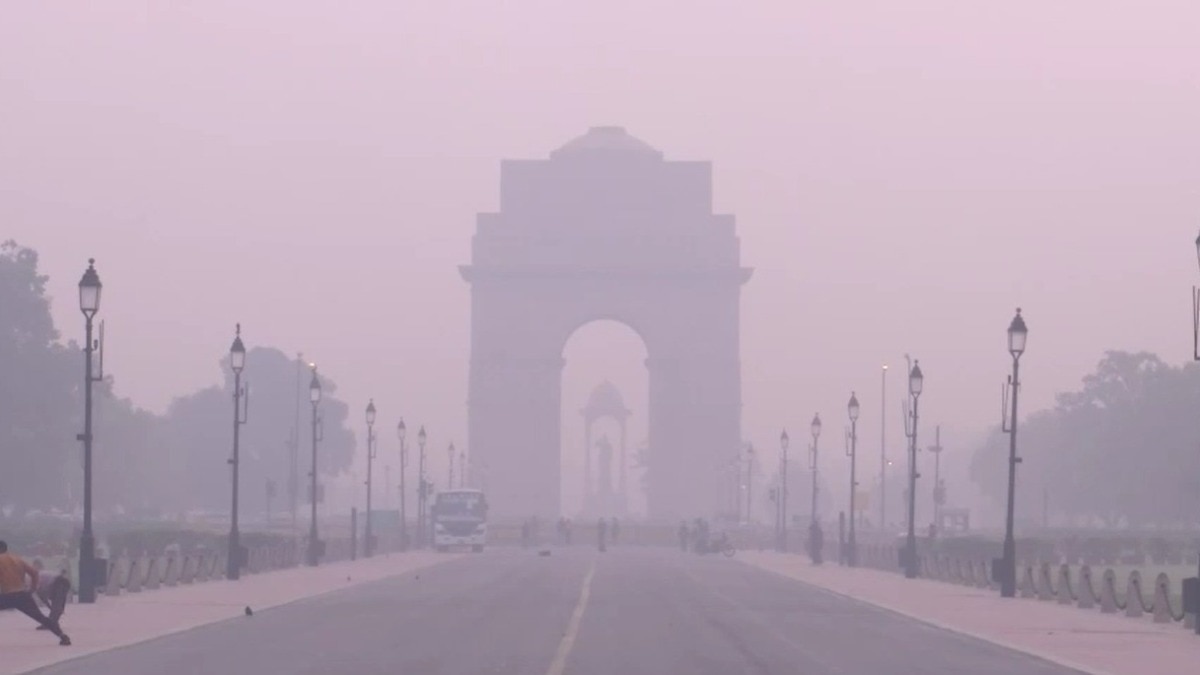
Delhi's overall air quality remained in the 'very poor' category for the third consecutive day on Wednesday, November 4, with the national capital recording an Air Quality Index (AQI) of 369 at 6.05 am. A thick layer of smog continued to blanket the city.PM2.5 was the prominent pollutant in Delhi. Air quality was particularly concerning in several parts of the city, with Punjabi Bagh and Jahangirpuri both recording an AQI of 447, placing them in the 'severe' category.Meanwhile, Mundka and the area around IIT Delhi recorded AQI readings of 436 and 438, respectively. Of Delhi's 59 air quality monitoring stations, 20 recorded 'severe' air quality, while 33 others were in the 'very poor' category. The remaining stations reported 'poor' air quality.This could mark a further deterioration in Delhi's air quality for the third straight day since Monday, November 2, when the city was brought under Stage II of the Graded Response Action Plan (GRAP) as its 24-hoir average AQI settled at 324, placing it in the 'very poor' category for the first time this season. The Air Quality Early Warning System for Delhi forecast that the city's air quality is likely to remain in the 'very poor' category till at least Friday, November 6.The weather forecast for Wednesday predicted a maximum temperature of 27–29 degrees Celsius and a minimum temperature in the range of 14 to 16 degrees Celsius. With no rainfall expected, the sky was forecast to remain mainly clear in the morning.\DELHI'S AIR POLLUTION SOURCES IN FIGURES According to the Decision Support System (DSS), transport emissions were the biggest contributor to Delhi's pollution at 15.8 per cent, closely followed by stubble burning at 15.3 per cent.Among other sources, residential emissions accounted for 3.9 per cent, industries in Delhi and the periphery for 3 per cent, construction activities for 2.2 per cent, waste burning for 1.4 per cent, energy production and road dust for 1.2 per cent each, and other sectors for 1 per cent.Satellites detected 219 farm fire incidents across six states on November 2. Punjab accounted for the highest number at 98, followed by Rajasthan (67) and Madhya Pradesh (48). Uttar Pradesh reported four incidents, while Haryana recorded two.No residue-burning events were detected in Delhi or Uttarakhand, according to data from the Consortium for Research on Agroecosystem Monitoring and Modelling from Space (CREAMS) Lab, Division of Agricultural Physics, ICAR-Indian Agricultural Research Institute, cited by news agency PTI.A total of 3,535 farm fire incidents were recorded across the six states between September 15 and November 2, with Punjab accounting for the largest share at 1,612. Rajasthan reported 738 incidents, followed by Madhya Pradesh (614), Uttar Pradesh (349), Uttarakhand (176), Haryana (44) and Delhi (two).The stubble-burning season runs from September 15 to November 30. Delhi reported its first farm fire incident of the season on September 19, followed by a second one on October 24.- Ends(With inputs from agencies)
Delhi chokes on toxic air as very poor AQI stretches into 3rd day
Full Article
Original Source
Read the full article at Indiatoday →KhanList aggregates and links to publicly available news content. We do not host full articles from third-party sources. Always verify important information with original sources.