
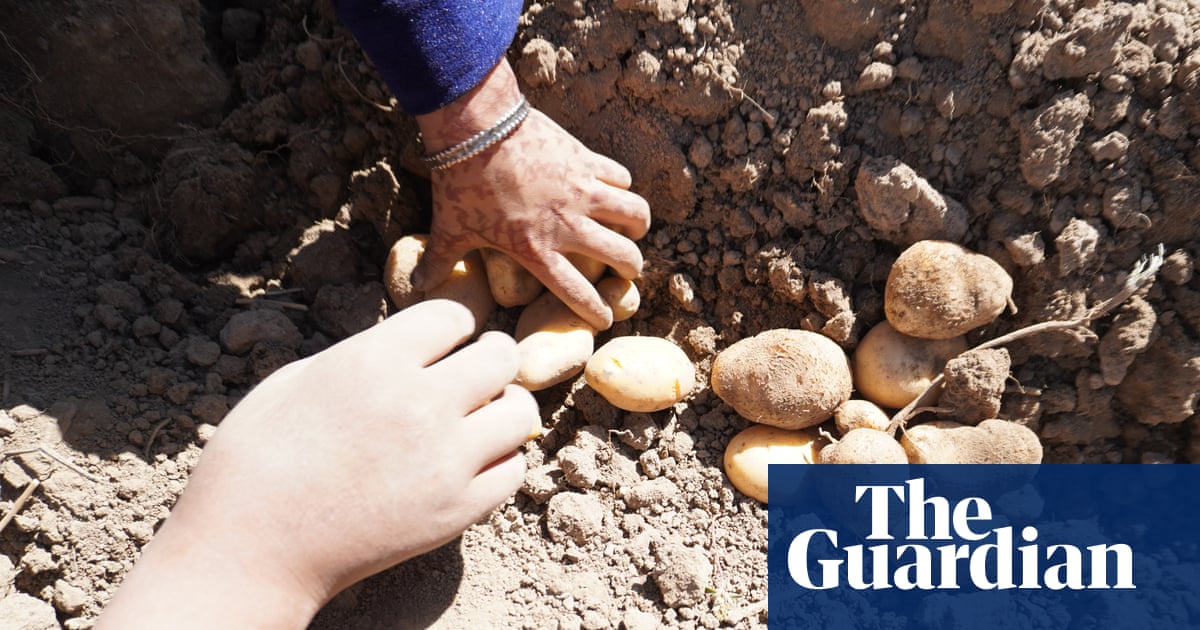
Hajra Begum rolls a potato in her hands, checking its skin for cuts, soft spots and signs of rot. After a day harvesting in her family’s field in Chorwan, a remote mountain village in Gurez, Indian-administered Kashmir, she is sorting the crop for winter storage. Some of the potatoes will feed her family through the cold months; others will be saved for planting in spring.“It should be perfect for planting,” she says. “If you keep a bad potato, you will waste the whole next year.”Begum, 40, is preparing to lower the potatoes into a khraw, a traditional underground storage pit lined with straw and sealed against the cold. For generations, khraws have kept potatoes, turnips and cabbages through Himalayan winters, when heavy snowfall cuts villages off from the Kashmir valley and temperatures fall below -20C (-4F) – cold enough to crack pipes and freeze diesel.Hajra Begum prepares a khraw – an underground pit lined with straw and sealed against the cold – before the coming of winter in ChorwanBut the practice is slowly dying out. As roads have improved and young people have left for work and education, fewer families maintain the pits. Their decline threatens not only a traditional way of storing food but also the local potato varieties themselves and the knowledge of which ones store well, resist rot and produce reliable harvests.“When I was young, almost every family had three or four pits,” Begum says. “Now, down in the main valley, they have abandoned the practice altogether. Only a handful of families still use them. The rest buy from the market or subsidised ones from the government.”Begum learned from her mother how to tell potatoes that store well from those that rot or sprout too quickly. She is passing this on to her daughter, but is unsure whether the skill will survive into another generation.Gurez is a high-altitude Himalayan valley perched near the Line of Control, the heavily militarised boundary separating Indian- and Pakistani-administered Kashmir. About 80 miles (125km) from Srinagar, the valley remains cut off each winter when snow closes Razdan pass, its main road link, which sits at roughly 3,600 metres.It is home to the Dard-Shin people, an Indigenous community who speak Shina and have a culture that is distinct from Kashmiri, with community links across the border in Gilgit-Baltistan, administered by Pakistan.Hajra loads the khraw with her crop – the genetic diversity of the valley’s potatoes has not been documented, and there are concerns about the loss of genetic diversityPotatoes account for about 45% of Gurez’s cultivated area, according to a 2019 study by the Indian Council of Agricultural Research’s National Bureau of Plant Genetic Resources (ICAR-NBPGR), a government body that studies and conserves India’s crop diversity. Yet the genetic diversity of the valley’s potatoes has not been systematically documented.Dr Sheikh M Sultan, a senior scientist based at ICAR-NBPGR’s Srinagar station, surveyed the valley and later struggled to find some of the varieties he had once encountered. “When I first visited, I saw many varieties,” he says. “Later, I could hardly locate even one sample of some. The loss of genetic diversity is tremendous.”Sultan says migration, improved roads and changing lifestyles have contributed to the decline. As traditional farming disappears, so does knowledge about selecting, cultivating and preserving local varieties.“When people stop producing their own seeds and start relying entirely on commercial varieties, the loss can be irreparable,” he says.A family harvests potatoes with a bullock-drawn plough in Gurez valleyHe warns that research institutions often prioritise introduced varieties over indigenous crops whose characteristics remain poorly understood. “Our indigenous varieties may possess valuable characteristics, including tolerance to cold and resistance to certain pests and diseases,” he says.“These are resources we should be studying and improving, rather than neglecting.”Climate breakdown is adding to the pressures on farmers across the Himalayas. People in Gurez report drier springs, reduced snowfall and water shortages, which they say have affected potato production.Abdul Jabbar Mapnoo, 70, a farmer in Chorwan, remembers winters when deep snow covered the valley. “Every house used to have two or three khraw, each holding about five quintals – 500kg – of potatoes,” he says. “The springs are drying up, and there is less snow in winter. Potato production has fallen. I remember winters when six feet of snow would cover the valley in January or February.”As farming becomes more difficult and markets easier to access, households have less incentive to grow their own potatoes. Varieties adapted to local conditions over generations could disappear from cultivation before researchers establish what makes them distinctive.In Chorwan, Ateeqa Begum sorts potatoes into those used for winter food and others to plant in springDr Parveen Kumar, a scientist at the Sher-e-Kashmir University of Agricultural Sciences and Technology of Kashmir, says locally adapted varieties should not be overlooked. “Climate change is a reality, and farmers need to be aware of adaptation strategies,” he says.Pressure on farmland poses another risk. In Gurez, where cultivable land is scarce, the Kishanganga hydroelectric project has affected land in the valley through acquisition and submergence. Among the areas affected is Badwan, a village known for its potatoes.One potential route for preserving the varieties could be through using geographical indications – a designation granted by the UN’s Food and Agriculture Organization, and is similar to the French appellation d’origine contrôlée. It can be used on goods that have a specific origin and possess qualities or a reputation linked to this – which can help increase the market value and give them greater recognition. This, and the globally important agricultural heritage systems programme have helped areas such as the saffron-growing landscape of Pampore in Kashmir.Harvesting with a bullock-drawn plough. Knowing which potatoes to eat and which to save as seed relies on generational knowledgeHowever, recognition alone will not preserve the varieties. They must be identified and documented before they disappear from cultivation, along with farmers’ knowledge of how to select, store and replant them.In Chorwan, Begum unloads the last sack of potatoes into the pit and covers it, ready for another winter. Some will feed her family; the rest will be replanted in spring. Knowing which potatoes to eat and which to save as seed relies on knowledge passed down through generations.If these varieties are not documented while they are still being cultivated, Kashmir may lose a living agricultural treasure trove before scientists can fully understand what it contains. Find more age of extinction coverage here, and follow the biodiversity reporters Rebecca Ratcliffe, Phoebe Weston and Patrick Greenfield in the Guardian app for more nature coverage.
Kashmir’s potato pits are vanishing – and generations of knowledge could be buried for ever
Full Article
Original Source
Read the full article at Theguardian →KhanList aggregates and links to publicly available news content. We do not host full articles from third-party sources. Always verify important information with original sources.