
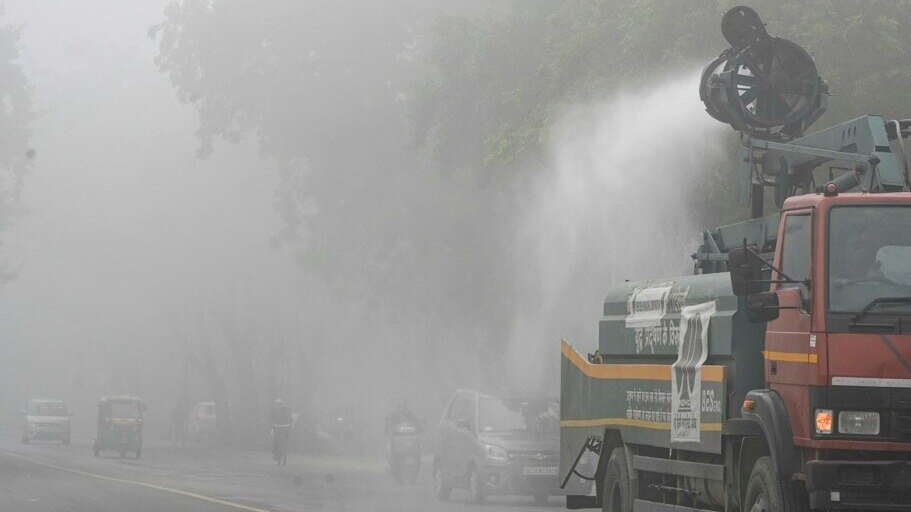
Delhi's early October AQI spike signals another toxic winter, raising concerns about respiratory illnesses, asthma in children and rising ICU admissions. A leading pulmonologist shares five ways to reduce exposure to air pollution.The anti-smog guns will have a water tanker with a capacity of not less than 7,000 litres (Photo: ITG)Winter is coming! With October 4 touching an alarmingly high Air Quality Index (AQI) level of 187, the highest four-day average since 2020, the signals are clear: Delhi’s gas chamber months are all set to get even more toxic, especially with visionless, ill-thought-out, stopgap and often mistimed interventions having been made down the years to deal with the Capital’s winter pollution cycle.The early spike has raised fears of another season of toxic air and respiratory emergencies, not to mention growing concerns about the long-term effects of pollution, including fears of a correlation with increasing lung cancer cases.Dr Ayush Gupta, Head of the Pulmonary Department at Sitaram Bhartia Institute of Science and Research, who has been dealing with burgeoning ICU admissions in successive winters, says that with the usual suspects of falling temperatures, slower winds, vehicle emissions, construction dust and crop burning in Delhi’s neighbouring states of Punjab and Haryana at play, the pollution pattern this year will be “cumulative”.“Down the years, the same people are being exposed to this pollution, high pollution levels, and it is causing a worsening effect on their health,” he said in an interview. “Every year, it becomes worse because of the exposure which they have had in the previous years also,” he added. Research studies in Delhi throw up alarming data on the sharp seasonal burden of respiratory illness. In a study across four hospitals covering March 2018 to February 2019, 41.2% of patients enrolled with acute respiratory symptoms presented during winter, compared with 27.9% in summer and 30.8% during the monsoon. A separate study found that emergency visits among children for acute respiratory symptoms were 29% higher on high-pollution days than on low-pollution days.For some Delhi residents, the consequences are already severe enough to dictate where they can live. “I have to stay away from Delhi. There is no other alternative,” says Shweta Kolluri, 40, who recalled how she left Delhi after just ten months during her first stint in the Capital in 2011–12. “I could stay only for 10 months because I had such bad asthma attacks out of the blue. I had to relocate, change jobs, and move away from Delhi,” she said. Masks and restricted outdoor activity help her manage pollution, but only up to a point.“I can cope with masks and limiting my outdoor activity up to an AQI of 300, but if it goes beyond that, which is the case for most of November, December, and half of January, I have to stay away from Delhi. There is no other alternative for me,” she said.Kolluri is among the few lucky ones who can leave Delhi during its peak pollution months and return when the AQI is better. Families with elders fear the winter season and often need to send their loved ones away to cleaner environments “just to keep them alive”, as Binu Thomas put it.A longtime Delhiite, Thomas often scouted places in Kerala to move her mother there during the winters. Eventually, her mother had to be relocated to America to stay with her son. Her persistent cough is now a thing of the past.Others are not so lucky and have to brave the pollution in Delhi itself. Dr Ayush says pollution has made lung vulnerabilities, as well as the mental and physical toll of pollution, calamitous. “Compromised lungs are getting younger and younger,” he pointed out.POLLUTION IS AFFECTING MORE CHILDREN, SAYS PULMONOLOGISTDr Gupta has been seeing rising asthma cases among children, including those as young as eight or nine. “As young as eight-nine years old are now having asthma, which was not so prevalent a few years back,” he said.He explained how air pollution is associated with asthma, chronic obstructive pulmonary disease (COPD), cardiovascular disease and even lung cancer. Dr Gupta says he is also seeing more lung cancer cases, although attributing individual cases or a rise in diagnoses directly to pollution requires further evidence.“The three most common illnesses which we found last year were acute worsening of asthma and COPD, viral pneumonia and bacterial pneumonia,” he said.Dr Gupta also reported that intensive care unit occupancy at his hospital typically rises from 50–60% to 90–100% and beyond during November and December.Alarmingly, this year, he said, the hospital has already seen numerous patients with viral pneumonia and H1N1 influenza during August and September, before the full winter pollution season had begun.POST-COVID POLLUTION: A DOUBLE HEALTH BURDEN?Dr Gupta added that the cumulative effects of air pollution extend beyond the lungs, affecting multiple organs.“It affects their mental health; it affects their physical health in the form of the lungs, heart, and kidneys, because these pollutants are not just limited to the lungs. Via the bloodstream, they are reaching all the organs of the body,” he warned.The post-COVID period has added another layer of concern. “In the post-COVID era, pollutants have had a multiplier effect. The ill-effects of COVID plus the pollution in the absence of a way ahead turn into a huge health crisis,” he said.For him, the combined health burden of COVID-19 and pollution is a “dual problem."‘I DON’T THINK ANYBODY FOLLOWS’ POLLUTION ADVISORIESThere is no shortage of health advisories for the pollution months, but most are either not followed or are inadequate.Take the case of Pooja Goyal, 41, who has breathing problems and carries an asthma inhaler to manage her symptoms. The festive season is a nightmare for her.“I have increased breathing problems. So, I carry my asthma pump with me all the time,” she said.She is also sceptical about the impact of government advisories. “I don't think anybody follows them. I’ve not seen anybody following it, except for the fact that everybody has air purifiers nowadays,” she said.Pooja raised concerns about tree cutting, construction and poorly maintained tree-planting initiatives, arguing that environmental considerations are often overlooked during development.DELHI AIR POLLUTION: FIVE PRECAUTIONS DR GUPTA RECOMMENDS Dr Ayush Gupta, Head of Pulmonology at the Sitaram Bhartia Institute of Medical Research, discusses growing concerns over the cumulative effects of prolonged air pollution exposure in Delhi. Dr Gupta offers five practical measures to reduce exposure during high-pollution days.1. CHECK THE AQI AND CHANGE YOUR SCHEDULE“See the AQI, then step out, and you can modify your schedule according to the levels of AQI,” he advised.On heavily polluted days, stay indoors where possible and avoid early-morning and late-evening walks when pollution levels are at their highest. Shift exercise to the afternoon, but only if conditions are better.2. DO NOT MISS PRESCRIBED MEDICATIONPeople with asthma and COPD should continue their prescribed treatment and seek medical advice if symptoms worsen. Dr Gupta also recommends periodic medical check-ups.3. FOLLOW RECOMMENDED VACCINATIONSDiscuss appropriate vaccinations against respiratory infections with your doctor. Pollution can aggravate respiratory illness, making the prevention of infections particularly important for vulnerable patients.4. USE AN AIR PURIFIER CORRECTLYChoose a suitable, effective purifier for the room size. Dr Gupta advises keeping the room’s doors and windows closed while the purifier is operating. A properly sized HEPA air purifier can reduce indoor particulate pollution.5. WEAR A WELL-FITTING N95 MASK OUTDOORSAn N95 respirator can reduce exposure to fine particles when correctly fitted. Simple three-ply masks offer less protection. People who find masks uncomfortable because of existing breathing problems should seek individual medical advice.Dr Gupta particularly stresses reducing exposure during heavily polluted periods. For patients with respiratory disease, prolonged coughing, wheezing, sputum production or shortness of breath should prompt medical assessment.WILL DELHI EVER BREATHE EASILY IN WINTERS?Successive governments in Delhi have failed to tackle this serious issue. Last year’s Rs 3.21-crore cloud-seeding experiment in October, for example, was an abject failure simply because it was not thought out.The experiment failed to produce any artificial rain to douse the pollution because the clouds did not contain enough moisture. The government had approved the project as an emergency measure to tackle air pollution, but it is common knowledge that dry atmospheric conditions in Delhi and the surrounding areas are unsuitable for cloud seeding.AN EARLY WARNING, WITH WINTER STILL AHEADThe October AQI readings this year have brought Delhi’s winter pollution alarm forward. Shweta’s need to leave the city and Pooja’s reliance on medication show how air pollution shapes daily life well before winter reaches its peak.Personal precautions can reduce exposure, but they cannot remove pollutants from the air. Controlling vehicle emissions, industrial pollution, construction dust and agricultural burning remains essential if Delhi is to break its annual cycle of deteriorating air quality and respiratory illness.- Ends
Delhi air pollution: Early October AQI spike raises fears of a toxic winter
Full Article
Original Source
Read the full article at Indiatoday →KhanList aggregates and links to publicly available news content. We do not host full articles from third-party sources. Always verify important information with original sources.