
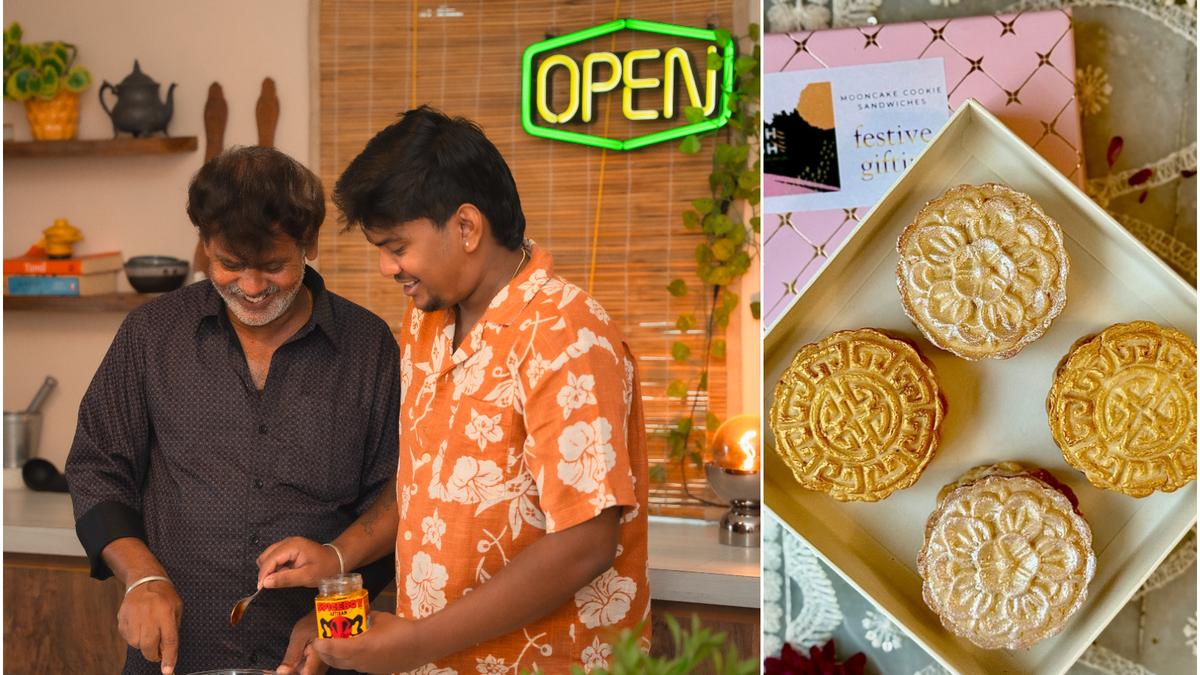
Hours before the crackers take over, Praveen Duraivelu’s family ushers in Deepavali with steam and the sputter of hot oil.This 27-year-old content creator who specialises in the everyday discoveries of life by diving deep into cuisine, says that he distinctly remembers spending each Deepavali sitting on the kitchen counter, watching his mother Latha, pile heaps of idli, and vada onto plates, serving them with delicious, fall-off-the-bone-tender mutton kuzhambu.“Everyone is up at 4am for a small dose of kumkum and turmeric in front of the gods and then a smear of oil and shiyakkai (soapnut). After this, my mother begins her prep. In a huge idli steamer, she gently places a special batter (the secret is a handful of curry leaves) that has fermented overnight. At the same time, a pathram (wok) of hot oil is placed on the gas stove for vadas,” he says. He adds, “My grandfather goes to the butcher in the morning to collect our order that is usually placed in advance. After showering, and bursting a small set of crackers, everyone sits down for the first meal of the day. The idlis are piping hot, the vada is near perfect, and the kozhambu ties it together. It is nothing short of a feast.” Praveen’s mother’s famous vadais | Photo Credit: Praveen Duraivelu Years of watching this ritual unfold has led him to believe that he has indeed mastered the art of replicating his mother’s Deepavali spectacle, especially because he seems to have cooked for quite a few years now. “My mother enters a flow state while making vadas. The trick is in using cold batter for a soft interior and a crispy exterior. Hotels use ice but she ferments the batter overnight after grinding the pulses in a 30-year-old grinder for the perfect texture. It is a delight to watch, though she gets angry when someone interrupts so I have largely stayed away. Last time, she let me film her. This time, I am intent on frying at least one vada,” Praveen says.Much like time has proven to be malleable, so has the ceaseless act of protecting traditions despite its many transfigurations. Over the years, the act of making Deepavali nombu or offerings (sweets, savouries, and the likes) has been outsourced. Praveen is one among the many moving parts of two generational cohorts — Gen Z and millennials — who are in the endeavor of carrying forward these festive traditions, while finding ways to subvert them. By keeping alive heirloom recipes and making them their own, these generations intend to personalise the celebration by toeing the fine line between nostalgia and reinvention. Think kaju katli mooncakes, science-backed vada, a savoury suyyam with chilli oil, and the good old Deepavali marundhu. Cheeky? Novel? Take your pick.Influenced indeedRahul Mo Seyon, who runs several tasting table and supper club experiences across Chennai and Bengaluru, speaks about how a small but definite Burmese influence seems to have taken over the kitchen at his household. Having been born and raised in Ennore, part of Chennai’s industrial and coastal North mired in environmental injustices to the locals of the land, Rahul says that it is the area’s distinct cuisine (it has a Burma Nagar) and his grandmother Amurtam Ammal’s towering culinary influence that finds its way to his Deepavali plate.“We make a savoury seeyam (lentil ball) during Deepavali. This is not commonly found in most places but it is perhaps because of our proximity to Burma Nagar in Ennore that we add fried shallots and garlic to this dish. I drizzle a bit of chilli oil that I make at home for the dish too,” he says, adding that most people tend to be surprised when they hear about this. Rahul Mo Seyon and his father who have made savoury seeyam | Photo Credit: Adharsh J About one week before the festivities, 27-year-old Rahul’s father Mohan Arumugam, takes over the Deepavali plate at the house. “My father began to cook for his siblings at the age of 11 because my grandmother who had cancer was bedridden. Until she died recently, she would dictate recipes to us. We would make big batches of snacks during the festival season and distribute them among relatives. Usually on the plate are dishes like murukku and adhirasam. We make the latter with white sugar instead of jaggery because back then, the family could not afford the latter, I think,” he says. This year, Rahul and his father seem to have a feast planned. “We are making the sweet and savoury version of the seeyam, a thinai payasam, some adhirasam, and thattai. Because it is for nombu, my cousins usually pitch in,” he says.Like Rahul, Harshita Mirpuri’s interesting family history has strongly impacted her palate. This 32-year-old founder, Dough Dough Deli, a cloud kitchen operating out of Poes Garden in Chennai, says that her grandmother, a Sindhi immigrant, has always made a Sindhi varo, a mixed nuts and dry fruit chikki or brittle during Deepavali puja. Inspired by this, and her own childhood spent growing up in Chennai, Harshita has made a Madras mixture brittle to sell as part of her Deepavali hamper. What is more interesting are her mother Prerna Mirpuri’s kaju katli and paal cake that seem to have metamorphosed into moon cakes this year. Harshita Mirpuri’s kaju katli and paal cakes in the form of the Chinese mooncake | Photo Credit: Special Arragement “For years, we used to buy kaju katli at a sweet shop in the city but one day, like all Indian moms, my mother said that she could do it better. She began making it at home and everyone quickly became obsessed with it. If you ask her to tell you a recipe though, she will resort to being vague and tell me ‘use some sugar’ but never a quantity because much of her experience does not come from documentation but from sheer instinct and practice. It is why my replication of the kaju katli and paal cake is based on observation and several, several trials. Adding them to the moon cake moulds was an attempt at innovating while still being rooted in my family’s traditions,” she says.Although the days before the season are busy, Deepavali day is spent with family ordering from a restaurant that everyone likes, says the entrepreneur. It is as chaotic as it is merry.Madhumitha Venugopal on the other hand, says that her definition of the festival has quickly become about determining her chosen family and a mass cooking experiment that could go either way. The process, though, is joyous, she says. This 31-year-old filmmaker says that since she has lived away from her family for a year now, her group of friends make it a point to celebrate the festival together. Madhumitha and her friend celebrating | Photo Credit: Special Arrangement In learning to wade through the uncertainties of life together and cherishing moments of unperturbed celebration without the pressures of piety, the likes of Madhumitha seem to have figured out many interesting and lasting ways of growing old with friends.Considering that she has inherited her mother Malini’s recipe of Deepavali marundhu, a festival staple that resembles a thick black ball of hardened goop made with a mixture of many different medicinal herbs and spices, Madhumitha is intent on ensuring that all her friends have no case of festival indigestion. “There is no point in mincing words. We are 30 now. Eating too many sweets and fried snacks will not sit well. Each household has its own marundhu recipe. I am looking forward to making mine so my friends and I can wake up after Deepavali without a sweet-induced hangover,” she says.What better way than this to round up a celebration?
Deepavali 2026: How Chennai’s Gen Z and Millennials are reinventing festive recipes
Full Article
Original Source
Read the full article at Thehindu →KhanList aggregates and links to publicly available news content. We do not host full articles from third-party sources. Always verify important information with original sources.