
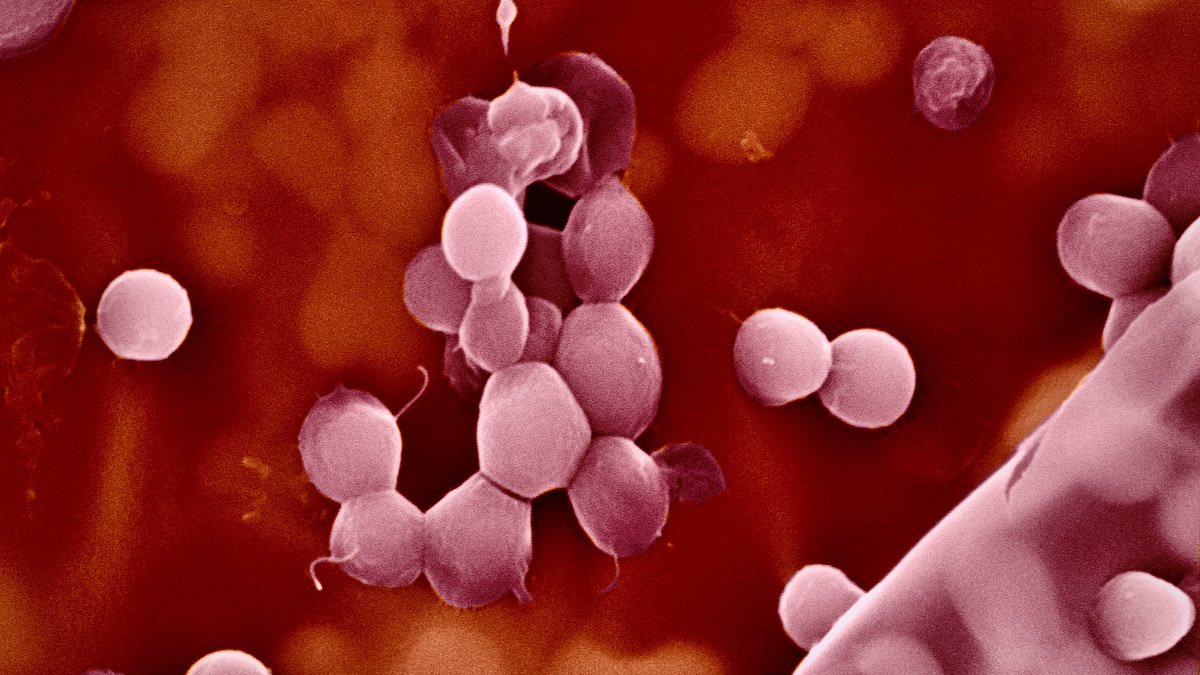
The hunt for life on Mars may have taken a major step forward, as scientists find microbes that could survive on the Red Planet.A team from the University of Florida grew alien-like 'extremophile' lifeforms in conditions that mimic those found beneath the Martian surface.These hardy microbes were left for months at just a fraction of Earth's normal atmosphere, in a solution seven times saltier than seawater, and breathing chemicals similar to bleach.Amazingly, these salt-loving microorganisms didn't just survive; they thrived.Although they grew much slower than those kept under Earth-like conditions, colonies in the simulated Mars environment were able to keep growing.The researchers found that the microbes were able to harness chemicals in their surroundings to produce the energy they needed for reproduction.This could mean scientists need to drastically reconsider the types of environments they consider to be suitable for life.Lead author Dr Adam Robinson says: 'We are adding to the growing body of evidence suggesting that we should consider the possibility of life on Mars today.' Scientists from the University of Florida grew alien-like 'extremophile' lifeforms in conditions that mimic those found beneath the Martian surface. Pictured: A false-colour electron microscope image of microbes grown in a Mars-like environment In the study, published in the journal Applied and Environmental Microbiology, Dr Robinson studied a particular type of extremely tough microbe called Haloferax volcanii.These microbes make their homes in some of Earth's least hospitable environments, such as the Dead Sea or Utah's Great Salt Lake.Because of their unique ability to tolerate conditions that would kill most forms of life, scientists often use them as a model for the kinds of life that could survive on other planets.Most excitingly, scientists think the high-salt environments where Haloferax thrives could be quite similar to the conditions below the surface of Mars.What makes surviving on Mars so tough isn't the cold, saltiness, radiation, or lack of atmosphere alone, but the fact that all of these stresses occur at the same time.In the past, scientists have tested whether bacteria can grow and reproduce in environments with one of Mars' environmental stresses.Likewise, some studies have shown that microbes can cling on for months when faced with several stresses at once.But very little research has been able to show that microbes can actually grow in the face of multiple Mars-like environmental hazards. Scientists recreated some of Mars' conditons in the lab (pictured), leaving them with just a fraction of Earth's normal atmosphere, in a solution seven times saltier than seawater, and breathing chemicals similar to bleach The researchers studied an extremely tough microbe called Haloferax volcanii, which can be found in very salty environments like the Great Salt Lake. Pictured: Pink waters in the Great Salt Lake, triggered by salt-loving organisms that flourish as the salinity rises Dr Robinson says: 'Far fewer have been able to combine these conditions together and show that microorganisms can actively grow.'In the lab, Dr Robinson and his co-authors kept cultures of Haloferax in extremely salty, oxygen-free, carbon dioxide-rich conditions for 180 days.The researchers gave them a mix of chemicals, either nitrates or perchlorates, that are found on Mars and could be used in place of oxygen during respiration.Microbes given one of these chemicals were able to feed and reproduce, while the cultures that were given neither didn't show any noticeable growth at all.Interestingly, the researchers may have also figured out how these microbes were able to survive in such salty conditions.They noticed that the microbes formed biofilms, a clump of organisms encased in a slimy protective layer, that helped them hold in fresh water.When the researchers investigated, they discovered that the cultures had lost very little of their water over the six months of the experiment.In fact, Dr Robinson says that we should expect any real Martian bacteria to be even tougher. In Mars-like conditions, the bacteria formed into slimy clumps called biofilm (bottom row). This may have helped them retain fresh water in an extremely salty environment Although this doesn't prove that there is life on Mars, it suggests that more of the Martian surface could be considered habitable than scientists had previously thought. Pictured: Mars' surface seen by the Perseverance Mars Rover He told the Daily Mail: 'If Mars hosted life earlier in its history, it is possible that some organisms evolved to tolerate increasingly hostile conditions as the environment changed. 'If life from Earth can grow under hostile conditions it has never naturally encountered, what might potential life on Mars look like after billions of years of evolution under those conditions?'However, this doesn't necessarily show that Earth-based life could survive on the Martian surface, and it definitely doesn't prove that there is life on Mars today.Dr Robinson says: 'I would not say this study suggests there is definitely life on Mars today. However, this work adds to a growing body of evidence suggesting that the shallow subsurface of Mars may still retain environmental conditions conducive to active metabolism and extant life.'One of the biggest caveats is that the laboratory conditions didn't perfectly recreate all the dangers Martian life would face.In the lab, the cultures were held at balmy temperatures of 21°C (70°F), the temperature of a balmy summer day on Mars.Meanwhile the average temperature on the Red Planet is -60°C (-76°) and can reach lows of -153°C (-243°C) at the frozen poles.Likewise, although it is possible that there could be sub-surface pockets of liquid water for bacteria to live in, no one has actually found these on Mars. However, Dr Robinson says this doesn't affect the main point of the study, which is to show that the search for life on Mars should be a priority for future exploration missions.He adds: 'We are currently performing experiments at lower pressures and temperatures, working step by step toward conditions more representative of the average present-day environment near the Martian surface.'MARS: THE BASICSMars is the fourth planet from the sun, with a 'near-dead' dusty, cold, desert world with a very thin atmosphere. Mars is also a dynamic planet with seasons, polar ice caps, canyons, extinct volcanoes, and evidence that it was even more active in the past. It is one of the most explored planets in the solar system and the only planet humans have sent rovers to explore.One day on Mars takes a little over 24 hours and a year is 687 Earth days.Facts and Figures Orbital period: 687 daysSurface area: 55.91 million mi²Distance from Sun: 145 million milesGravity: 3.721 m/s²Radius: 2,106 milesMoons: Phobos, Deimos
Could life already exist on Mars? Scientists discover microbes that can THRIVE in extreme conditions found beneath the Red Planet's surface
Full Article
Original Source
Read the full article at Dailymail →KhanList aggregates and links to publicly available news content. We do not host full articles from third-party sources. Always verify important information with original sources.