
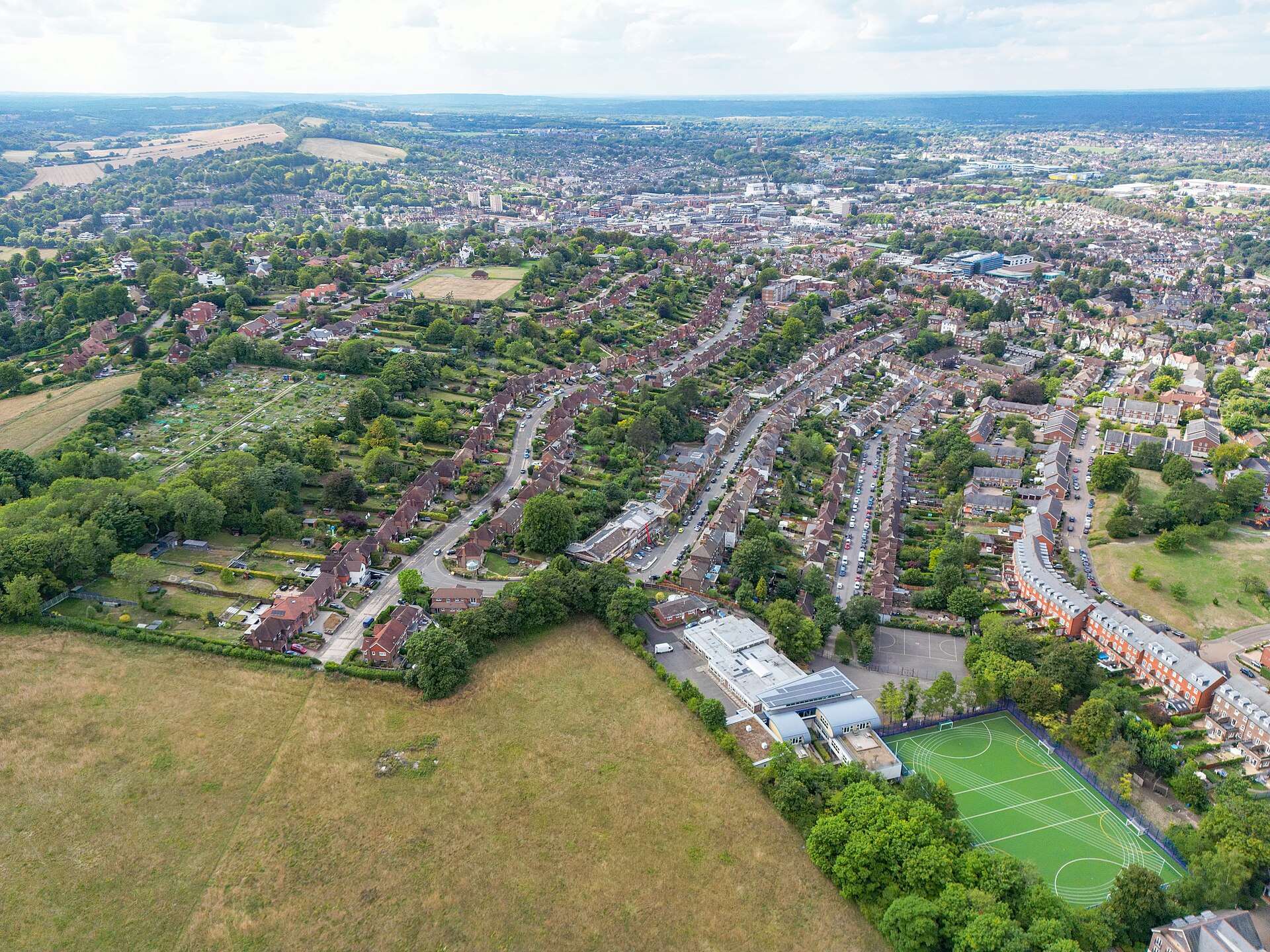
Cities can become dangerously hot during extreme heat events, making it increasingly important for urban planners to find ways to reduce temperatures and protect people from heat exposure. Woodlands, grasslands, lakes and rivers can create significantly cooler microclimates, offering one potential way to reduce urban heat, a new study finds. The study focused on Guildford, a town in southeast England with a variety of green-blue infrastructure (GBI) types. GBI are land and water-based features integrated with each other and the built environment to provide mutually beneficial services, including wildlife corridors, flood mitigation and cooling. In Guildford, researchers collected data from six sites — a woodland, grassland, lakeside, vegetated green wall, small pocket park and riverside — and compared how effective they are in cooling the areas around them. They compared each site with a built-up location. The team established sensors at each site and recorded temperatures at one-minute intervals, from June 2023 till the end of August 2025. These sensors recorded temperatures through both normal climatic conditions and several extreme heat events. The researchers also used satellite data over the same timeline to get a more robust picture of the conditions in each location. The team found that all six GBI sites were cooler by 1.81-2.49° Celsius (3.26-4.48° Fahrenheit) than their built-up comparison site. The cooling was more pronounced during extreme heat events. The woodland site was upward of 6°C (almost 11°F) cooler than the built environment on the hottest days. The riverside and pocket park were cooler by 3.5°C (6.3°F) on the hottest days. Overall, the green wall had the least cooling effect while the woodland had the most. “Those nuances are important because they reinforce something we increasingly see in urban heat research: there isn’t a single number we can attach to a tree, park, lake, or green wall and say, ‘this is how much cooling it provides,’” Vivek Shandas, professor of geography with Portland State University, U.S., who was not part of the study, told Mongabay by email. “Cooling depends on the design of the place, its scale, the surrounding buildings and pavement, weather conditions, and time of day.” The researchers acknowledge that their observations are from just one site for every GBI type, and local conditions could play a significant role in their findings. Still, Shandas said the study moves the research beyond the simple notion that “green is good” and “toward a much more actionable question: How do we design cities so that cooling is available where and when people actually need it?” The United Nations recently announced that global temperatures will soon surpass the climate change target established by the 2015 Paris Agreement, underscoring the urgent need for cities to adapt to extreme heat. Banner image: An aerial view of Guildford, England. Image by Russss via Wikimedia. (CC BY-SA 4.0). Credits Topics
Comparing green space for urban cooling, study
Full Article
Original Source
Read the full article at News →KhanList aggregates and links to publicly available news content. We do not host full articles from third-party sources. Always verify important information with original sources.