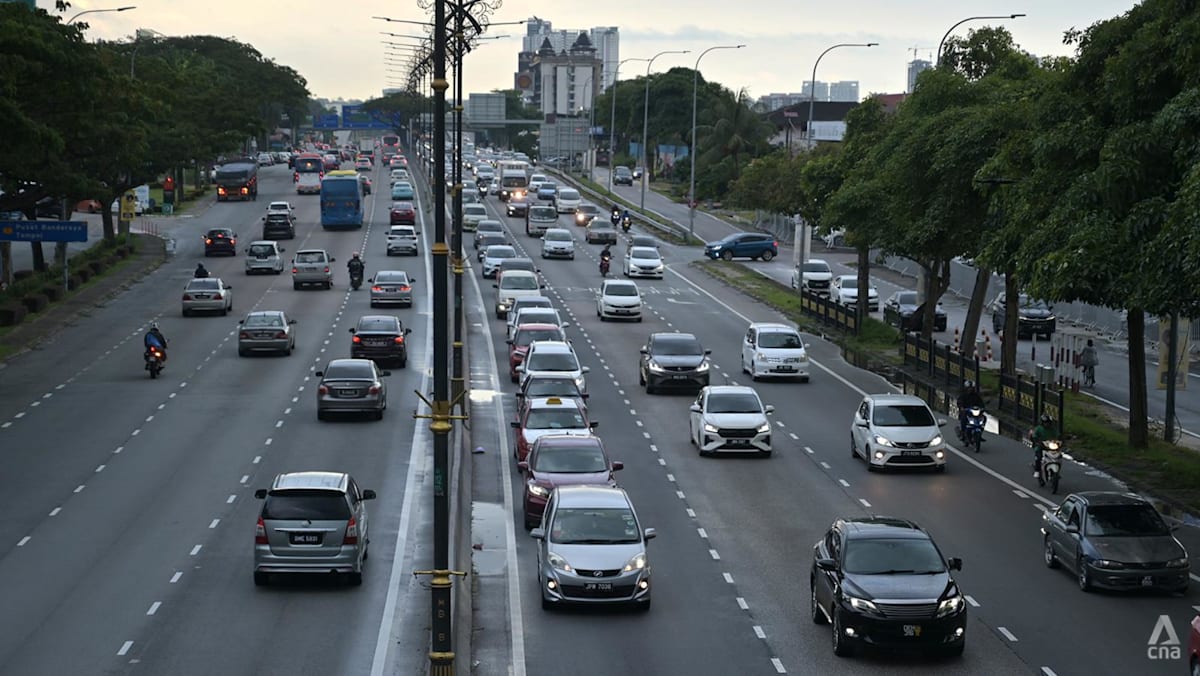
Commentary If congestion pricing saves time, improves buses and funds better infrastructure, support will follow, says NUS’ Timothy Wong. Vehicles on the road in Johor Bahru. (File Photo: CNA/Zamzahuri Abas) New: You can now listen to articles. This audio is generated by an AI tool. SINGAPORE: Johor Bahru stands at a crossroads. The Rapid Transit System (RTS) Link between Malaysia and Singapore, set to open in January 2027, will transform its transport system. Connecting Bukit Chagar in Johor Bahru and Woodlands North in Singapore, the RTS will be able to transport up to 10,000 passengers per hour in each direction. Plans are underway to upgrade Johor Bahru’s public transport networks to handle the surge in commuters from the RTS. The recently approved RM10 billion (US$2.5 million) elevated Autonomous Rapid Transport (e-ART) system will connect to the RTS Link and run through Skudai, Tebrau and Iskandar Puteri. However, it will take four years to complete.As I argued in a previous commentary, buses must form the backbone of a feeder network - both as an interim solution while the e-ART is built, and as a permanent last-mile service thereafter. The Johor state government intends to expand bus routes and fleet size, designate bus lanes and set up a high-frequency RTS shuttle bus service plying the station and surrounding areas.There is, however, a fundamental obstacle: Traffic congestion in Johor Bahru will render buses slow and unreliable. A bus stuck in the same jam as private cars offers little incentive to switch. However, one intervention can break this deadlock: Congestion pricing. THE CHICKEN-AND-EGG FALLACYSeveral Malaysian officials have argued that cities such as Kuala Lumpur, Penang and Johor Bahru are not yet ready for congestion pricing because the public transport network is not sufficiently comprehensive and reliable. Without alternatives, congestion tolls force drivers to pay more without reducing traffic.The trouble with this argument is that it assumes public transport can be made attractive without also tackling congestion. The reality is the opposite: Buses cannot become faster and more reliable while they remain trapped in gridlock.Congestion pricing and public transport investment are not sequential steps but simultaneous necessities. One enables the other. The country must invest in its bus networks and simultaneously implement congestion tolls to ensure buses can travel smoothly. WHY CONGESTION PRICING WORKSSceptics may assume that only draconian tolls can shift behaviour. Evidence from other cities suggests otherwise.When Sweden's capital city Stockholm introduced congestion charges in 2006, the initial fee was modest, 20 Swedish kronor, roughly the price of a cup of coffee at the time. Yet traffic into the city centre dropped by around 20 per cent almost immediately.London's ₤5 congestion charge, introduced in 2003, was roughly 5 per cent of a worker’s daily income. It reduced traffic volumes in the charging zone by 15 per cent in its first year. These are not small effects.The reason is straightforward: Some share of trips into congested areas are discretionary or shiftable. A small price nudges those at the margin away from driving - people who could take another route, travel at another time or switch modes. The remaining drivers then enjoy freer roads.The relationship between traffic volume and speed is non-linear; at higher volumes, additional vehicles cause more delay. But this also means the reverse is true; removing a small fraction of vehicles from a congested road can improve speeds significantly. Congestion pricing could lead to an outcome where everyone wins. All drivers benefit from reduced congestion. Those who switch to public transport benefit too, because buses now run faster on less crowded streets.In addition, revenue raised can help fund improved public transport access through the most critical bottlenecks. This means funding larger bus fleets that ply the densest corridors to the city centre and building park-and-ride facilities at strategic entry nodes. ADDRESSING EQUITY CONCERNSThe most serious objection is that congestion pricing burdens the low-income. Often, these commuters have inflexible schedules and poor public transport access, so they may end up paying the congestion toll. This concern deserves a direct answer.First, the low-income already pay, just not in money but with time. They wake up early to spend hours crawling through traffic. A worker commuting two hours each way is paying a steep cost that no subsidy currently offsets.Congestion pricing changes the equation. If the same worker can now take a bus that moves 30 per cent faster because roads are clearer, they may be better off. If they choose to continue driving, the time savings they enjoy from clearer roads may outweigh any toll they now must pay.Second, and most importantly, the government has tools to ensure equity. Revenue raised from congestion pricing can fund subsidised transit passes, improved bus services in underserved areas or be returned via cash transfers to lower-income drivers. To win over the public, the government may need to earmark the revenue for such measures from the outset. An RTS Link train on a test run in Johor Bahru on Jun 15, 2026. (Photo: CNA/Zamzahuri Abas) PUBLIC OPINION CAN SHIFTPerhaps the greatest barrier is political: The assumption that voters will never accept road pricing. Here, too, evidence offers hope.In Stockholm, a trial congestion charge was put to a public referendum. Before the trial, most residents opposed it. After experiencing the benefits of cleaner air, shorter commutes, a majority voted to keep the price for roads that were previously free.London saw similar shifts in sentiment. New York City, after decades of debate, finally implemented congestion pricing in lower Manhattan, with initial polling showing growing acceptance.Critics may argue that these Western cities possessed far more mature rail networks before pricing their roads. However, the fact that Johor Bahru’s transit future must be more bus-reliant may, in fact, make congestion pricing more favoured among commuters. Unlike underground trains, buses require actively managed, clear surface roads to guarantee the reliability that wins over commuters.If congestion pricing demonstrably saves time, improves buses and funds better infrastructure, support will follow results. Johor Bahru, Penang and Kuala Lumpur cannot afford to wait. They need to act - on buses and on pricing. Only then will these cities overcome standstill and begin to move.Timothy Wong is senior lecturer in the Department of Economics at the National University of Singapore.
Commentary: Why Johor Bahru should roll out congestion pricing when RTS opens
Full Article
📰 Original Source
Read full article at Channelnewsasia →KhanList aggregates and links to publicly available news content. We do not host full articles from third-party sources. Always verify important information with original sources.