
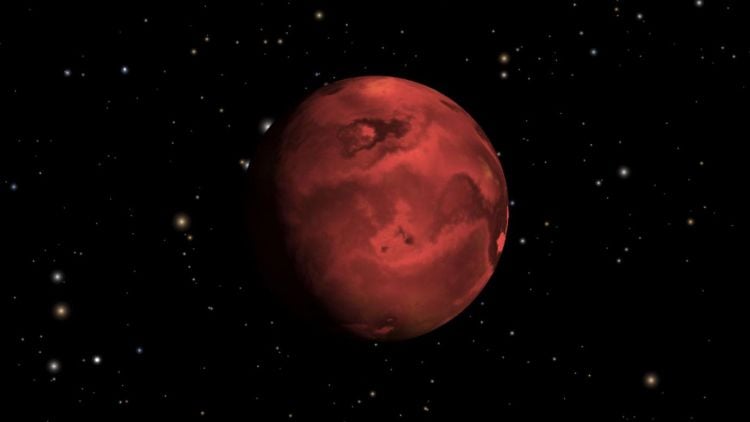
Exoplanets continue to challenge our understanding of planetary formation, evolution, and whether they might be able to support life as we know it. Scientists often use planets in our solar system as analogs for exoplanets, studying exoplanets with extremely short orbital periods forces scientists to constantly rethink our understanding of what planets can withstand during their lifetimes. One such type of exoplanet that has entered the foray in recent years are “lava world” exoplanets, and especially lava exoplanets that orbit dangerously close to their stars. But while it has been long known that lava worlds on with higher temperatures have atmospheres, “colder” lava worlds have been found to lack atmospheres. Now, an internation team of researchers might have inched our way to solving that conundrum, as they examine an Earth-sized lava world orbiting its star in less than one Earth day. As discussed in a recent study published in The Astrophysical Journal Letters, researchers from the United States, United Kingdom, China, and Spain present new evidence that an unusually cold lava world might challenge our understanding of lava worlds due to its potential possession of an atmosphere. For the study, the researchers used NASA’s James Webb Space Telescope (JWST) to observe HD 3167 b, which is located about 154 light-years from Earth, has a radius and mass of about 1.6 and 4.8 of Earth, respectively, and orbits its K-type star in about 0.96 Earth days. K-type stars are both smaller and cooler than our Sun but are estimates to comprise the largest population of stars in the Milky Way Galaxy. While “hotter” lava worlds have been confirmed to have atmospheres since the extreme temperatures melt away the surface, resulting in this becoming a gas and enveloping the planet, “colder” lava worlds are known for being bare rocks that lack atmospheres. However, despite HD 3167 b being on the colder end of the temperature spectrum, the researchers found that it could possess an atmosphere. They made this discovery through observing the exoplanet’s secondary eclipse, which is when it is observed as it passes behind its star. This differs from a transit, which occurs when it passes in front of its star. When JWST observed HD 3167 b’s secondary eclipse, the exoplanet’s surface was found to be much cooler than previously hypothesized, with the researchers noting this could mean its heat from the dayside is redistributed to the night side. The note of dayside and night side is important since exoplanets orbiting this close to their stars are tidally locked, meaning one side always faces its star. The researchers note how this study could challenge our understanding of lava worlds, specifically regarding their ability to retain and maintain atmospheres based on the surface temperature and composition. “Despite how inhospitable they are for life, we’re also interested in studying these kinds of planets because we think early Earth might have looked a lot like a lava world,” said Brandon Park Coy, who is a PhD student in the Department of the Geophysical Sciences at the University of Chicago and lead author of the study. “We think that very early in the solar system’s history, when the terrestrial planets formed, they were extremely hot due to the energy from all of the planetesimal collisions. Earth had what’s known as a magma ocean stage with an entirely liquid surface. This result gives us a window into studying what conditions may have been like in Earth’s first couple of million years.” As suggested, lava worlds have been studied dating back to the 2000s, but their formation and evolution differ greatly from our solar system’s own lava world, Jupiter’s moon, Io. While Io’s volcanic activity, which includes hundreds of active volcanoes, is caused by tidal heating from the gravitational interactions between the much larger Jupiter and the other Galilean moons, lava exoplanets result from the searing temperatures literally melting their surfaces, and this material evaporating to form an atmosphere. What new insights into lava exoplanets will researchers make in the coming years and decades? Only time will tell, and this is why we science! As always, keep doing science & keep looking up!
Coldest Lava Exoplanet Found to Hold an Atmosphere
Full Article
Original Source
Read the full article at Universetoday →KhanList aggregates and links to publicly available news content. We do not host full articles from third-party sources. Always verify important information with original sources.