
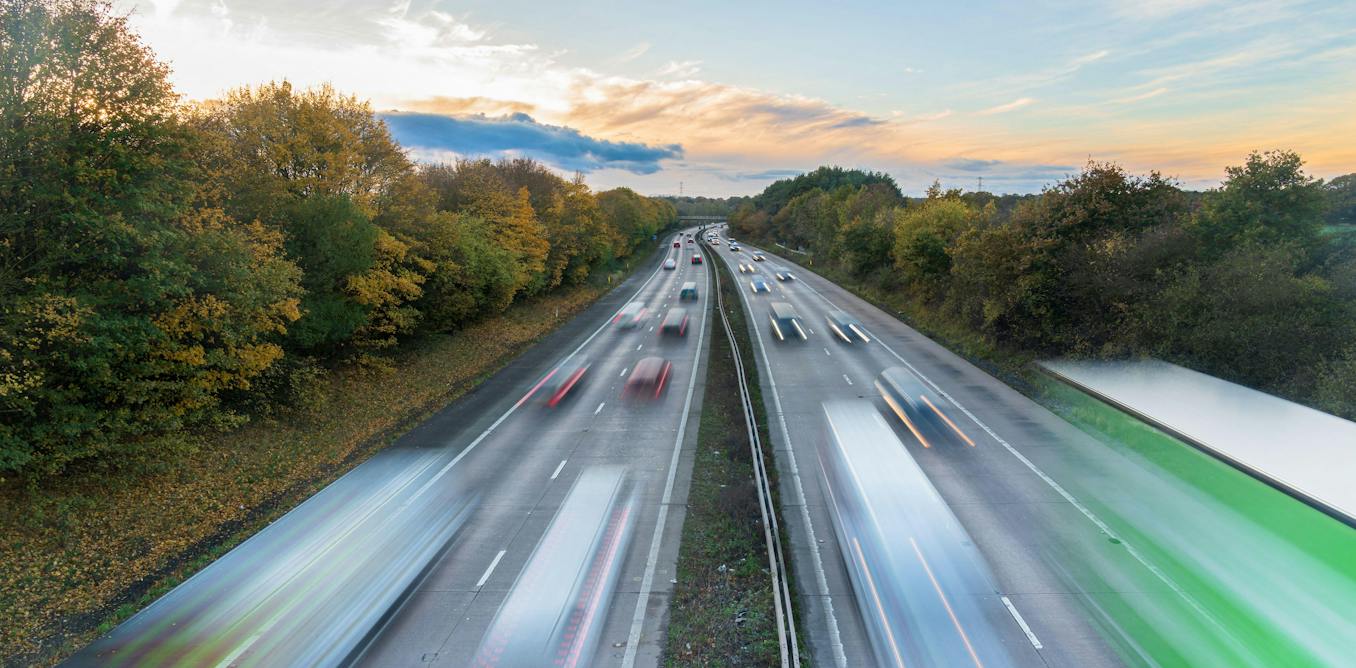
Imagine joining the motorway in the near future and seeing a 50 mph speed limit sign, but no roadworks, no accident and no obvious reason to slow down. This time, the aim is to save fuel. UK diesel prices have hit an all-time high, with the average litre costing almost £2. Petrol prices are also rising, mainly due to disruptions to global oil supplies. The UK’s National Emergency Plan for Fuel, last updated in 2024, includes measures to reduce demand in the event of a severe disruption, including lower road speeds. The International Energy Agency has also recommended speed reductions as a way to cut oil demand during a supply crisis. One proposal, recently resurfaced by British tabloids, would see a 50mph limit on motorways. This would mirror the 50 mph limit imposed during the oil crisis of 1973, when the UK government took a range of special fuel-saving measures. But in 2026, how much fuel would such a limit actually save? The basic physics is straightforward. Cars use more fuel at higher speeds because they have to push through more air. Aerodynamic drag force increases with the square of the speed, while the power needed to overcome that drag rises roughly with the cube of the speed. Double the speed, and you’ll need roughly eight times as much power to overcome aerodynamic drag (two cubed, or 2 x 2 x 2, equals eight). So cutting motorway speeds can significantly reduce the energy needed to keep a car moving. At 50mph, for example, the power needed to overcome drag is only around 36% of that required at 70mph. But this does not mean fuel consumption would fall by 64%. But real-world driving is more complicated, and aerodynamic drag is only part of the story. Fuel consumption also depends on other factors including engine efficiency, the vehicle’s weight and shape, gearing, weather conditions and how the car is driven. So a 50mph speed limit would not cut fuel consumption as drastically as the figures predicted from the reduction in aerodynamic drag. The reality about fuel consumption So how much fuel could a lower speed limit actually save? One useful real-world example comes from Spain. In March 2011, during an economic crisis with rising oil prices and worries about import dependence, the government reduced the speed limit on motorways from 120km/h (75mph) to 110km/h (68mph) for four months. Fuel consumption fell over those four months, compared to the same period the previous year. Later analysis attributed an estimated 2-3% reduction from speed limits alone. Control de velocidad! Reduced speed limits in Spain made a small but noticeable difference. Jesús Hellín / Alamy The relationship between speed and fuel consumption is not linear, either. Research on vehicle energy use suggests that fuel consumption and emissions per kilometre are generally lowest at speeds of around 60-90 km/h (37-56 mph), though the precise optimum will depend on driving conditions and the type of car. Other studies point in the same direction, though again their results vary depending on vehicles and conditions. Tests of US car models found that slowing from 65 to 60 mph reduced fuel consumption by an average of about 8%, although the reduction varied between vehicles. A UK study also estimated that increasing the motorway limit from 70 mph to 80 mph would increase a small car’s fuel consumption by around 17%. These controlled tests show how strongly fuel consumption can respond to changes in speed, but they don’t tell us exactly how much fuel would be saved in practice if speed limits were lowered. Should it be 50 mph, 55 mph or 60 mph? A 50 mph speed limit may produce additional fuel savings for some vehicles when compared with 60 or 70 mph, but the incremental fuel savings from 55 or 60 to 50 may be relatively small, while the additional journey time cost is substantial. There is therefore a trade-off between fuel savings and journey times. Vehicle technology continues to evolve, perhaps soon involving self-driving cars that can travel together on the motorway at the same optimised speed. We’ll need to determine what those optimal speed limits should be – a speed that effectively balances fuel consumption, journey time and road capacity.
Would a 50 mph motorway speed limit really save much fuel?
Full Article
Original Source
Read the full article at Theconversation →KhanList aggregates and links to publicly available news content. We do not host full articles from third-party sources. Always verify important information with original sources.