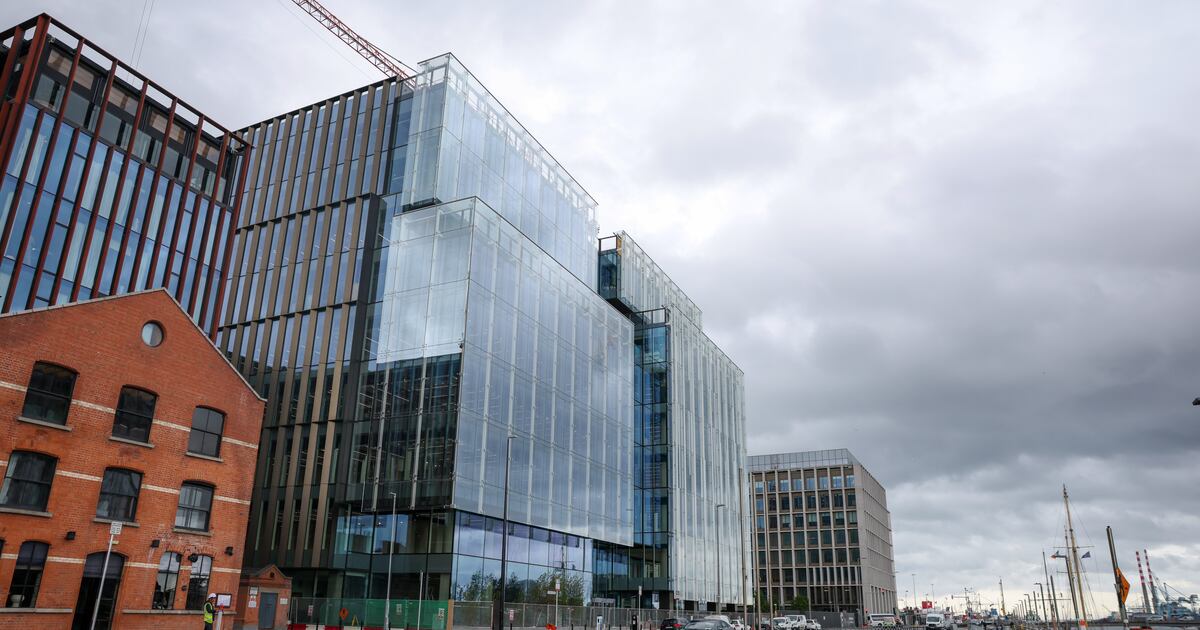
When US banking behemoth Citi paid €100 million to acquire the site of its new European headquarters in Dublin’s north docklands from developer Johnny Ronan’s RGRE in January 2023, it looked like a bold move given all the questions that still surrounded the future of office working in the early aftermath of the Covid-19 pandemic. Only the month before, Meta had sent shock waves through the Dublin office market when it instructed agent Cushman & Wakefield to sublet all four of the newly developed blocks at its new European headquarters in Ballsbridge, rather than occupy them itself. Although the social media giant’s move came in the midst of turbulence and retrenchment among tech companies worldwide, it also opened up a gaping 34,838sq m (375,000sq ft) void that remains largely unfilled nearly four years later.While that speaks volumes about the demand among companies for space in Dublin’s office market, it doesn’t speak for Citi. The bank, which has had a presence in Ireland for more than 60 years and is the largest bank in the Irish market by assets, with some $210 billion on its balance sheet, is gearing up to make the move from its long-standing home at 1 North Wall Quay to its new 300,000sq ft (27,870sq ft) European headquarters.READ MOREThe new office building is nearing completion at Waterfront South Central, the mixed-use scheme RGRE is developing next to the 3Arena in Dublin’s north docks. Unsurprisingly, the building’s scale and complexity have required a massive financial commitment from Citi. The total spend on its new European headquarters is set to weigh in at around $650 million (€569.6 million) between the costs of site acquisition and construction, with the vast majority of those funds flowing into the Exchequer. Some 2,300 people were employed on the project at various stages over the past three years while more than 80 per cent of the contracts were signed with and fulfilled by Irish companies.While the investment is substantial, it’s also absolutely essential, according to Citi’s Head of Enterprise Services & Public Affairs Ed Skyler. Speaking to The Irish Times on a recent visit to Dublin to inspect the bank’s new European headquarters, Skyler a former deputy mayor of New York under mayor Michael Bloomberg, highlighted the importance of Citi’s Irish-based operations to its global business. Ed Skyler, Citi head of enterprise services and public affairs, speaks to The Irish Times in advance of the bank moving into its new Dublin building. Photograph: Enda O'Dowd “Firstly, you have to step back and recognise the importance of Ireland to Citi,” he says. “And so there are three really important things that go on in Ireland, and specifically in Dublin for us. One is we’re the first American bank to be here. We’ve been for 61 years. We service hundreds of domestic clients in Ireland through markets, wealth-management services, corporate banking, investment banking. So it’s a very important business for us. “Beyond that, it’s also the headquarters of our European business. And we established it a year after Brexit, so we have 21 other branches plus our business here. And that’s $300 billion of assets here and in Germany, Italy, France, and throughout Europe. [ Office market is facing generational change not a cyclical dipOpens in new window ]“And the third thing that’s important here is that this is one of our global-city service centres, so that means that there’s operations here that are servicing, supporting cities and functions globally. So that can be finance, that can be audit, that could be technical operations or human resources and legal that are based here supporting teams outside the country, so it really is a triple play for us of different activities that are really important.”On the decision to move rather than refurbish its existing North Wall Quay offices, Skyler adds: “I think we’ve been in this building since 1995, and while it was state-of-the-art at the time, it reached the end of its useful life.“This building was fantastic when it opened. But, as we’ve seen in recent years, the way people work is different, and what people expect out of their employer is different in terms of sustainability, health and wellness, and we are all around the world designing spaces that provide that for our people.”Distributed across 10 office floors, the bank’s Waterfront South Central offices will be 31 per cent larger than its current HQ and will have 2,000 seats to accommodate about 3,100 employees based on the bank’s current hybrid-working model of three days a week in the office. The facilities will include a purpose-built fitness centre with two studios, a restaurant offering a range of cuisines aimed at promoting healthy and sustainable diets, two barista coffee bars, indoor gardens and a games room, along with numerous breakout spaces and quiet areas designed for relaxation and recharging. A community gallery will also be established to reinforce Citi’s stated commitment to creativity and inclusion both internally and within the wider community.Inside the new European headquarters of US banking giant Citi, development of which is nearing completion in Dublin's north docklands. Photograph: Enda O'Dowd Citi's new office buildingboverlooks the river Liffey in Dublin. Photograph: Enda O'Dowd Citi's new European headquarter in Dublin's docklands. Photograph: Enda O'Dowd In terms of its sustainability, the development is targeting LEED Platinum certification and the Nearly Zero Energy Building (NZEB) standard. The building will operate on 100 per cent renewable energy while its mechanical systems have been designed to use 39 per cent less in operational energy.“I think that people are going to walk into that building and they are going to feel like they are someplace special. I think that applies to colleagues and to our clients as well,” Skyler says. “When we think about moving into a modern building, it’s going to have fitness centres, it’s going to have, great food options and coffee bars. It’s going to have medical care, so it’s going to be a place that’s going to keep our colleagues and employees healthy and well. “It’s also going to catalyse the way they work, where they have five times as many collaborative spaces and touchdown rooms. It will be open-plan, basically zero assigned seating, so it allows for those constructed collisions in the way that people work now, which is that they want to work together and not be in some cubicle where they can’t see above their computer screen.”[ Why AI is more likely to fill offices than empty themOpens in new window ]On whether artificial intelligence might yet have an impact on the volume of office space Citi requires in Dublin, Skyler says: “We have right now, about 3,000 people that come to work here [in Dublin]. It’s too soon to say how AI will impact that, but when we make real-estate decisions, we always keep flexibility in mind. We can always densify or de-densify space. We’ve been shrinking our office footprint significantly. “Our overall office footprint over the last 10 years has gone from about 45 million to 25 million square feet as a result of divestitures, and as a result of optimisation and making use of our space more efficiently and more collaboratively.”
Citi’s new $650m Dublin HQ: ‘People are going to walk into that building and they are going to feel like they are someplace special’
Full Article
Original Source
Read the full article at Irishtimes →KhanList aggregates and links to publicly available news content. We do not host full articles from third-party sources. Always verify important information with original sources.