
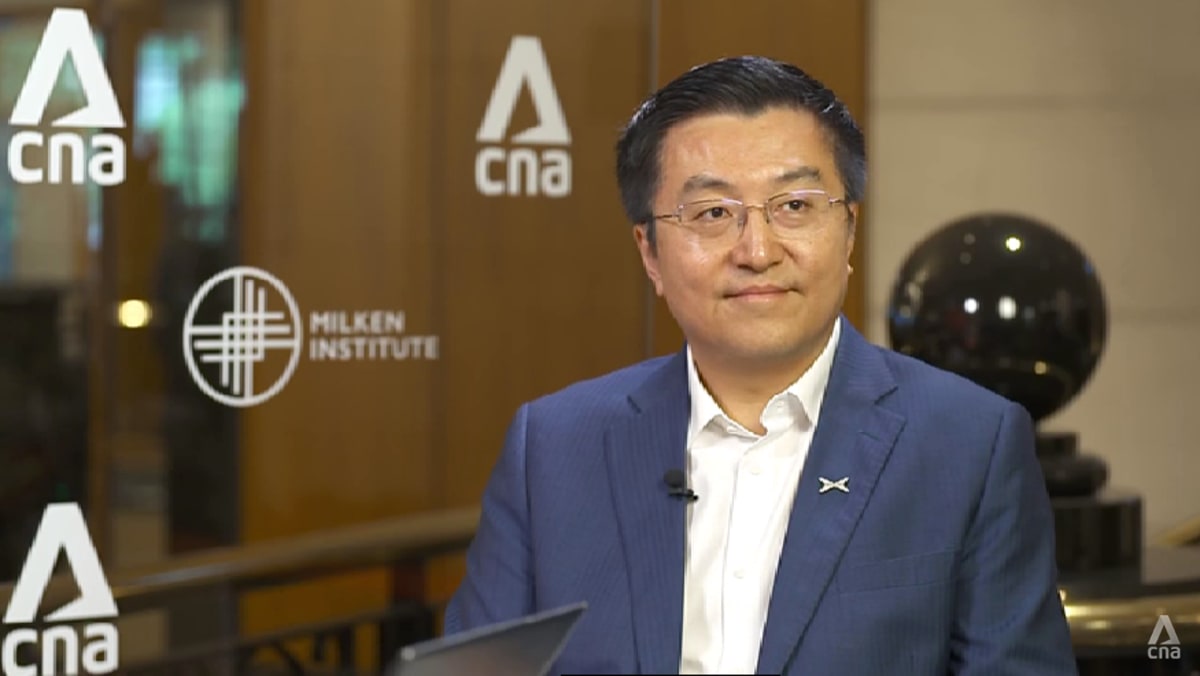
Business Xpeng is also ramping up production of its humanoid robot, Iron, with plans to put it to work in stores before offering it to external customers, vice-chairman and president Brian Gu tells CNA’s Julie Yoo in an interview. Xpeng vice-chairman and president Brian Gu. (File Photo: Reuters/Lam Yik) New: You can now listen to articles. This audio is generated by an AI tool. SINGAPORE: Chinese electric vehicle maker Xpeng plans to begin testing robotaxis in selected overseas cities next year, as it takes its autonomous driving technology beyond China, vice-chairman and president Brian Gu said. Robotaxis could become a more common sight on roads in the next two to three years as commercial deployment expands, he added. “Starting next year, we hope to launch pilot testing in select global cities,” Gu told CNA on the sidelines of the Milken Institute Asia Summit in Singapore. “Robotaxis are not that far from everyday life. As soon as probably two to three years later, you could see larger-scale commercial deployment around the world.” He did not reveal which cities are being considered. Xpeng is currently testing its Yoyo robotaxi in the southern Chinese city of Guangzhou, with close to 100 vehicles involved in the pilot. Gu said there has been “tremendous development” in autonomous driving capabilities in recent years, adding that Xpeng's driver-assistance systems were used for nearly 60 per cent of the distance travelled by its vehicles. But fully autonomous robotaxis would need to meet a higher bar, including being able to safely handle complex and unexpected situations without a human driver, he noted. INTENSE COMPETITION Xpeng’s robotaxi push comes amid intense competition in China’s EV sector. “The Chinese automotive market is the most competitive in the world because of the sheer number of players,” Gu said. He added that companies hoping to emerge from that competition would increasingly need capabilities beyond making cars, including in artificial intelligence, manufacturing, supply chains and overseas operations. “Today, to be successful, you cannot just be an automotive company. (You) have to develop a full stack approach. You have to be an AI company, a global company,” he said. Xpeng has been expanding beyond electric cars into areas including robots and flying vehicles, as it seeks to position itself as what it calls a “physical AI” company. Gu said the technology developed for its vehicles, including its own AI models and chips, could also be applied to other machines. HUMANOID ROBOTS Among them is Iron, Xpeng’s humanoid robot, which the company is preparing to produce in larger quantities from early next year. The 1.73m-tall robot is designed to resemble humans in its size, posture and movement. Xpeng plans to deploy the robots in its own stores and offices, where they would work as receptionists and sales assistants. “(They will) work alongside human employees by welcoming customers, introducing the products, answering questions, maybe even hand over bottled water,” said Gu. Xpeng intends to begin offering Iron to external customers in the second half of 2027, he added.
China’s Xpeng targets overseas robotaxi trials next year, wider rollout in 2 to 3 years
Full Article
Original Source
Read the full article at Channelnewsasia →KhanList aggregates and links to publicly available news content. We do not host full articles from third-party sources. Always verify important information with original sources.