
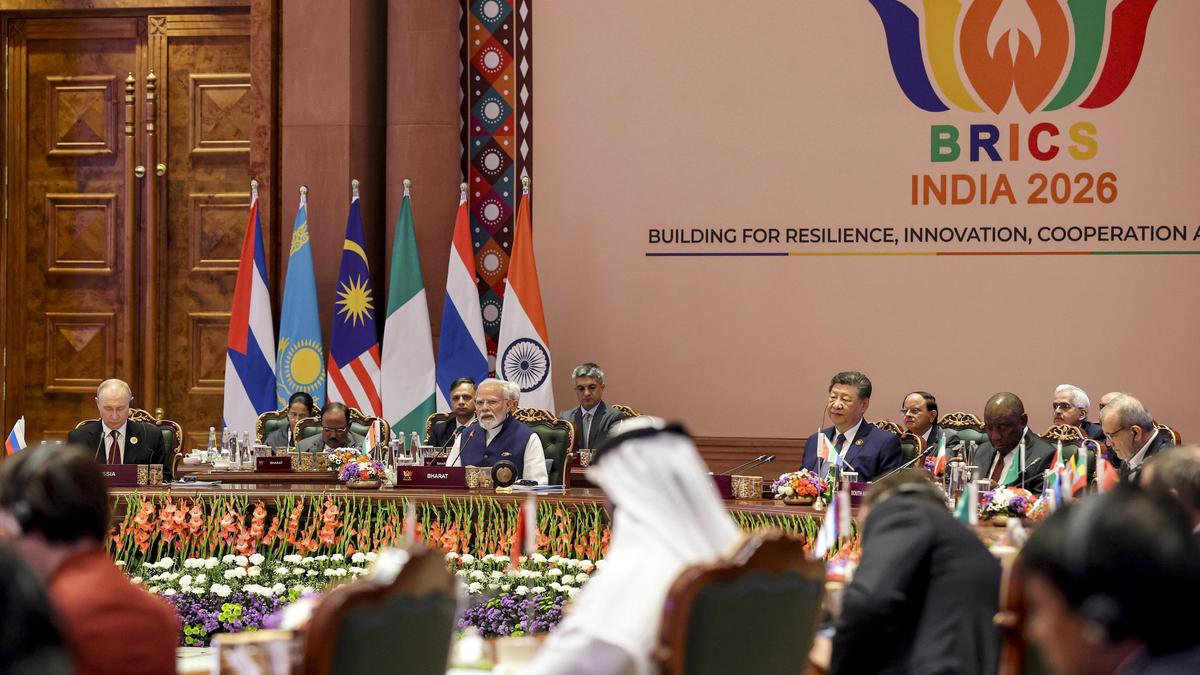
The 18th BRICS Summit, held in New Delhi on September 12-13, 2026, was an extravaganza of sorts. The summit’s New Delhi Declaration has been widely hailed as a major achievement for reconciling the divergent views of the 11-member grouping. Its unanimous adoption is again a major achievement in a world often works at cross purposes. Achieving this consensus under India’s chairmanship, is an excellent example, at one level, of India’s standing within BRICS and its importance in the councils of the worldThe Declaration covered matters such as reform of global governance, trade, finance, energy, climate, technology, health and agriculture. The decisions taken were unanimous, involving aspects such as mutual respect, sovereignty, equality, openness and consensus. It proposed that the BRICS group should work towards local currency trade and inter-operable cross-border payment systems, extend support for the BRICS Economic Partnership Strategy 2030; a Global Value Chain Action Plan for 2026-2030; seek a more representative United Nations (UN) and international financial system with greater regard given to developing countries, and supporting de-escalation in West Asia as also humanitarian access in Gaza.The message, the approachThe political message conveyed was that global institutions no longer adequately reflected contemporary economic and demographic reality. This underlined the need for a stronger voice for emerging markets and developing economies. This in turn called for a broader effort to promote multi-polarity, reform of the Bretton Woods institutions, underline preference for dialogue, diplomacy and political solutions, and on trade, defend the World Trade Organization (WTO) and the rules-based multilateral trading system, including a two-tier WTO disputes settlement mechanism. It supported the Palestine people’s rights to determination as well as a just and lasting settlement based on international law.The Summit contained a detailed reference to Artificial Intelligence (AI), acknowledging its potential to stimulate economic growth, improve public services and accelerate sustainable development. The Declaration supported international cooperation on AI governance, including wider access to computing resources, research, skill and innovation. Over all, the Declaration appeared to adopt a pragmatic approach to issues concerning energy, health, climate and food security.In his inaugural address, Prime Minister Narendra Modi urged BRICS leaders to draw up 10 global governance reform proposals, adding that the message from the BRICS Summit should be that ‘if our future is shared, then the right to shape the future must also be assured’. Editorial | More heft: On India and the 18th BRICS SummitAmong the many comments on the New Delhi Declaration, the broad consensus was that it was in keeping with India’s policy of strategic autonomy, multi-alignment, and multi-vector engagement. The optics were excellent. The presence of Chinese President Xi Jinping and Russian President Vladimir Putin lent gravitas to the proceedings, and the fact that the United Arab Emirates and Iran participated without indulging in mutual recriminations was also significant. All this seemed to suggest that BRICS is beginning to make some progress on matters of substance, rather than merely being a diplomatic spectacle. Among other highlights was the atmosphere of bonhomie that seemed to prevail and, at the very least, appeared to reflect an Indian approach to BRICS, viz., cooperation and consensus and for consultation and discussion on dispute settlement. ‘India must face the reality that membership of BRICS hardly gives it any additional political or economic strength’ | Photo Credit: Sputnik via Reuters What a more sober assessment showsNotwithstanding all this, it is important to acknowledge that this is the age of ‘variable geometry’ and not of ‘deep seated’ alliances. Given the state of the world, this is the grim reality of today. While, this BRICS Summit might seem to have ‘bucked’ this trend, a more sober and realistic assessment would seem to suggest that this is not the case. It may perhaps be too radical or drastic to cast BRICS as outdated; perhaps BRICS could possibly hope to become something in the nature of Europe’s ‘coalition of the willing’ which has been contrived in the wake of the near demise of the North Atlantic Treaty Organization in Europe.The fault may not lie entirely with the leaders of BRICS, for evidently no one could have predicted or anticipated the shifts and changes that have taken place in the international order since the first BRIC summit in Yekaterinburg, Russia, in 2009. Ad hoc cooperation rather than firm alliances is the order of the day at present, alongside pragmatic coalitions built around shared ‘interests’, rather than true values and intentions.This is often justified as pragmatism that is often needed during difficult periods, wherein multilateralism is replaced by plurilateralism in different corners of the globe. To expect that BRICS would remain unaffected given the many iterations taking place across the globe, and amidst the virtual collapse of the international economic and political order, would hence, be too much to hope for.Each of the demands made by the original BRICS countries — Brazil, Russia, India, China and South Africa — meanwhile remain unfulfilled to this day, including aspects such as reform of the International Monetary Fund, the World Bank, and the UN. Also unfulfilled is the strengthening of cooperation among developing countries, to reduce dependence on western financial systems so as to create a more multipolar world.Notwithstanding the creation of better opportunities for trade, BRICS has failed to become a well-integrated economic bloc that could stand up to the tyranny of the Bretton Woods Twins, let alone become a highly integrated economic bloc.The China factorApart from its failure to promote multilateralism, or extend strong support to a more democratic and just multipolar world (combined with other weaknesses such as the failure to strengthen global South-South Cooperation), is another reality that cannot be ignored. In the nearly two decades since Yekaterinburg, China’s economic preponderance has far eclipsed that of all other BRICS members, and has, in the process, achieved a political heft that is leading to a serious imbalance within the BRICS community.The spectacle of United States President Donald Trump’s kowtowing to Mr. Xi, during Mr. Xi’s visit to Washington DC in September 2026, demonstrates that China can no longer be regarded as a member of the Global South, and hardly (any longer) championing many of the demands espoused by the BRICS nations such as the tyranny of the Big Powers. A fledgling economic power in 2009, China’s heft threatens to derail the stance that BRICS has consistently held, viz., that of opposing the hegemony of the West.Tensions remain between China and India, which are the leading members of BRICS. While no serious conflict has taken place since 2020 (Galwan), thanks to diplomatic efforts at all levels, relations remain uneasy notwithstanding the present diplomatic calm. This in turn does affect the future trajectory of BRICS and how far it can succeed in achieving its objective.Hence, notwithstanding the surface calm evident at the New Delhi Summit, the reality is that the ability of BRICS to act in unison in a world that is in disarray is strictly limited. As far as India is concerned, while it does not have to fear the so-called Thucydides Trap or be concerned about U.S. economist Charles Kindleberger’s theories, it must face the reality that membership of BRICS hardly gives it any additional political or economic strength. The increasing imbalance in BRICS — in terms of political and economic strength and influence — perhaps contains the seeds of its irrelevance in the years ahead, notwithstanding the hopes expressed during the New Delhi Declaration.M.K. Narayanan is a former Director, Intelligence Bureau, a former National Security Adviser, and a former Governor of West Bengal
BRICS in a fragmented world order, a test of relevance
Full Article
Original Source
Read the full article at Thehindu →KhanList aggregates and links to publicly available news content. We do not host full articles from third-party sources. Always verify important information with original sources.