
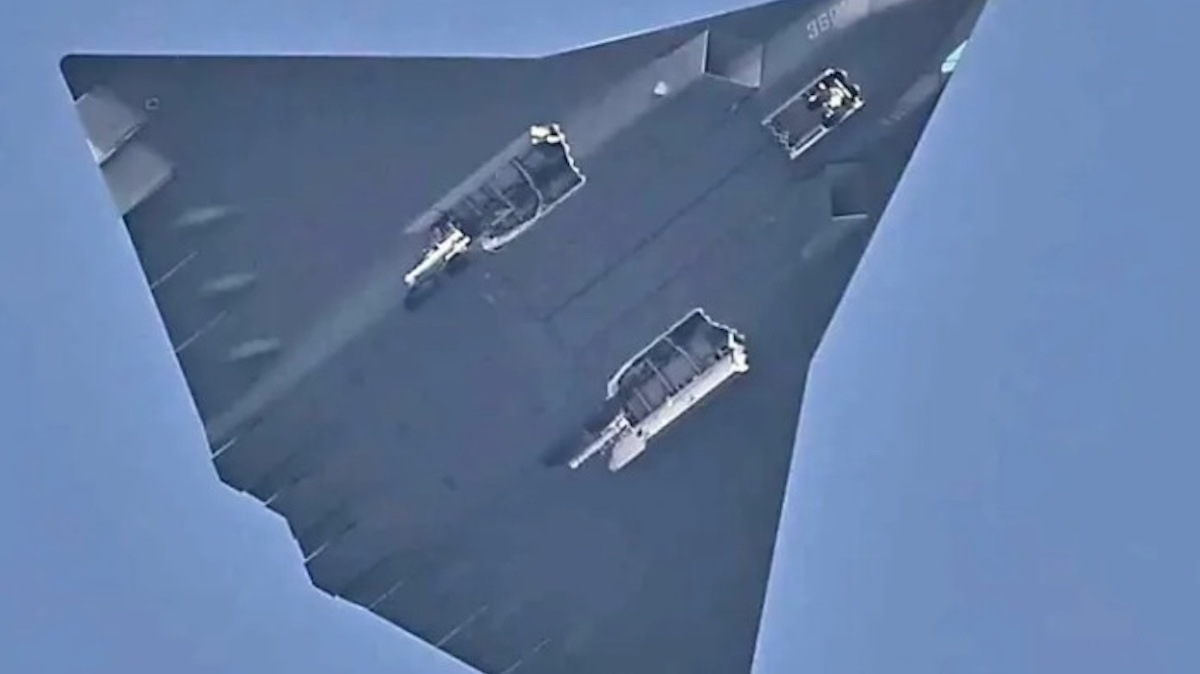
Recent revelations from China’s defense industry suggest the long-sought goal of mounting combat lasers onto fighter aircraft may finally be moving from theory to reality. State-owned aerospace contractor Aviation Industry Corporation of China (AVIC) showcased plans for an airborne directed-energy weapon at a defense expo, offering the strongest public indication yet that China is developing high-energy combat lasers for its next-generation warplanes, multiple media outlets reported. AVIC’s Beijing Precision Engineering Institute for Aircraft Industry displayed promotional materials detailing a “fighter aircraft laser-weapon tracking and aiming system” weighing under 380 kilograms and delivering at least 100 kilowatts of power. The aircraft shown in the promotional materials — the J-36, a heavy, three-engine sixth-generation fighter-bomber first spotted flying in late 2024 — may have the payload and power capacity to support such a device to intercept cruise missiles, neutralize drones, or blind incoming air-to-air missile seekers. While airborne integration faces severe aerodynamic, vibration, and thermal hurdles that previously stalled similar US pod initiatives, China’s pursuit marks a significant step toward fielding active, magazine-independent directed-energy defenses against long-range Western munitions, though public evidence has yet to confirm whether flight trials have commenced. Heavy sixth-generation combat aircraft such as China’s J-36 have emerged as ideal host platforms for airborne laser weapons, offering the size, weight, and power capacity that smaller tactical fighters historically lacked. While no universal definition of a sixth-generation fighter exists, it is characterized by breakthroughs rather than upgrades. Features may include manned-unmanned teaming, autonomous or AI-driven operation, shape-shifting structures, directed-energy weapons, and broad-spectrum stealth. Operating a high-energy combat laser—projected at 100 kilowatts or more to burn incoming cruise missiles or blind air-to-air missile optical seekers—requires massive electrical generation and complex cooling infrastructure. With its estimated 50- to 55-ton takeoff weight, roughly 20-meter wingspan, and three-engine configuration, the tailless J-36 has the internal volume and power margins to accommodate heavy directed-energy suites without compromising its core stealth profile. These directed-energy systems provide an active, magazine-independent defensive shield capable of engaging incoming threats at the speed of light, effectively countering long-range Western interceptors while operating for extended patrol durations without depleting conventional physical ammunition. While the US has also explored fighter-mounted laser weapons, it appears to have shelved research efforts in that area. In July 2022, The War Zone (TWZ) reported that the US Air Force received Lockheed Martin’s sub-100-kilowatt LANCE pod-mounted laser to counter incoming missiles under the SHiELD program, alongside Boeing and Northrop Grumman. However, TWZ revealed the US Air Force canceled the effort in May 2024 without flight testing it on a fighter. According to TWZ, integration failed because of extreme size, weight, and power limits; severe thermal dissipation hurdles; aircraft vibration; maneuvering stresses; and atmospheric turbulence that degraded beam focus. TWZ notes that technical roadblocks repeatedly delayed planned trials from 2021 to 2025 before officials formally halted further evaluations. Still, a fighter-mounted laser weapon would effectively have negligible cost per shot, offering a very favorable cost ratio against cheap targets such as drones that would not be worth spending a million-dollar air-to-air missile against. Such a weapon would also effectively have an infinite magazine, as long as the host aircraft meets energy requirements and observes heat-management limits. The operational urgency of solving this cost-and-magazine equation is already playing out in the Middle East amid the Iran war. Air & Space Forces Magazine reported this month that the US Air Force rushed to equip F-15E Strike Eagles with laser-guided rockets to address an unsustainable cost imbalance and to expand combat magazine capacity to counter swarms of Iranian-manufactured attack drones in the Middle East. The report says that intercepting cheap one-way drones previously required million-dollar AIM-120 AMRAAM or US$500,000 AIM-9X Sidewinder missiles, which quickly exhausted fighter missile arsenals during mass attacks. It notes that by adapting the Advanced Precision Kill Weapon System (APKWS), the US Air Force fielded an air-to-air interceptor costing roughly $35,000 per rocket, enabling a single F-15E to carry up to 42 munitions and economically counter drone waves. However, a cost of $35,000 per rocket remains utterly uneconomical compared with a single laser shot, which may cost as little as $3. Also, states such as China, with a massive manufacturing base, could drastically lower the cost of one-way attack drones to their advantage. For instance, Defense Security Asia reported in November 2025 that China has unveiled the Feilong-300D suicide drone, which costs just $10,000 per unit, undercutting its original Iranian Shahed-series inspiration, which costs anywhere between $20,000 and $80,000. In light of those developments, US Assistant Secretary of Defense for Critical Technologies Michael Dodd called on defense contractors to deliver lighter, more efficient airborne directed-energy weapons to counter surging drone threats and support special operations missions, as reported by Air & Space Forces Magazine in August 2026. Dodd urged industry to provide testable hardware, not conceptual designs, to mount high-energy lasers and microwaves on aircraft. The report notes that the US Department of Defense (DOD), amid loosened domestic airspace restrictions, pressed for routine live-fire evaluations to equip aircraft with deep, cost-effective magazines that can neutralize unmanned aerial swarms and disrupt enemy command networks without risking collateral damage. Yet fielding such directed-energy systems ultimately requires an airframe capable of carrying them into contested airspace—a domain where US sixth-generation efforts trail China’s rapid prototyping tempo. In July 2026, the South China Morning Post (SCMP) reported that up to five J-36 prototypes may already exist, each featuring successive design refinements. According to SCMP, the first J-36 prototype had caret-shaped air intakes, tandem landing gear, and box-shaped engine nozzles, while later prototypes have diverterless supersonic air intakes, side-by-side landing gear, and exhaust designs that might improve stealth and maneuverability. It says the latest prototype appears to retain many features from previous versions, while featuring a modified nose section. For comparison, F-47 direct reporting program manager General Dale White confirmed this month that the US Air Force and Boeing are moving toward the 2028 maiden flight of the sixth-generation fighter. US President Donald Trump initially unveiled the program in March 2025 under the Next Generation Air Dominance (NGAD) initiative to replace 185 F-22 Raptors, and it transitioned to engineering and manufacturing development in July 2026. Supported by $3.45 billion in fiscal 2026 funding and an over $5 billion fiscal 2027 budget request, the effort is producing initial test airframes to ensure the platform flies before the Trump Administration ends, even as officials actively manage defense industrial base and workforce constraints. Looking ahead, whoever successfully pairs directed-energy systems with a sixth-generation airframe will not only break the prohibitive cost spiral of modern aerial munitions but will also establish an enduring tactical advantage over conventional air-to-air weaponry.
China’s J-36 may soon fly with lasers the US couldn’t master
Full Article
Original Source
Read the full article at Asiatimes →KhanList aggregates and links to publicly available news content. We do not host full articles from third-party sources. Always verify important information with original sources.